Commentary on the Sermon on the Mount
By Martin Luther
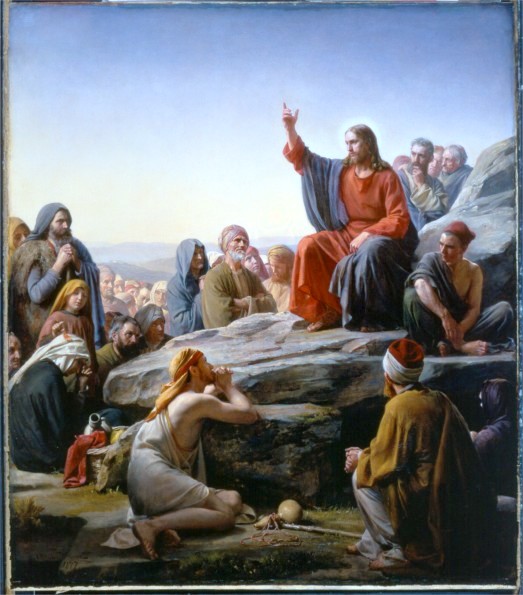
During Bugenhagens absence from Wittenberg Luther
preached a long while for him, regularly, on the fifth, sixth and seventh
chapters of Matthew, beginning
Translated by Charles A, Hay,

LUTHER’S
PREFACE
I am truly glad that my exposition of the three
chapters of St. Matthew, which St. Augustine calls the Lord’s Sermon on the
Mount, are about to be published, hoping that by the grace of God it may help
to preserve and maintain the true, sure and Christian understanding of this
teaching of Christ, because these sayings and texts are so very common and so
often used throughout all Christendom. For I do not doubt
that I have herein presented to my friends, and all others who care for these
things, the true, pure Christian meaning of the same.
And it is hard to understand how the very devil
himself has by his apostles so cunningly twisted and perverted especially the
fifth chapter, as to make it teach the very opposite of what it means. And
though Christ purposely intended thereby to antagonize all false teaching, and
to exhibit the true meaning of God’s commands, as he expressly says: “I am not
come to destroy the law;” and takes it up piece by piece to make it perfectly
clear; yet the infernal Satan has not found a single text in the Scriptures
which he has more shamefully perverted, and made more error and false doctrine
out of, than just this one which was by Christ himself ordered and appointed to
neutralize false doctrine. This we may call a masterpiece of the devil.
First of all there have fallen upon this chapter the
vulgar hogs and asses, jurists and sophists, the right hand of the pope and his
Mamelukes. They have sucked this poison out of this beautiful rose, and
scattered it everywhere; they have covered up Christ with it and have exalted
and maintained the antichrist, namely, that Christ here does not wish everything
which he teaches in the fifth chapter to be regarded by his Christians as
commanded and to be observed by them; but that much of it was given merely as
advice to such as wish to become perfect, and any who wish may observe these
parts; despite the fact that Christ there threatens wrathfully: – no one shall
enter heaven who sets aside one of the least of these commands, – and he calls
them in plain words commands.
Thus they have invented twelve gospel counsels
[consilia evangelii], twelve items of good counsel in the gospel, which one may
heed if he wants to be something over and above other Christians (higher and
more perfect); they have thus made not only Christian salvation, yes even
perfection also, dependent aside from faith upon works, but they have made
these same works voluntary. That is, as I understand it, to forbid really and
truly good works, which is just what these nasty revilers accuse us of doing. For they cannot deny this, and no covering and smoothing over will
help them as long as this fifth chapter of Matthew abides. For their books and glosses are at hand, along with their former
and present daily impenitent life that they lead in accordance with this their
teaching. And the teaching of those twelve “evangelical counsels” is
very common among them, viz., not to require wrong doing, not to take
vengeance, to offer the other cheek, not to resist evil, to give the cloak
along with the coat, to go two miles for one, to give to every one that asks,
to lend to him who borrows, to pray for persecutors, to love enemies, to do
good to them that hate, etc., as Christ here teaches. All this (they
disgustingly say) is not commanded, and the monks at
This is the way the jurists and sophists have hitherto
ruled and taught the church, so that Christ with his teaching and
interpretation, has had to be their fool and juggler; and they still show no signs
of repentance for this, but are eager to defend it, and to put forward again
their cursed shabby canons, and to crown again their cunning pope. God grant,
however, that I may live and may have to give clasps and jewels for this crown;
then he, God willing, shall be called rightly crowned.
Therefore, dear brother, if you please, and have
nothing better, let this my preaching serve you, in the first place, against
our squires, the jurists and sophists, I mean especially the canonists, whom
they themselves indeed call asses, and such they really are, so that you may
keep the teaching of Christ for yourself pure in this place of Matthew, instead
of their ass’s cunning and devil’s dung.
In the second place also against the new jurists and
sophists, namely, the factious spirits and Anabaptists, who in their crazy
fashion are making new trouble out of this fifth chapter.
And just as the others go too much to the left in holding nothing at all of
this teaching of Christ, but have condemned and obliterated it, so do these
lean too much to the right, and teach that one should have nothing of his own,
should not swear, should not act as ruler or judge, should not protect or
defend, should forsake wife and child, and much of such miserable stuff.
So completely does the devil mix things up on both
sides, that they know no difference between an earthly and a heavenly kingdom,
much less what is to be taught and to be done differently in each kingdom; but
we, God be thanked, can boast that we in these sermons have clearly and
diligently shown and exhibited it, so that whoever hereafter errs, or will err,
we are freed from all responsibility on his account, having faithfully
presented our opinion for the benefit of all. Let their blood be upon their own
head; our reward for this we await, namely, ingratitude, hatred, and all sorts
of hostility, and we say cleo gratias.
Since we then learn and know by such abominable
examples, of both papistic and factious jurists, what the devil is aiming at,
and especially how he seeks to pervert this fifth chapter of St. Matthew and
thereby to exterminate the pure Christian doctrine, every preacher or rector is
entreated and exhorted to watch faithfully and diligently against it in the
little charge committed to him, and help to preserve the true interpretation of
this text. For, as long as the devil lives and the world abides, he will not
cease to attack this chapter. For his object is thereby to entirely suppress
good works, as has been clone in the papacy; or to instigate false good works
and a feigned holiness, as he has now begun to do through the new monks and the
factious spirits.
And even if both the popish and the mobocratic jurists
and the monks were to perish, he would still find or raise
up others. For he must have such followers, and his kingdom
has been governed by monks ever since the world began. Although they
have not been called monks, yet their doctrine and life have been monkish, that
is, they have been other than and peculiar or better than what God has commanded;
as among the people of Israel were the Baalites, the idolatrous priests
(camarim) and such like, and among the heathen the castrated priests (Galli)
and the vestal virgins.
Therefore we can never be safe against him. For from
this fifth chapter have come the pope’s monks, who claim to be a perfect class,
in advance of other Christians, basing their claim upon this chapter; and yet
we have shown that they are full of avarice, of arrogance, and of late full of
all sorts of devils. Christ, our dear Lord and Master, who has opened up to us
the true meaning, desires to give it additional force for us, and besides to
help us live and act accordingly. To whom be grateful
praise, together with the Father and the Holy Spirit forever, Amen.
COMMENTARY
ON THE SERMON ON THE MOUNT
THE FIFTH
CHAPTER OF ST. MATTHEW
V. 1-2. And seeing the multitudes, he went up into a
mountain: and when he was set, his disciples came unto him: and he opened his
mouth, and taught them, saying:
HERE the evangelist with a formal stately
preface declares how Christ disposed himself for the sermon he was about to
deliver; that he went upon a mountain, and sat down, and opened his mouth; so
that we see he was in earnest. These are the three things, it is commonly said,
that mark a good preacher; first, that he take his place; secondly, that he
open his mouth and say something; thirdly, that he know when to stop. To take
his place, that means that he assume a position as a master or preacher, who
can and ought to do it, as one called for this purpose and not coming of his
own accord, but to whom it is a matter of duty and obedience; so that he may
say: “I come, not hurried hither by my own purpose and preference, but I must
do it, by virtue of my office. This is said as against those who have
heretofore been causing us so much vexation and tribulation, and indeed are
still doing it, namely the factious spirits and fanatics, that are running up
and down through the country, poisoning the people, before the pastors or those
in office and authority find it out, and thus befoul one family after another
until they have poisoned a whole city, and from the city a whole country.
To guard against such sneaking
renegades one ought not to allow any one to preach who has not been duly and officially
appointed; also no one should venture, though he should be a preacher, if he
hears a lying preacher in a popish or other church, who is misleading the
people, to preach against him; nor should any one go about into the houses and
get up private preachings, but he should remain at home and mind his own
official business, or keep silent, if he neither will or can publicly take his
place in the pulpit. For God does not want us to go wandering about with his
word, as though we were impelled by the Holy Spirit and had to preach, and thus
were seeking preaching places and corners, houses or pulpits, where we are not
officially called. For even
But you say, “How? Is no one then to
teach anything except in public? Or is the head of a family not to teach his
servants in his house, or to have a scholar or some one about him who recites
to him?” Answer: Certainly, that is all right, and all just in place. For every
head of a family is in duty bound to teach his children and servants, or to
have them taught. For he is in his house as a pastor or bishop over his
household, and he is commanded to take heed what they learn, and he is
responsible for them. But it is all wrong for you to do this away from your own
house, and to force yourself into other houses or to neighbors, and you should
not allow any such sneak to come to you and to carry on special preaching in
your house for which he has no authorization. But if any one comes into a house
or city let him be asked for the evidence that he is known, or let him show by
letter and seal that he has been duly authorized. For one
must not trust all the stragglers that boast of having the Holy Spirit, and
insinuate themselves thereby here and there into the homes. In short, it
means that the gospel, or the preaching of it, should not be heard in a corner,
but up upon a mountain, and openly in the free daylight. That is one thing that
Matthew wants to show here.
The next thing is that he opens his
mouth. That belongs (as above said) also to a preacher, that he do not keep his
mouth shut, and not only publicly perform his official duty so that every one
must keep silence and let him take his proper place as one who is divinely
authorized and commanded, but also that he briskly and confidently open his
mouth, that is, to preach the truth and what has been committed to him; that he
be not silent or merely mumble, but bear witness, fearless and unterrified, and
speak the truth out frankly, without regarding or sparing any one, no matter
who or what is struck by it. For that hinders a preacher very much if he looks
about him and concerns himself as to what the people do or do not like to hear,
or what might occasion for him disfavor, harm or danger; but as he stands high
up, upon a mountain, in a public place, and looks freely all around him, so he
is also to speak freely and fear nobody, although he sees many sorts of people,
and to hold no leaf before his mouth, nor to regard either gracious or wrathful
lords and squires, either money, riches, honor, power, or disgrace, poverty or
injury, and not to think of anything further than that he may speak what his
office requires, even that for which he stands where he does.
For Christ did not institute and
appoint the office of the ministry that it might serve to gain money,
possession, favor, honor, friendship, or that one may seek his own advantage
through it, but that one should openly, freely proclaim the truth, rebuke evil,
and publish what belongs to the advantage, safety and salvation of souls. For
the word of God is not here for the purpose of teaching how a maid or man
servant is to work in the house and earn his or her bread, or how a burgomaster
is to rules a farmer to plough or make hay. In short, it neither gives nor
shows temporal good things by which one maintains this life, for reason has
already taught all this to every one; but its purpose is to teach how we are to
attain to that life, and it teaches thee to use the present life, and to nourish
the belly here as long as it lasts; yet, so that thou mayest know where thou
art to abide and live when this must come to an end. If now the time comes for
preaching of another life that we are to be concerned about, and for the sake
of which we are not to regard this one as if we wanted to remain here forever,
then contention and strife begin, so that the world will not endure it. If then
a preacher cares more for his belly and worldly living, he does not do his
duty; he stands up indeed and babbles in the pulpit, but he does not preach the
truth, does not really open his mouth; if there seems to be trouble ahead he
keeps quiet and avoids hitting anybody. Observe, this is why Matthew prefaces
his account with the statement that Christ, as a true preacher, ascends the
mountain and cheerfully opens his mouth, teaches the truth, and rebukes both
false teaching and living, as we shall hear in what follows.
V. 3. Blessed are the poor in spirit, for theirs is
the kingdom of heaven.
This is a delightful, sweet and genial beginning of
his sermon. For he does not come, like Moses or a teacher of
law, with alarming and threatening demands; but in the most friendly manner,
with enticements and allurements and pleasant promises. And indeed, if
it had not been thus recorded, and if the first uttered precious words of the
Lord Christ had not been given to us all, an over-curious spirit would tempt
and impel everybody to run after them even to
But now that it is so common, that every one has it
written in a book, and can read it daily, nobody regards it as something
special and precious. Yes, we grow tired of them and neglect them, just as if not
the high Majesty of heaven, but some cobbler, had uttered them. Therefore we
are duly punished for our ingratitude and contemptuous treatment of these words
by getting little enough from them, and never feeling or tasting what a
treasure, force and power there is in the words of Christ. But he who has grace
only to recognize them as the words of God and not of man, will surely regard
them as higher and more precious, and never grow tired or weary of them.
Kindly and sweet as this sermon is for Christians, who
are our Lord’s disciples, just so vexatious and intolerable is it for the Jews
and their great saints. For he hits them a hard blow in the very beginning with
these words, rejects and condemns their doctrine and preaches the direct
contrary; yes, he denounces woe against their way of living and teaching, as is
shown in the sixth chapter of Luke. For the substance of their teaching was
this: If it goes well with a man here upon earth, he is happy and well off;
that was all they aimed at, that God should give them enough upon earth, if
they were pious and served him; as David says of them in Psalm 144: “Our
garners are full, affording all manner of store; our sheep bring forth
thousands and ten thousands in our streets; our oxen are strong to labor; there
is no breaking in or going out; there is no complaining in our streets.” These
they call happy people, etc.
Against all this Christ opens his mouth and says there
is something else needed than having enough here upon earth; as if to say: You
dear disciples, if you come to preach among the people, you will find that they
all teach and believe thus: He who is rich, powerful, etc., is altogether
happy; and again, he who is poor and miserable is rejected and condemned before
God. For the Jews were firmly fixed in this belief: if it went well with a man,
that was a proof that God was gracious to him; and the reverse. This is
explained by the fact that they had many and great promises from God of
temporal and bodily good things that he would bestow upon the pious. They
relied upon these, and supposed that if they had this they were well off. This
is the theory that underlies the book of Job. For in regard to this his friends
dispute with and contend against him, and insist strongly upon it that he must
have knowingly committed some great crime against God, that he was so severely
punished. Therefore he ought to confess it, be converted and become pious, then God would take away the punishment again from him, etc.
Therefore it was needful that his sermon should begin
with overturning this false notion and tearing it out of their hearts, as one
of the greatest hindrances to faith, that strengthens
the real idol mammon in the heart. For nothing else could follow this teaching
than that the people would become avaricious, and every one would care only for
having plenty and a good time, without want and discomfort; and every one would
have to infer: If he is happy who succeeds and has plenty, I must see to it
that I am not left in the lurch.
This is still to-day the common belief of the world,
especially of the Turks, who completely and thoroughly rely upon it, and thence
conclude that it would not be possible that they should have so much success
and victory if they were not the people of God and he were not gracious towards
them above all others. Among ourselves also the whole
papacy believes the same thing, and their teaching and life are based upon the
fact that they only have enough and besides have secured for themselves all
manner of worldly property; as everybody can see. In short, this is the
greatest and most widely diffused belief of religion upon earth, whereupon all
men of mere flesh and blood rely, and they cannot count anything else as
happiness. Therefore he here preaches an altogether different new sermon for
Christians, viz. that if it does not go well with them, if they suffer poverty
and have to do without riches, power, honor and a good time, they are still to
be happy and not to have a temporal, but a different, an eternal reward; that
they have enough in the kingdom of heaven.
Do you now say: How, must Christians then all be poor,
and dare no one have money, property, honor, power, etc.? Or, what are the
rich, as princes, lords, kings, to do? Must they give up all their property,
honor, etc., or buy the kingdom of heaven from the poor, as some have taught?
No; it is not said that we are to buy from the poor, but we are to be ourselves
poor and be found among those poor, if we are to have the kingdom of heaven.
For it is said plainly and bluntly: Blessed are the poor; and yet there is
another little word along with that, viz. spiritually poor, so that nothing is
accomplished by any one’s being bodily poor, and having no money and property.
For, outwardly to have money, property and people, is not of itself wrong, but
it is God’s gift and arrangement. No one is blessed, therefore, because he is a
beggar and has nowhere anything of his own; but the expression is, spiritually
poor. For I said already in the beginning that Christ is here not at all treating
of secular government and order, but is speaking only of what is spiritual –
how one aside from and over and above that which is outward is to live before
God.
It belongs to secular government that one should have
money, property, honor, power, land and people, and without these it could not
exist. Therefore a lord or prince must and cannot be poor; for he must have all
sorts of possessions suited to his office and rank. Therefore it is not meant
that one must be poor and have nothing at all of his own. For the world could
not exist in such a way that we should all be beggars and have nothing. For no head of a family could maintain his family and servants, if
he himself had nothing at all. In short, to be bodily poor decides
nothing. For we find many a beggar who gets bread at our door more proud and
evil-disposed than any rich man, and many a miserly farmer with whom it is
harder to get along than with any lord or prince.
Therefore be bodily and outwardly poor or rich, as may
be your lot, God does not ask about that; and he knows that every one must be
before God, that is spiritually and in his heart, poor; that is, not to place
his confidence, comfort and assurance in temporal possessions, nor fix his
heart upon them and make mammon his idol. David was an excellent king and had
indeed his purse and his chest full of money, his barns full of grain, the
country full of all sorts of goods and stores; yet along with this he had to be
spiritually a poor beggar, as he sings about himself: “I am poor, and a
stranger in the land, as all my fathers were.” Notice, the king who sits in the
midst of such possessions, a lord over land and people, dare not call himself
anything else than a stranger or a pilgrim who goes upon the highway and has no
place where he can abide. That means a heart that does not cling to property
and riches; but, although it has, yet it is as though it had not, as St. Paul
boasts of the Corinthians, 2 Corinthians
The meaning of all that has been said is that one is
to use all temporal good and bodily necessities, whilst he lives here, not
otherwise than as a stranger in a strange place, where he spends the night and
leaves in the morning. He needs no more than food and lodging, and dare not
say: “This is mine, here will I stay ;” nor dare he
take possession of the property as thou of right it belonged to him; else he
would soon hear the host say to him: “Friend, do you not know that you are a
stranger guest here? Go your way, where you belong.” Just so here; that you
have worldly goods, that is the gift of God to you for this life, and he allows
you indeed to make use of it and to fill with it the worm-bag (Madensack) that
you wear about your neck; but not that you fix and hang your heart upon it as
though you were to live forever; but you are to be always going farther and
thinking about another higher and better treasure that is your own and is to
endure forever.
This is roughly said for the common man, that one may
learn to understand (speaking according to the Scriptures) what it means to be
spiritually poor or poor before God, not to reckon outwardly as to money and
property, or as to want or superfluity, since we see (as above said) that the
poorest and most miserable beggars are the worst and most desperate scoundrels,
and dare to commit all sorts of knavery and evil tricks, which decent, honest
people, rich citizens or lords and princes, are not guilty of; on the other hand
also, many saintly people that have had plenty of money, honor, land and
people, and yet with so much property have been poor; but we must reckon
according to the heart, that it must not be much concerned whether it has
anything or nothing, much or little, and always to treat what it has as though
one did not have it, and had to be ready at any time to lose it, keeping the
heart always fixed upon the kingdom of heaven.
Again, he is called rich according to the Scriptures
who, although not having any worldly possessions, still scrambles and scratches
after them, so that he never can get enough. These are the very ones whom the
gospel calls rich bellies, who amid great possessions have the very least, and
are never satisfied with that which God gives them. For it looks into the heart
which is sticking full of money and worldly goods, and judges accordingly,
although there is nothing in the purse or money box. Again it judges him poor
in heart, though he has chest, house and hearth full. Thus Christian faith moves
straight forward; it regards neither poverty nor riches; it asks only how the
heart stands. If there be an avaricious belly there, the man is said to be
spiritually rich; and again, he is spiritually poor who does not cling to such
things and can empty his heart of them, as Christ elsewhere says: “He who
forsakes houses, lands, children, wife, etc., he shall have a hundred fold
again, and besides eternal life,” that he may bear away their hearts from
earthly good, so that they do not regard it as their treasure, and that he may
comfort his own, who have to forsake it, that they shall receive much more and
better, even in this life, than what they relinquish.
Not that we are to run away from property, home, wife
and child, and wander about the country burdening other people, as the
Anabaptist crowd does, that accuse us of not preaching the gospel aright
because we keep our home and stay by wife and child. No, such crazy saints he
does not want; but the true meaning is: Let a man be able in heart to leave his
earthly home, his wife and child, though staying in the midst of them,
nourishing himself along with them and serving them through love, as God has
commanded, and yet able, if need be, to give them up at any time for God’s
sake. If thou art thus disposed, thou hast forsaken all things in such a way
that thy heart is not taken captive, but remains pure
from avarice and from clinging to other things for comfort and confidence. A
rich man may properly be called spiritally poor, and need not therefore throw
away his earthly possessions, except when he must needs forsake them; then let
him do it in God’s name, not for the reason that he would rather be away from
wife, child and home, but would rather keep them as long as God grants it and
is served by his so doing, and yet willing if he wishes to take them from him
again.
So you see what it means to be spiritually and before
God poor, or spiritually to have nothing and forsake all. Now look also at the
promise that Christ adds, and says: “For of such is the kingdom of heaven.”
This is indeed a great, excellent, glorious promise, that
we are to have a beautiful, glorious, great, eternal possession in heaven,
since we are here gladly poor and regardless of earthly good. And as thou here
givest up a very small matter that thou wouldst still gladly use as long and as
much as thou canst have it, thou shalt instead thereof attain a crown, that
thou mayest be a citizen and a lord in heaven. This ought to influence us, if
we wanted to be Christians, and if we held his words to be true. But no one
cares who it is that says this, and still less what he says; they let it pass
through their ears in such a way that no one concerns himself about it any more
nor lays it to heart.
But he shows with these words that no one understands
this unless he is already a true Christian. For this trait and all the rest
that follow are simply fruits of faith which the Holy Spirit himself must work
in the heart. Where now faith is not, there the kingdom of heaven also will be
wanting, nor will spiritual poverty, meekness, etc., follow, but only sordid
raking and scraping, quarreling and noisily contending for worldly goods.
Therefore all pains are lost upon such worldly hearts, so that they never learn
or know what spiritual poverty is, nor do they believe or care for what he says
and promises about the kingdom of heaven; although for their sake he so orders
and ordains it that he who will not be spiritually poor in God’s name, and for
the sake of the kingdom of heaven, must still be poor in the devil’s name and
get no thanks for it. For God has so hung the greedy to their belly that they
are never satiated with their greedily gained good, nor can they ever be happy.
For squire greediness is such a merry guest, who never lets any one rest; he
seeks, pushes and hunts without ceasing, so that he dare not enjoy his dear
treasure for an hour; as Solomon the preacher too wonders and says: “A man to
whom God hath given riches, wealth and honor, so that he wanteth nothing for
his soul of all that he desireth, yet God giveth him not power to eat thereof,
but a stranger eateth it. This is vanity, and it is an evil disease.” He must
always be afraid and anxiously concerned how he may keep what he has, and add
to it, that it perish not, or be diminished, and is so completely tied up that
he dare not cheerfully spend a penny. But if there were a heart that could be
content and satisfied, it would have rest and the kingdom of heaven besides;
otherwise along with great possessions, or indeed with its greediness, at must
have purgatory here and there hellish fire besides, and as they say: Travel
here with a barrow and there with a wheel; that is, have here trouble and
anxiety and there bitter grief.
Notice, God always overrules it so that his word must
remain true, and no one be saved or satisfied except Christians; and the rest,
although they have everything, yet they are none the better off – indeed are
not as well off, and must still be poor beggars, as far as the heart is
concerned; only that the former are willingly poor and are looking forward to
an imperishable eternal possession, that is to the kingdom of heaven, and are
blessed children of God; but the latter are greedy for worldly good and still
do not get what they want, and must besides be all the time martyrs of the
devil. And there is, in short, no difference between a beggar before the door,
and such a wretched greedy-gut, except that the one has nothing and can be put
off with a crust of bread, whilst the other, the more he has the harder he is
to fill, even though he should get all the world’s money and goods in a heap.
Therefore this sermon, as I said, is of no account for
the world, and answers for it no good purpose; for it insists upon being sure
of its case, and will not take anything upon faith, but must see it and handle
it, and says, it is better to have a sparrow in your hand than to be gaping at
a crane in the air. Therefore Christ lets them go, does not want to force
anybody or drag him to him by the hair; but he gives his kind counsel to all
who are willing to be advised, and holds out before us the most precious
promise. If thou wilt, thou hast here peace and rest in heart, and there
forever what thy heart shall desire. If thou wilt not, then go along and have
rather here and there all manner of misery and misfortune. For we see and know
that all depends upon being satisfied and not clinging to worldly good; as many
a one is whose heart God can fill, though he has only a bit of bread, so that
he is cheerful and better contented than any prince or king. In short, he is a
rich lord and emperor; need have no care, trouble or sorrow. That is the first
part of this sermon: He who wants to have enough here and there, let him take
heed that he be not greedy and avaricious, but accept and use what God gives,
and earn his daily bread in faith, then he will have here his paradise and even
the kingdom of heaven, as Paul says, 1 Timothy 4:8, “Godliness is profitable
unto all things, having promise of the life that now is and of that which is to
come.”
V. 4. Blessed are they that mourn, for they shall be
comforted.
As he began this sermon against the teaching and faith
of the Jews (and indeed not of them alone, but of the whole world, even where
it is at its best, which clings to the notion that it is well off if it only
has possessions, honor, and its mammon, and it serves God only for this end),
he now continues and shows the folly of what they regarded as the best, most
blessed life upon earth, viz., having good, quiet days and suffering no discomfort,
as some are described in the seventy-third Psalm: “They are not in trouble as
other men, neither are they plagued like other men.”
For that is the chief thing that men desire, that they
may have joy and pleasure and have no trouble. Now Christ turns the leaf over,
states the exact opposite, and calls those blessed that have sadness and
suffering, and so throughout, all these statements are made in direct
opposition to the world’s way of thinking, as it would like to have it. For it
does not want to suffer hunger, trouble, disgrace, contempt, injustice and
violence, and those who can be free from all this it counts blessed.
So that he means here to say that there must be
another life than the one they seek and care for, and
that a Christian must see to it that he is a sufferer and sorrow-bearer in this
life. He who will not do this may indeed have a good time here, and live
according to all his heart’s desire, but he will have to suffer forever
hereafter, as Luke says,
See, that is exactly our text: “Blessed are they that
mourn, for they shall be comforted;” and again, as much as to say: Those who
here seek and have nothing but joy and pleasure shall weep and howl forever.
Do you ask again: What then are we to do? Are those
all to be damned that laugh, sing, dance, dress well, eat and drink? We surely read
about kings and holy people that were cheerful and lived well. And especially
Paul is a wonderful saint, who insists upon it that we be always cheerful,
Philippians 4:4, and says, Romans
Answer: Just as I said before, that to have riches is
no sin, nor is it forbidden; just so to be cheerful, to eat and drink well, is
no sin, nor is it condemnatory; in like manner it is not wrong to have honor
and a good name; and yet I am to be blessed if I do not have this, or can do
without it, and instead of this suffer poverty, wretchedness, disgrace and
persecution. So both of these things are here, and must be, to mourn and be
cheerful, to eat and suffer hunger, as Paul boasts concerning himself,
Philippians
Therefore, the meaning is: Just as not he is called
spiritually poor who has no money or anything of his own, but he who does not
hanker after it or put his confidence in it as if it were his kingdom of
heaven: so also not he is said to mourn who is always outwardly of downcast
countenance, looking gloomy and never laughing; but he who does not comfort
himself with having a good time and living sumptuously, as the world does –
that cares for nothing but having constant joy and pleasure, and revels in it,
and does not think or care how it goes with God or the people.
Thus many excellent, great people, kings and others,
that were Christians, have had to mourn and bear trouble, although they lived
splendidly before the world; as David everywhere in the Psalms complains about
his weeping and sorrowing. And also now I could easily give examples of great
people, lords and princes, who have had the same bitter experience with
reference to the precious gospel; as, now at the late diet at Augsburg and on other
occasions, although they got along very well outwardly, and were clothed in
princely style in silk and gold, and to all appearance were like those who walk
upon roses, yet they had to be daily right among poisonous serpents, and they
had to experience at heart such unheard-of arrogance, insolence and shame, so
many evil tricks and words from the shameful papists, who took pleasure in
embittering their hearts and as far as they could in preventing them from
having a single cheerful hour, so that they had to chew the cud of inward
misery and do nothing but lament before God with sighs and tears. Such people
know something of what it means to mourn and be sorrowful, although they do not
at once show it, but eat and drink with others, and sometimes with laughing and
jesting, to conceal their sorrow. For you must not think that mourning means
only weeping and lamenting, or wailing, like children and women; this is not
yet the real deep grief, if it has found its way to the heart and pours itself
out through the eyes; but that is it, when the real hard blows come that strike
and crush the heart, so that one cannot weep or dare complain to any one.
Therefore mourning is not
a rare plant among Christians, although it makes no outward show, even if they
would gladly be cheerful in Christ, and also outwardly as much as they can. For
when they look at the world they must daily see and be painfully conscious of
so much malice, arrogance, contempt for and blasphemy of God and his word, and
besides so much misery and misfortune that the devil occasions, both in church
and state, that they cannot have many cheerful thoughts, and their spiritual
joy is very weak. And if they were to look at such things all the while, and
did not sometimes turn their eyes away, they could never be cheerful at all; it
is enough that this really happens oftener than they would wish, so that they
need not go far to find it.
Therefore only begin and
be a Christian, and you will soon learn what mourning means. If you cannot do better,
take a wife, and settle yourself, and make a living in faith, so that you love
the word of God and do what belongs to your calling; then you will soon learn,
both from neighbors and in your own house, that things will not go as you would
like, and you will be everywhere hindered and hedged so that you will get
enough to suffer and must see what will make you sad at heart. Especially
however the dear preachers must learn this thoroughly, and be daily exercised
with it, so that they must take to heart all manner of envy, hatred, scorn and
ridicule, ingratitude, contempt besides, and revilement, so that they are
inwardly pierced and uninterruptedly tormented.
But the world will have none of this mourning,
therefore it seeks those callings and modes of living in which it can have a
good time and need not suffer anything from anybody, as the monks’ and priests’
calling used to be. For it cannot endure that it should in a divinely given
calling serve other people with constant care, trouble and labor, and get
nothing for this but ingratitude and contempt and other malicious treatment as
a reward. Therefore when things do not go with it as it wishes, and one is
scowled at by another, they can do nothing but pound away with cursing and
swearing, yes, and with their fists besides, and are ready to sacrifice
property and reputation, land and people. But God orders it so, that they still
must not get off so easily, that they need not see or suffer any misery, and he
awards to them as a recompense, because they try to avoid it, that they still
must suffer, and even make this twofold greater and heavier by their wrath and
impatience, and cannot have any comfort and good conscience. But Christians
have this advantage, that although they mourn they shall be comforted and be
blessed both here and there.
Therefore, whoever does not want to be out and out a
worldling, but to have part with Christians, let him be counted in as one who
helps to sigh and mourn, so that he may be comforted, as this promise tells. We
read of a case of this kind in the prophecy of Ezekiel, chapter nine, how God
sent six men with deadly weapons to the city of
For those who thus mourn may
properly have and take joy when they can, so that they do not utterly sink
through sadness. For Christ also added these very words and promised this
consolation, that they should not despond in their sorrow, or let the joy of
their heart be entirely taken away and extinguished, but should mingle this
mourning with consolation and refreshment, otherwise, if they never had any
comfort or joy, they would have to pine and shrivel away. For no man can endure
nothing but mourning; for it sucks out the very juices
of the body, as the wise man says: “Grief has killed many people.” Also: “A
gloomy spirit dries up the marrow in the bones.” Therefore we should not only
avoid this, but we should commend and urge such people to be cheerful sometimes,
if possible; or at least to moderate their grief and partly forget it.
Therefore Christ does not wish that there should be
nothing but mourning and sadness here, but warns against those who will not
mourn at all, who want to have only a good time and all their comfort here; and
he wants to teach his Christians, if it goes badly with them and they have to
mourn, that they may know that this is God’s good pleasure, and it should also
be theirs, and that they should not swear, or rage, or despair, as though their
God had no mercy. When this is the case, the little bitter draught is to be
mixed with honey and sugar, and so made less repulsive; that is the purpose of
this promise, that this is well pleasing to him, and that he calls them
blessed, besides that he comforts them here, and there they shall be entirely
relieved of sorrow. Therefore bid good-bye to the world and all that harm us, in the name of their lord, the devil, and let
us sing this song and be cheerful, in the name of God and Christ. For it will
surely not end with them as they wish; but, although they now rejoice at our
misfortune, and do much to injure us, we will still keep up good courage, and
shall live to see that they will have to weep and lament when we are comforted
and happy.
V. 5. Blessed are the meek, for they shall inherit the
earth.
This beatitude follows admirably upon the first when
he said: Blessed are the poor in spirit, etc. For as he there promised the
kingdom of heaven and an eternal inheritance, so he here adds a promise of this
present life and possessions here upon earth. But how does this agree together?
to be poor and to possess the land? It seems to me
that the preacher has forgotten how he began. For, if one is to possess the
land and worldly goods, he cannot be poor. But he does not mean to say here
that to own the land and have all kinds of possessions here upon earth, means,
that every one is to possess a whole country; else God would have to create
more worlds; but he refers to the blessings that God bestows upon each one,
that he gives to one wife, children, cattle, house and home, and what is
implied in this, that he may abide in the land (where he lives) and have
control of his worldly goods, as the scriptures usually speak, and it is
repeatedly said in Psalm thirty-seven: “those that wait upon the Lord shall
inherit the earth;” also, “such as be blessed of him shall inherit the earth,”
etc. Therefore, he himself adds here the gloss, that to be spiritually poor, of
which he spoke before, does not mean to be a beggar,
or to throw away money and goods. For he teaches here that
they are to remain and dwell in the land and have to do with earthly
possessions; as we shall hear bye and bye.
Now, what does it mean to be meek? Here you must, in
the first place, be again reminded, that Christ is not speaking at all about
the government and its official authority; for it does not belong to this to be
meek (sanftmuthig, as we use the word Sanftmuth in German); for it holds the
sword, that it may punish the wicked, and it has a wrath and vengeance that are
called the wrath and vengeance of God; but he is speaking only of individual
persons, how each one is to conduct himself towards others, aside from official
position and control; as father and mother, if they do not live as father and
mother towards their children, nor perform their official duty as father and
mother, that is, towards those who are not called father or mother, as
neighbors and others. For I have elsewhere often said that we must make a wide
difference between these two, office and person. He who is known as Jack or
Martin is a very different man from him who is called Elector, or Doctor, or
Preacher. For here we have two different persons in one man. One, in which we
are created and born, according to which we are all alike, man, woman, child,
young, old, etc. But when we have now been born, God makes of you another
person, makes you a child, me a father; one a master, another
a servant; this one a prince, that one a citizen, etc. That means then a
divine person, holding a divine office, and moves clothed
with its own dignity, and is not called simply Jack or Nicholas, but a
prince of
Therefore, if we hold official and authoritative
position, we must be strict and rigid, be wrathful and punish, etc. For here we
must do what God places within our reach and of his own accord commands us to
do. Beyond this, in what is unofficial, let every one learn for himself that he
be mild towards everybody, that is, not to deal with and treat his neighbor
unreasonably, with a hateful or revengeful spirit, like those who rush through
headlong, never willing to bear anything or yield an inch, but turning the
world upside down, never listening to anybody or excusing him for anything, but
pile on the bundles at once and never stop to think, only how they may take
vengeance and strike back again. Rulers are not hereby forbidden to punish and
enforce retribution by divine authority; but also no license is here granted
for a judge, burgomaster, lord or prince, who is a villain, and confounds the
two persons and goes beyond his official authority through personal malice, or
from envy, hatred and hostility (as often happens) under the mantle of office
and legal right’ as if our neighbors, under the name of the authorities, wanted
to carry out something against us which they could not otherwise accomplish.
And especially he is here talking again with his Jews,
as he had begun, who always insisted upon it that they were not to suffer
anything from a heathen and a stranger, and that they were always right if they
unhesitatingly avenged themselves, and quoted for this purpose the sayings of
Moses, as Deuteronomy
Observe, Christ is here rebuking those wild saints who
think every one is master in the whole world and has a perfect right to bear no
suffering, but only to make a racket and bluster, and with violence to defend
his own; and he teaches us that he who wishes to rule and possess his own, his
property, home, etc., in peace, must be meek, so that he may overlook things
and act reasonably, and suffer just as much as he can. For it cannot be
otherwise but that your neighbor will sometimes take advantage of or injure
you, either accidentally or through malice. If it was done accidentally, you
make it no better on your part if you neither can nor will endure anything. If
it was done maliciously, you only aggravate him by scratching and pounding,
whilst he is laughing at you and making merry that he is worrying and vexing
you, so that you still can have no peace or quietly enjoy your own.
Therefore choose one of the two, whichever you please:
either to live with meekness and patience among the people
and keep what you have with peace and a good conscience, or with racket
and rumpus to lose your own, and besides have no peace. For this is settled,
the meek shall inherit the earth. And look only yourself at those queer
characters that are always quarreling and disputing about property and other
matters, and yielding to nobody, but are determined to rush everything through,
whether they do not squander more by quarreling and contending than they could
ever gain, and at last lose land and people, house and home, with unrest and a
bad conscience besides; and God adds his sanction to it, which says: “Be then
not meek, so that you do not keep the land, nor enjoy your mite with peace.”
But if you want to live rightly and have rest, then
let your neighbor’s malice and hostility smother and extinguish itself;
otherwise you cannot better please the devil, or more greatly harm yourself,
than by getting up an angry racket. Have you a government over you? report the case and let them attend to it. For it is the
business of the government not to permit the innocent to be much oppressed; and
God will also overrule in such a way that his word and ordinance abides, and
you according to this promise come to possess the land. Thus you will have
peace and blessing from God, but your neighbor will have unrest, together with
God’s displeasure and curse. But this sermon is intended only for those who are
Christians, and believe, and know that they have their treasure in heaven, that is secure for them, and cannot be taken from
them; therefore they must have enough also here, although they do not have
chests and pockets full of red ducats. Since you know this, why will you let
your joy be disturbed and taken from you – yes, why even make disquiet for
yourself and rob yourself of this excellent promise?
Observe, you have now three points with three rich
promises, so that he who is a Christian must have enough, both temporal and
eternal, though he must here suffer much, both inwardly, in heart, and
outwardly. Again, the worldlings, because they will not endure poverty, nor trouble, nor violence, neither have nor enjoy either the
kingdom of heaven or worldly good with peace and quiet. You can read more about
this in Psalm thirty-seven, which is the real commentary upon this passage, and
richly describes how the meek inherit the earth and the ungodly are to be cut
off.
V. 6. Blessed are they which do hunger and thirst
after righteousness, for they shall be filled.
Righteousness must here not be understood as being the
Christian righteousness in general, whereby the person becomes pious and
acceptable before God. For I have before said that these eight beatitudes are
nothing else than a teaching about the fruits and good works of a Christian,
which must be preceded by faith, as the tree and main body or sum of his
righteousness and blessedness, without any work or merit, out of which these
beatitudes must all grow and follow. Therefore understand here the outward
righteousness before the world, which we observe among ourselves towards
others, that this is the meaning, short and simple, of these words: he is a
really blessed man who perseveringly and assiduously strives to promote the
general welfare and the right conduct of every one, and who helps to maintain
and carry this out with word and deed, with counsel and act.
This is now also an excellent beatitude, which
comprehends very many good works, but which is by no means common. For
instance, that we may illustrate, if a preacher wishes to be counted as
hungering and thirsting for righteousness, he must be ready to instruct and
help every one in his calling, that he may conduct it properly and do what
belongs to it, and when he sees that there is something wanting, and things do
not go right, that he be on hand, warn, rebuke, and correct as well and by such
means as he can: thus that I, as a preacher, be faithful to my office, and
others to theirs, that they follow my teaching and preaching, and thus on both
sides the right thing is done. Where now there are such people as take a
special and earnest interest in gladly doing what is right, or in being found
rightly at work, these may be said to be hungering and thirsting after
righteousness. If this were the case there would be no knavery or injustice,
but complete righteousness and blessedness on earth. For what is the
righteousness of the world else than that every one do in his calling what is
due? That means that every one’s rights should be duly regarded, those of the
man, the woman, the child, the man servant and maid servant in the family, the
citizen or the city in the land; and it all amounts to this, that those who are
to oversee and rule other people execute this office with diligence,
carefulness and fidelity, and that the others also faithfully and willingly
render to these due service and obedience.
Nor does he without cause use the phrase: “Hunger and
thirst after righteousness;” he means thereby to indicate that in order to
attain it one must have great earnestness, a yearning eagerness and incessant
diligence: that where there is a lack of this hunger and thirst, all will
amount to nothing. The reason is this; for there are too many and great
hindrances, both on the part of the devil, who is everywhere blocking the way,
and on the part of the world, (namely his children,) which is so wicked that it
cannot endure a pious man, who wants to do right or help others to do it; but
it so annoys and worries him that in the end he loses patience and is out of
humor about it. For it is painful to see how shamefully people act, and reward
whole-hearted kindness with ingratitude, contempt, hatred and persecution.
Hence also many persons who could not bear to witness this base conduct, at
last grew desperate about it and took refuge in the wilderness, fleeing from
human society and becoming monks, so that the saying has often been verified:
“Despair makes a monk ;” either, that one does not trust to make his own living
and runs into a monastery for his stomach’s sake, as the great crowd has done;
or, that one despairs of the world and does not trust to remain pious in it or
to help other people.
But this is not hungering and thirsting after
righteousness. For he who wants to preach or rule in such a way, that he allows
himself to be made weary and impatient, and to scamper off into a corner, he
will be slow to help other people. It is not your duty to creep into a corner
or into the wilderness, but to come out briskly, if you were therein, and offer
both your hands and feet and your whole body for use, and hazard everything
that you have and can do; and you are to be such a man as can be hard against
hard, so as not to allow himself to be frightened off or dumfounded, or be
overcome by the ingratitude or malice of the world: but you should always push
along and persevere as much as possible. In short, you should have such a
hunger and thirst after righteousness that will never diminish or cease and
cannot be satiated, so that you care for nothing else, only so that you may
accomplish and maintain what is right, despising on the other hand everything
that would hinder you. If one cannot make the world altogether pious, let him
do what he can. It is enough, that he has done his own duty, and has helped
some, if only one or two. If the others will not follow, then let them go, in
God’s name. One must not run off because of the wicked, but conclude: it was
not undertaken for their sake, nor for their sake was it dropped; perhaps bye
and bye some of them may come to their senses, or there may be fewer of them, and
they may somewhat improve.
For here you have a consolatory, certain promise, with
which Christ allures and attracts his Christians, that those who hunger and
thirst after righteousness shall be filled; that is, that they shall be
delightfully rewarded for their hunger and thirst by seeing that they have not
labored in vain, and that at last some have been reached who have been
benefited; and it will be manifest not only here upon earth, but still more
hereafter, when every one will see what such people have accomplished by their
diligence and perseverance, although things do not now go as they would like,
and they have nearly lost heart; as when a pious preacher has snatched so many
souls out of the jaws of the devil and brought them to heaven; or a pious
faithful ruler has helped many lands and people, who bear this testimony of him
and praise him before the whole world.
Just the opposite, are the sham saints who out of
great sanctity forsake the world and run into the wilderness, or hide
themselves in corners, so that they may escape the trouble and worry that they
must otherwise endure, and pay no regard to what is going on in the world;
never once thinking upon it that they ought to help or advise other people with
doctrine, instruction, exhortation, reproof and correction, or at least with
praying and supplication to God. Yes, they are disgusted with it, and grieve
over it, that other people become pious, for they want to be considered the
only holy ones, so that whoever wants to get to heaven must buy from them their
good works and merit. In short, they are so full of righteousness that they
look contemptuously upon other poor sinners, just as the great saint Pharisee,
Luke 17, intoxicated with self-sufficiency, blurts out
his contempt for the poor publican, is profuse in his self-congratulations, so
that he pays his respects to God, and is thankful that he alone is pious and
other people bad.
Observe, these are the people against whom Christ here
speaks – the proud, self-sufficient spirits that tickle themselves with and
find joy and pleasure in the fact that other people are not pious, whereas they
ought to pity, compassionate and help them; they cannot do anything else but
despise, backbite, judge and condemn everybody; and everything must be stench
and filth except what they themselves do. But; that they should go and instruct
and benefit a poor faulty sinner, that they shun as
they would shun the devil. Therefore they will have to hear again, how Christ
exclaims about them, Luke
V. 7. Blessed are the merciful, for they shall obtain
mercy.
This is also an excellent fruit of faith, and follows
well upon the preceding: he who is to help others and contribute to the common well-being
and success, should also be kind and merciful – that is, that he should not be
ready to raise a racket and make a disturbance if something be wanting, and
things do not go as they should, whilst there is still hope of improvement. For
that is one of the virtues of sham sanctity that it can have no compassion for
or mercy upon the fallible and weak, but insists upon the extremest strictness
and most careful selection, and as soon as there is the slightest failure, all
mercy is gone and they do nothing but fume and fret; as also St. Gregory shows
how to recognize this, and say: Vera justitia compassionem habet, falsa
indignationem – true holiness is merciful and compassionate, but false holiness
can do nothing but be angry and rage; and yet they say: Pro zelo justitiae, (as
they boast), that is, we do it through love and zeal for righteousness.
For all the world is coming to see that they have been
carrying on their mischievous and outrageous tricks under the beautiful,
excellent semblance and cover that they were doing it for the sake of
righteousness. Just as they have heretofore exhibited and are still exhibiting
their hostility to and treachery against the gospel under the name of
protecting the truth and exterminating heresy; they claim thereby to merit that
God is to crown them for this and raise them to heaven, as those who out of
great thirst and hunger for righteousness persecute, strangle and burn his
saints.
For they claim, forsooth, to have the name, even more
than the true saints, of hungering and thirsting after righteousness, and put
on such a sanctimonious appearance and use such admirable words, that they
think even God himself will not know any better. But the noble tree is known by
its fruits. For, when they should insist upon righteousness, that both
spiritual and temporal affairs be rightly conducted, they do not do it, do not
think of instructing and improving any one, live themselves in constant vice,
and if any one rebukes their conduct, or does not praise it and do as they wish,
he must be a heretic and let himself be damned to hell. See, just so is surely
every sham saint. For his selfrighteousness makes him so proud that he despises
everybody else, and can have no kind, merciful heart.
Therefore is this a necessary warning against these
abominable saints, so that every one may take care, if he has to do with his
neighbor, whom he should help and rectify in his way of living, that he still
may be able to be merciful, and forgive, that it may be seen that you are
honestly aiming at righteousness, and not wishing to gratify your own malice
and anger, and that you are so righteous that you deal amicably and gently with
him who is willing to desist from unrighteousness and become better, that you
bear with and endure his fault or weakness until he comes to terms. If,
however, you try all this, and still find no hope of improvement, then you may
give him up and turn him over to those whose place it is to punish him.
This is now one side of mercifulness, that one takes
pleasure in forgiving sinners and those at fault. The other is to be beneficent
also towards those who are externally in need or require help, which we call
works of mercy, from Matthew 25:35. This feature too the ostentatious Jewish
saints knew nothing about. For with them there was nothing but ice and frost,
yes a heart hard as a block or a stone, and not an affectionate drop of blood
that found pleasure in doing good to a neighbor, and no mercifulness to forgive
sin; they cared and planned alone for their own belly, although another might
die of hunger; so that there is much more mercifulness among open sinners than
in such a saint; as it cannot be otherwise, since they praise only themselves
and count themselves holy, despising every one else as of no account, and suppose
that all the world must serve them and give them plenty; but they are not under
obligation to give anything to or to serve anybody.
Therefore this sermon and exhortation is despised by
and of no account among such saints, and finds no scholars except those who are
already cleaving to and believing on Christ, who know of no holiness of their
own, but who, as already described, are poor, wretched, meek, really hungering
and thirsting, and so disposed that they despise nobody, but compassionately sympathize
with the need of everybody else. To these applies now the comforting promise:
It is well for you that are merciful, for you will find again abundant mercy,
both here and hereafter, and such mercy as inexpressibly far exceeds all human
benefactions and mercifulness. For there is no comparison between our
mercifulness and that of God, nor between our possessions and the eternal
treasures in the kingdom of heaven; and he is so pleased with our benefactions
to our neighbor that he promises us for a penny a hundred thousand ducats, if
it were necessary for us, and for a drink of water the kingdom of heaven.
Now, if any one will not suffer himself to be moved by
this excellent, comforting promise, let him turn the other side of the page and
hear another sentence: “Woe to the unmerciful, and let them be cursed, for no
mercy shall be shown to them; as now the world is full of such people, among
the nobility and citizens and farmers, who so wondrously sin against the dear
gospel that they not only give nothing to poor pastors and preachers, but
besides take and torment, where they can, and act just as if they meant to
starve it out and drive it out of the world, and notwithstanding go along quite
securely, thinking that God must keep quiet about it and let them do just as
they please.” But they will be struck some day, and, I fear, somebody will come
who will make of me (who have given warning enough) a prophet, and he will
treat them with perfect heartlessness, and besides take from them reputation
and property, body and life, that God’s word may remain true, and he experience
unmitigated wrath and eternal displeasure who will not show or have mercy, as
St. James says: “He shall have judgment without mercy that hath showed no
mercy.” Therefore also Christ at the last day will adduce this unmercifulness
as the worst injury done against himself, even all that we have done out of
uncharitableness, and will himself utter the curse: “I was hungry and thirsty
and ye gave me no meat, ye gave me no drink, etc. Depart ye,
therefore, ye cursed, into everlasting, hellish fire,” etc. He warns and
exhorts us faithfully from pure grace and mercy. Whoever will not accept this,
let him choose the worse and eternal damnation. Consider the rich man, Luke
V. 8. Blessed are the pure in heart, for they shall
see God
This beatitude is somewhat obscure, and not so easily
understood by us who have such gross carnal hearts and minds, and it is hidden,
too, from all the sophists, who should really be the most learned, so that none
of them can say what it means to have a pure heart, and still less, what it
means to see God; they busy themselves with mere dreams and evil thoughts,
about matters of which they know nothing themselves by experience. Therefore we
must look at these words according to the Scriptures, and learn to understand
them correctly.
A pure heart, they fancy, means that a man runs off
from the community into a corner, a monastery, or the wilderness, and does not
think upon the world, nor concern himself about worldly affairs and business,
but amuses himself with nothing but heavenly thoughts; they have by this
fanciful teaching not only befooled and dangerously misled themselves and other
people, but have committed the murderous fault of holding as unclean the doing
of things and holding of positions in society that are unavoidable in the world
and indeed are by God himself appointed. But the Scripture speaks of this pure
heart and mind, that it is quite consistent with it that one be a husband, love
his wife and children, think about them and care for them, and busy himself about other matters that belong to such a relation.
For all this God has ordained. But what God has
ordained, that cannot be impure – yes, it is the very purity with which we see
God. Thus, when a judge acts in his official capacity and condemns a criminal
to death, that is not his office and work, but God’s.
Therefore it is a good, pure and holy work (if he be indeed a Christian) which
he could not do if he had not already a pure heart. Also, that must be called a
pure work and heart, although a man or maid-servant in the house performs a
dirty, filthy task, as hauling manure, or washing and cleaning children.
Therefore it is a shameful perversion when one pays so little attention to the
relations that are embraced in the ten commandments, and gapes after other,
special, showy works; just as if God had not as pure a mouth or eyes as we, or
as pure a heart and hand when he makes both man and woman: how should then such
works or thoughts make an impure heart? But thus they shall become blind and
fools who despise the word of God and measure purity only by the outward mask
and display of works, and meanwhile have to make mischief with their own
wandering thoughts, and stand gaping to climb up to heaven and feel after God,
until in the effort they break their own necks.
Therefore, let us understand rightly what Christ means
by a pure heart; and notice again, that this sermon was principally aimed at
and sharply directed against the Jews. For, as they wanted to have no
suffering, but coveted a life of ease, pleasure and joy, and would not hunger,
nor be merciful, but to be self-satisfied and the only pious ones, besides judging
and despising others; so their holiness, too, was this, that they must be
outwardly clean, in body, skin, hair, clothes and food, so that not even a
little spot dare be upon their clothing. And if any one touched a dead body, or
had a scab or the itch upon his person, he dared not approach other people;
that they regarded as purity. But that is not what constitutes being pure, said
he; but those I praise who take pains to be of a pure heart, as he says,
Matthew
What then is a pure heart? or
in what does it consist? Answer: It is easily told, and you need not climb to
heaven nor run into a monastery after it and make it out with your own
thoughts; but be guarded against all such thoughts as you call your own, as
against so much mud and filth, and know, that a monk in the monastery, when he
is sitting in his deepest contemplativeness, and thinking of his Lord God, as
he paints and imagines him to himself, is sitting (if you will pardon me) in
the dirt, not up to his knees, but over head and ears. For he
is following his own notions, without any word of God, which is simply lying
and delusion; as the Scriptures everywhere testify.
But that is a pure heart, that
is ever on the lookout for God’s word, and takes this in place of its own
thoughts. For only that is pure before God, yes purity itself, through which
everything that comes in contact with it and belongs to it is and is called
pure. So with a common rough mechanic, a cobbler or a smith, who sits at home,
though he be personally unclean and sooty, or smells badly on account of being
blackened and soiled, and thinks: My God has made me a man and given me a
house, wife and child, and ordered me to love them, and with my labor to
nourish them, etc. Now observe, he is making a heart matter of it with God,
and, although outwardly he stinks, inwardly he is perfectly fragrant before
God. But if he gets to be highly pure, so that he also embraces the gospel and
believes on Christ (without which indeed that purity cannot be), then he is
pure through and through, inwardly at heart towards God, and outwardly towards
everything that is under him upon earth, so that everything that he is and
does, whether he goes, stands, eats and drinks, etc., is pure to him, and
nothing can make him impure; so when he looks at his own wife or sports with
her, as the patriarch Isaac, Genesis 26:8, which to a monk is disgusting and
makes him impure. For there he has the word of God, and knows that God has
given her to him. But if he forsook his wife and took up another, or neglected
his trade or office and injured or worried other people, he would be no longer
pure; for that would be against the command of God.
As long, however, as he is faithful in these two
particulars, namely, in the word of faith towards God, by which the heart
becomes pure, and in the word of the knowledge of what he is to do towards his
neighbor in his calling, everything is pure to him, even if with his fists and
his whole body he is busy with dirt. A poor servant girl, if she does what she
ought to, and along with it is a Christian, she is before God in heaven a
beautiful, pure maid, so that all the angels applaud her and love to look at
her. On the other hand, the very strictest Carthusian, though he fasts and
castigates himself to death, does nothing but weep for pure devotion, and never
thinks about the world, and yet is without faith in Christ and love towards his
neighbor, is a mere stench and pollution, both inside and outside, so that both
God and the angels abominate and are disgusted with him.
So you see how all depends upon the word of God, so
that what is comprehended in and moves with that, must all be called clean,
pure and snow-white as to God and man. Therefore
Therefore guard yourself against all your own
thoughts, if you wish to be pure before God, and see to it that your heart is
established and fixed upon the word of God, then you
are pure over and above all Carthusians and saints in the world. When I was
young, they gloried in this proverb: Love to be alone and your heart will stay
pure; and they quoted in proof a saying of St. Bernard, who said whenever he
was among the people he befouled himself – as we read in the lives of the fathers
of a hermit, who would not have any one come near him or talk with anybody, and
said: “The angels cannot come to him who moves among men.” We read also of two
others who would not let their mother see them; and as she often watched her
opportunity and once took them by surprise, they presently closed the door and
left her standing without a long while weeping, until they, finally persuaded
her to go away and wait until they would see each other in a future life.
Behold, that was called a noble deed, and the height
of sanctity and most perfect purity. But what was it? There is the word of God:
“Thou shalt honor thy father and thy mother.” Had they regarded that as holy
and pure, they would have shown their mother and their neighbor all honor, love
and friendship: on the contrary, following their own notions and self-chosen
holiness, they cut themselves off from them, and by their very attempt to be
the purest they most shamefully defiled themselves before God; just as though
the most desperate scoundrels could not have such thoughts and put on such an
appearance that one would have to say: “These are living saints, they can
despise the world and hold intercourse only with spirits; “ – yes, with spirits
from the bottom of hell. The angels like nothing better, than when we
familiarly handle the word of God; with such they love to dwell. Therefore let
the angels be undisturbed up there in heaven, and look for them here below,
upon earth, in your neighbor, father and mother, child and others, that you may
do to them what God has commanded, and the angels will not be far away from
you. I speak thus, that one may learn in this matter of purity to order himself
aright, and not go so far to hunt for it as the monks do, who have thrown it
quite out of the world and stuck it in a corner or into a hood; all of which is
stench and filth, and the true harboring-place of the devil; but let it be
where God has placed it, namely in the heart that clings to God’s word, and
uses its calling and all creatures in accordance therewith, in such a way that
both the entire purity of faith toward God is embraced therein, also outwardly
shown in this life, and everything is done in obedience to the word and command
of God, whether it be bodily clean or unclean.
So I have said above, concerning a judge who has to
condemn a man to death, and thus shed blood and pollute himself with it, which
a monk holds to be an abominably unclean deed; but the Scripture calls this
serving God; as St. Paul, Romans 13:1-4, calls “the higher powers” that “bear
the sword,” “the minister of God ;” and it is not their work and command but
his, that he lays upon them and demands from them.
Now you have the meaning of a pure heart that acts in
accordance with the clean and pure word of God. What is however their reward,
or what does he promise them? It is this, that they shall see God. A glorious
title and a splendid treasure! But what does it mean to see God? The monks have
here again their dreams, that it means to sit in the cells and meditate
heavenward, and lead a contemplative life – so they call it, and have written
many books about it. But it will never do to call that seeing God, when you
come harping on your own notions and scrambling heavenward; as the sophists and
our factious spirits and crazy saints insist upon measuring and mastering God
and his word and works by their own brains: but it is this, if thou hast a true
faith that Christ is thy Savior, etc., then thou seest at once that thou hast a
gracious God. For faith leads thee up, and opens for thee the heart and will of
God, where thou beholdest nothing but superabundant grace and love. That is
exactly what it means, to see God, not with bodily eyes, (for with these no one
can see him in this life,) but with faith, that beholds his paternal, friendly
heart, in which there is no wrath or disfavor. For he who regards him as
wrathful, does not see him aright, but has drawn a veil and cover, yes, a dark
cloud, over his face. But to behold his face, as the Scripture expresses it,
means to recognize him aright as a gracious, benevolent father, upon whom one
can rely for everything good; and this comes only through faith in Christ.
Accordingly also, if thou livest in thy calling after
the word and command of God, with thy husband, wife, child, neighbor and
friend, thou canst see what is the mind of God in regard to these relations,
and canst conclude that he is pleased, as that is not thine own dream, but his
word and command, that never belies or deceives us. Now it is a most excellent
thing, and a treasure above all that one can think or wish, to know that one is
standing and living aright towards God: in such a way, that not only the heart
can comfort itself with the assurance of his grace and glory in it, but that
one can know that his external walk and conversation is pleasing in his sight;
whence it follows that he can cheerfully and heartily do and suffer everything
and let nothing alarm or dishearten him. None of these things can they do who
do not have this faith and a pure heart that is guided only by God’s word; as
all the monks have openly taught that no man can know whether he is in a
gracious state or not; and it serves them just right, that, because they
despise faith and real godly works, and seek a purity of their own devising,
they must never see God, nor know how they stand with him.
For if you ask some one, who has most diligently
observed his hours for prayer, held his masses daily, and fasted, whether he is
sure too that God is pleased with this, he must say he does not know that, and
is doing it all at a venture; if it succeeds, let it succeed. It is not
possible for any one to say anything else. For no one can boastingly say: God
gave me this hood, or ordered me to wear it; he commanded me to hold this mass,
etc. We have all been groping in this blindness hitherto, when we were doing so
many so-called good works, making contributions, fasting, praying rosaries, and
yet we never dared to say: This work is well pleasing to God; I am sure of
this, and will die upon it. Therefore no one can say that in all his doing and
living he has ever seen God. Or if any one should presumptuously glorify such
works, and think that God must regard them favorably and reward them, that
would mean seeing not God, but the devil in place of God. For there is no word
of God for that, but it is all devised by men, grown out of their own hearts.
Therefore it can nevermore make any heart sure or satisfied, but it remains
hidden under presumption until the last hour comes, when it all vanishes and
drives into despair, and so it never comes to pass that one sees the face of
God. But he who lays hold upon the word of God and abides in the faith, can
maintain his stand before God and look upon him as his gracious Father, and
need not fear that God is standing behind him with a club; is sure that God is
looking graciously and smilingly upon him, together with all the angels and
saints in heaven.
See, that is what Christ means by this word, that only
those behold God who have this pure heart; whereby he cuts off and sets aside
all other sorts of purity, so that, where this kind is not, although otherwise
everything be pure in a man, it avails nothing before God, and he can never see
God. On the other hand, if the heart is pure, everything is pure, and it
matters not if outwardly everything be impure, yes, even if the body is full of
sores, scabs and leprosy all over.
V. 9. Blessed are the peacemakers; for they shall be
called the children of God.
Here the Lord honors with a high title and excellent
praise those who find pleasure in diligently trying to make peace, not only so
far as they are themselves concerned, but also among other people, that they
may help to settle ugly and tangled disputes, endure contention, guard against
and prevent war and bloodshed; which is indeed a great virtue, but very rare in
the world and among the sham saints. For those who are not Christians are both
liars and murderers, like their father, the devil. Therefore they serve no
other purpose than to create strife, contention, war, etc.; as we now find
among the priests, bishops and princes hardly anything but bloodhounds, who by
many tokens have abundantly shown, that there is nothing they would rather see
than that we should all swim in blood. Thus, if a prince becomes angry, he thinks
at once that he must begin a war; then he inflames and incites everybody, until
there has been so much warring and shedding of blood that he begins to be sorry
for it, and gives a thousand ducats for the souls of those that were slain.
These are nothing but bloodhounds; they cannot rest until they have taken
vengeance and sated their rage, until they have dragged their land and people
into wretchedness and misery; and yet they want to be called Christian princes
and have a good cause.
There is more needed to begin a war than that you have
a good cause. For although we are not forbidden here to carry on a war, as
above said, that Christ here does not mean to detract anything from the powers
that be and their official authority, but is teaching only individual people
who wish to lead for themselves a Christian life; yet it is not right that a
prince determines to have a war with his neighbor, even though (I say) he has a
good cause and his neighbor is in the wrong; but the meaning is: Blessed are
the peacemakers; so that he who wants to be a Christian and a child of God, not
only does not begin war and strife, but helps and advises for peace, wherever
he can, although there was reason and cause enough for going to war. It is
enough, if one has tried his best for peace and all avails nothing,
that one acts on the defensive, to protect land and people. Therefore
not Christians, but the children of the devil are those to be called, the
quarrelsome fellows, who rush to their rapiers and jerk their sword from its
sheath for a word; still more, however, those who now persecute the gospel, and
cause its preachers to be innocently burned or murdered, who have done them no
harm, but only good, and have served them with body and soul. But of these we
say nothing now, but of those only who maintain that they are right and have a
good cause, and think that they, as high and princely persons, ought not to
suffer, although other people would suffer.
It is also meant here, if injustice and violence are
done to you, that it is not right for you to consult your own foolish head, and
begin right away to take vengeance and strike back; but you are to think over
it and try to bear it and have peace. If that will not answer, and you cannot
endure it, you have law and governmental authority in the land, where you can
seek relief in a regular way. For the powers that be are ordained to guard
against this injustice and punish it. Therefore he who injures you, sins not
only against you, but rather against the authority itself, for the order and
command to keep the peace was given to it and not to you. Therefore let your
judge, whose business it is, avenge and punish this, for against him your
opponent has done the wrong. If you, however, take vengeance into your own
hands, you do still greater wrong, for you make yourself guilty of the same sin
as he who sins against the powers that be, and interferes with their office;
and by so doing you put your own good cause in the wrong. For the common saying
is: “He who strikes back is in the wrong, and striking back makes a quarrel.”
Notice now this is one thing that Christ here demands
against the revengeful and uproarious; and he calls those peacemakers, in the
first place, who help to make peace among the people, as pious princes,
counselors or jurists, and persons in authority, who hold their governmental
position for the sake of peace. In the second place, pious citizens and
neighbors, who by their salutary good counsel adjust, harmonize and settle
contention and strife (that has been occasioned by bad, poisonous tongues)
between husband and wife, or among neighbors; as St. Augustine boasted of his
mother, Monica, that when she saw two at outs she always spoke the best on both
sides, and whatever of good she heard about the one party that she brought to
the other, but whatever of evil she heard that she kept quiet, or mildened it
as much as she could, and thus she often effected a reconciliation. For it is among the women particularly that the shameful vice of
slander is prevalent, often so that great trouble is occasioned through an evil
tongue. To this those bitter and poisonous brides of the devil largely
contribute, who if they hear a word about anybody give it a point and edge, and
intense bitterness against others, so that sometimes wretchedness and murder
are the result.
This all comes from the fact that there is naturally
sticking to us the shameful, devilish filth, that every one likes to hear and
tell the worst about his neighbor, and is tickled if he sees a fault in some
one else. If a woman were as beautiful as the sun, and had any mark or little
spot upon her body, one should forget everything else and look only for the
spot, and talk about that. So, if some one were the most renowned for honor and
virtue, yet a poisonous tongue shall come along and say she had been seen once
laughing with somebody, and so defame her as to eclipse all her praise and
honor. Such are real poisonous spiders that can suck nothing but poison out of a beautiful, lovely rose, and ruin both the
flower and the sap, whilst a little bee sucks nothing but honey out of it and
leaves the roses uninjured. That is the way those act, who discern nothing in
other people, unless there is something faulty or impure in them, which they
can blame; on the other hand, what there is good in them, they do not see; for
men have many virtues which the devil cannot destroy, and yet he hides or
defaces them that they shall not be seen. So, in the case of a woman, though
she be very full of faults and have no other virtue, yet she is a creature of
God, and can at least carry water and wash clouts; and there is no person upon
earth so bad that there is not something in him that one must praise. How is
it, then, that we leave out of view the good and feast our eyes upon what is
impure, as if we took delight (by your leave) in looking only at a man’s
behind, when God himself has covered the uncomely parts of the body, and (as
Paul says, 1 Corinthians 12:24) “has given more abundant honor to that part
which lacked?” And we are such a filthy set, that we seek only after that which
is dirty and stinks, and wallow in it like hogs.
See, those too are real children of the devil, who
himself gets his name from doing that, so that he is called diabolus, that is,
a disgracer and reviler, who finds his pleasure in this, that he puts us most
completely to shame, and embitters us among ourselves, so that he may occasion
only murder and misery, and allow no peace or concord between brethren and
neighbors, husband and wife. I once heard of a case of this kind, of two
married persons who lived together in such love and harmony that they were the
town’s talk, and when the devil could not hinder this in any way, he sent an
old hag to the woman, who told her that her husband was going with another
woman and meant to kill her; she thus embittered her heart against her husband,
and advised her to conceal a knife about her person, that she might get ahead
of him. When she had accomplished this, she went to the husband and told him
the same about her, that she meant to murder him, and
in proof of it (said she) he would find at night a knife beside her in bed.
That he then found, and cut off her head with it. Whether this be true or not,
it shows at all events what wicked, poisonous tongues can do, even between
those who heartily love each other, so that they may properly be called
devil’s- months or female devils, as he, the devil, diabolus, signifies nothing
else than a bitter, poisonous, evil mouth.
Therefore be on your guard against such as these, that
you pay no attention to them, and learn to put the best construction upon, or
even to conceal, what you hear about your neighbor, so that you may make and
keep peace and harmony; then you can be called with all honor a child of God
before all the world and the angels in heaven. You should let yourself be drawn
and attracted by this honor – yes, you should run after it, if that were
possible for you, even to the end of the world, and gladly give for it all that
you have. Now you have it here offered to you and spread before you for
nothing, do not need to do or give anything for it, except that if you want to
be a child of God, that you also show yourself to be that, and do the works of
your Father towards your neighbor. For thus has our Lord
Christ done for us when he reconciled us to the Father and secured his favor,
and still daily intercedes for us and pleads our cause.
Do thou likewise, that thou mayest be a pacificator
and mediator between thy neighbors, and carry the best to both sides, but
withhold the bad, that the devil has inspired, or explain it as well as you
can. If you come to Margaret, do as was said of Monica, the mother of
Augustine, and say: O, dear M., why are you so bitter? She surely don’t mean it
ill; I see nothing else about her but that she would like to be your dear
sister, etc. In like manner, if you meet with Catharine, do the same with her.
Then as a true child of God you would have effected on
both sides a peace, as far as you could.
But if you will or must speak of the evil, then do as
Christ has taught you. Do not carry it to others, but go to him who has done
the wrong and exhort him to do better; not in such a way that you make a
display of it when you come, and expose the person concerned; that you speak
when you should be silent, and be silent when you should speak. This is one and
the first way that you should deal alone between yourself and your neighbor.
If, however, you must tell it to others, if the other course does not answer,
then tell it to those whose duty it is to punish, father and mother, master or
mistress, burgomaster and judge, etc. That is the right and regular course to
pursue, that what is wrong may be done away or punished. Otherwise, if you
spread it among other people, the person remains unbenefited, and the evil
unrebuked, and will besides be reported abroad by
yourself and others, so that it will be on everybody’s tongue. Notice how a
pious physician does with a sick child; he does not run about among the people
and herald it abroad, but he goes to the child and examines his pulse, or
whatever is necessary, not that he may gratify his pleasure at the child’s
expense, or make fun of him, but with the good and kind intention of helping
him. So we read of the holy patriarch Joseph, Genesis 37:2,10,
who was with his brothers, by the cattle, and when they were badly reported of,
he went and told it to their father, as their master, in whose place it was to
look into the matter and punish them, for they would not hear him.
But you may say: Why then do you yourself publicly
attack the pope and others, and do not keep the peace? Answer: One must advise
and help all he can for peace, and keep silence as well as he can. But, when
the sin is public, and becomes too widely spread, or does public injury (as the
pope’s teaching), then it is no longer right to be silent, but to protest and
rebuke, especially for me and others, who are in public office, whose duty it
is to teach and warn everybody. For the command and duty has been laid upon me,
as a preacher and doctor, who am to watch that no one is misled, so that I may
give account of this at the last judgment. So
V. 10. Blessed are they which are persecuted for
righteousness’ sake, for theirs is the kingdom of heaven.
I have said above that these statements and promises
must all be understood as matters of faith, and as said concerning things that
are not seen nor heard, and they have no reference to outward appearances. For
how can those be said to be prosperous and blessed outwardly who are poor and
mourn, and besides must suffer all sorts of persecution, which things the whole
world and reason call adversity, and which they teach to avoid? Therefore
whoever wants to have the blessedness and the good things that Christ here
speaks of, he must lift up his heart above all senses and reason, and not judge
himself by his feelings, but must argue thus: Am I poor, then am I not poor.
Poor I am outwardly, according to the flesh, but before God in faith I am rich.
So, when he feels sad, dejected and worried, he must not judge accordingly and
say he is an unhappy man, but he must turn about and say: I feel sadness,
indeed, misery and inward sorrow, but nevertheless I am blessed, cheerful and
comfortably fixed upon the word of God. Just the opposite of this is the case,
too, in the world, so that those who are called rich and happy are not so. For
Christ utters his woe against them, and calls them unhappy, although it appears
as if they were well off and succeeding admirably. Therefore they should raise
their thoughts above riches and a good time which they are enjoying, and should
say: I am indeed rich and live in the midst of enjoyment, but alas for me if I
have nothing else than this! For amid all this there must assuredly be abundant
misery, wretchedness and sorrow, that will overtake me
before I am aware of it. The same is true of all these sayings, that every one
of them has a different aspect before the world from that it wears according to
these words.
Now we have hitherto treated nearly all the parts of a
Christian mode of living and the spiritual fruits of faith in these two aspects:
First, as to his person, that he is poor, sad, miserable,
suffers want and hunger, and along with this, towards others is a useful,
beneficent, merciful, peaceable man, and does nothing but good works. Here he
now adds the last, how he is treated for all this – that although he is full of
good works, even towards enemies and evil men, he must get this reward from the
world, that he is persecuted, and lose body, life and everything for it.
Therefore, if you wish to be a Christian, consider
this well, that you may be unterrified, and not on that account become out of
heart and impatient, but be cheerful and content with it all, and know that you
are not badly off when this happens to you. For the same thing happened to
himself and all the saints, (as is soon hereafter stated,) and to those who
wish to be Christians it is for this reason thus foretold, that they shall and
must suffer persecution. Therefore you must make your choice. You have two ways
open before you, either towards heaven and eternal life, or towards hell;
either with Christ or with the world. But you must know this: If you live so
that you will have a good time here, and no persecution, then you will not get
to heaven with Christ, and the converse; and you must, in short, either let Christ
and heaven go, or choose this, that you will suffer all manner of persecution
and evil treatment in the world. In a word, he who will have Christ, must
forfeit personal ease, life, goods, honor, the favor of the world, and not be
frightened at contemptuous treatment, ingratitude or persecution.
The reason is this: The devil is a wicked, wrathful
spirit, and neither can nor will endure it that a man enters the kindom of God.
If any one undertakes to do this, he throws himself in his way, and stirs up
and tries all the opposition against him that he can. Therefore, if you wish to
be a child of God, get ready for persecution, as the wise man says, and Paul in
2 Timothy
But he adds significantly this expression: “for
righteousness’ sake;” to show that it is not enough to be persecuted if this be
wanting. For the devil and bad people must also endure persecution and one
scoundrel often quarrels with another, and they are not mutually friendly; as
one murderer persecutes another, a Turk makes war upon a Tartar, but these are
not for that reason happy; but it is true only of those who are persecuted for
righteousness’ sake; as also Peter, 1 Peter
Therefore see to it, that you have in the first place
a real divine cause for the sake of which you must suffer persecution, and are
really sure of it, so that your conscience can safely rest upon it, even if the
whole world were opposed to you. Therefore, first of all, the word of God must
be confidently and firmly grasped, so that no doubt or hesitation can arise
from that source. As, if now the emperor, bishops or princes wanted to forbid
married life, liberty to eat, using both forms in the sacrament, etc., and
would persecute you on that account: then you must see to it, that your heart
is sure of the matter and firmly convinced that the word of God has made these
things free and unforbidden, yes, commands us to make a serious matter of them
and stake even life upon them. Thus you can confidently say: this cause is not
mine, but it is that of my Lord Christ. For I have not concocted it out of my
own head, nor have I undertaken or begun it of my own accord, or at the advice
or suggestion of any one else; but I have received it from the mouth of Christ,
brought down and announced from heaven, who never belies or deceives me, but is
himself pure truth and righteousness. Upon the word of this man I will venture
to suffer, to do and leave undone whatever is befitting, and his word, by
itself, shall avail more to comfort and strengthens my heart, than the raging
and threatening of all devils and of the world can avail to terrify me.
For what does it amount to, if a prince or emperor is
foolishly furious in his rage, and threatens with sword, fire or the gallows,
if my Savior on the contrary, friendly communes with my heart and comforts me
with these assurances that I am blessed, and in hearty sympathy with my God in
heaven, and all the heavenly host and holy beings call me blessed? If my heart
and mind are in such a state that I can suffer for the sake of his word and
work, why should I allow myself to be frightened by these wretched people, who
indeed rage and foam in hostility against God, but who suddenly vanish like
smoke or like poor soap-bubbles? As the prophet Isaiah says, 51:12 sq.: “I,
even I, am he that comforteth you: who art thou, that thou shouldest be afraid
of a man that shall die, and of the son of man which shall be made as grass;
and forgettest the Lord thy Maker, that hath stretched forth the heavens and
laid the foundations of the earth,” etc., that is, he is everlasting and
almighty who comforts thee and has pleasure in thee: when they all shall have
vanished he will still be sitting above there, and thou too. Why will you then
care more for the threatening and fuming of a miserable, stinking maggot-bag,
than for this divine consolation and approbation? You should rather thank God,
and be heartily glad of. it, that you are worthy to
suffer thus, as the apostles went forth ( Acts
See, are we not now highly blessed with
these words, if we only accept it with loving gratitude? for
there is no lack of persecution. And we have along with it the great advantage,
that our enemies themselves cannot condemn our cause, and must confess (no
thanks to them for it) that it is right and the truth; but there is this wanting
in the matter, that we should teach it, for they will not learn or accept from
us, what has never happened or been heard of before. Therefore, what we suffer
on this account is a holy, blessed suffering, as they must themselves bear
witness, and it is now no longer a human, but a real devilish persecution, so
that they say we must and shall not call it the word of God, but must hold our
tongue and not preach, unless we first go and fall at the feet of the Pope, and
submit to be judged as it may please him and his minions.
Therefore let us suffer, so much the more willingly
and joyfully, everything that they can do against us, because we have the
strong, sure consolation, and great, glorious satisfaction, that our teaching
and cause are confirmed by their own mouth; besides that, we hear in this place
the excellent charming promise that we shall be well rewarded in heaven, and
are to rejoice and exult in this, as those who do not need to look forward to
heaven, but have it already; and they with their persecuting only the more help
us thitherward, yes, actually drive us toward heaven. Now see, whether these
simple, short words cannot give as much courage as the whole world can do, and
inspire more comfort and joy than all the suffering and torment that our
enemies can inflict upon us; if we do not hastily skim over them, but heartily
appropriate them and duly consider them.
This we have to say as to the persecution that is
carried on by actual violence and affects person or property, when Christians
are seized and tortured, burned, hanged and massacred; as happens now, and has
happened heretofore. Beyond this there is another kind of persecution which is
called defamation, disgracing, putting to shame, which concerns our honor and
good name, in which way Christians above all others have to suffer. Of this
Christ now further treats.
V.11. Blessed are ye, when men shall revile you, and
persecute you, and shall say all manner of evil against you falsely, for my
sake.
This is also a great, severe persecution, and (as
above said) the real suffering of Christians, that they are most bitterly and
poisonously slandered and defamed. For, although other people too must suffer
persecution, so that they are violently and unjustly treated; yet men are
satisfied with allowing them to retain their honor and good name. This is
therefore still no real Christian suffering. For to this it is not enough that
all manner of tortures and torments are imposed upon them; but along with this
their name must be most shamefully spit upon and slandered, so that the world
loudly boasts, when it murders the Christians, that it has executed the worst
scoundrels, whom the earth could no longer carry, and that it has done God the
greatest and most acceptable service, as Christ says, John 16:2; so that there
is no name upon earth so slandered and disgraced as that of a Christian, and no
people so bitterly opposed and attacked by such malicious, poisonous tongues as
the Christians.
They are showing this now thoroughly in their
treatment of the dear gospel and its preachers, by such slanderous abuse,
lying, deception, evil artifices, and malicious misrepresentations, that one
would rather die ever so often than endure these poisonous, malicious darts.
Here comes the Pope hurling his thunderbolts and damning us under nine hells,
as children of the very worst devil. In like manner his hangers-on, bishops and
princes, are raging and roaring with such an abominable vilifying and reviling
as to strike one through and through, so that one: would at last have to become
weary, and be no longer able to endure it, if we had not a stronger and
mightier consolation than all their malice and rage amounts to. Therefore we
let them rage and defame, that they may plague themselves and have the
scorching misery with their poisonous insatiable hatred and envy. But we are
well satisfied and in good spirits. If they are determined to be very angry and
rage, we can, on the other hand, laugh and be cheerful.
Therefore I say again: Let him who wants to be a
Christian know that he must expect to suffer such persecution from poisonous,
wicked, slanderous tongues, especially where they can do nothing with their
fists, that he may let all the world sharpen their tongues upon him, and aim at
him, sting and strike him, and he on the other hand only defiantly despise all
this, and besides laugh in God’s name, and let them rage in the name of their
god, the devil, in the comfortable assurance (as above said) that our cause is
right, and is God’s own, which they must themselves confirm, although they
indeed condemn us, and yet say it is the truth; besides, our heart and
conscience before God are assured that we are teaching aright. For we are not
teaching out of our own head and reason or wisdom, nor are we seeking our own
advantage, property or honor thereby before the world; but we preach and praise
only God’s word and his doings. On the other hand they, our enemies, glory in
nothing but their own works, merits and holiness, and us, who do not practice
these things with them, they persecute on that account.
For they do not persecute us as if we were adulterers,
robbers or thieves, etc.; they can indeed tolerate amongst them the most
desperate scoundrels and villains; but they raise a terrible hue and cry,
because we will not approve their doctrine and life, and praise only the
gospel, Christ, faith and really good works, and thus suffer not for ourselves,
but everything for the sake of Christ the Lord. Therefore we will sing the
whole tune with them, and we will show them that our head is harder than
theirs. For, in a word, they must let the man alone, whether
they like it or not.
V. 12. Rejoice and be exceeding glad, for great is
your reward in heaven.
These are surely sweet, comforting words,
that ought to make our heart cheerful and courageous against all sorts
of persecution. Ought one not to regard as dearer and of more account the word
and consolation of the dear Lord, than that of an impotent maggot-bag, or the
raging, threatening, excommunicating, cursing and thundering of the abominable
Pope, even if he were to pour out upon us the very dregs and whole hell of his
wrath and cursing, like a cloudburst; because I hear that Christ my Lord is so
heartily pleased, and orders me to be myself happy along with it, besides he
promises me such an excellent reward, that the kingdom of heaven shall be mine
and everything that Christ has, along with all saints and all Christendom; in
short, such a treasure and consolation that I ought not to exchange it for all
the world’s possessions, joy and music, although every leaf and blade of grass
were a tongue that sang my praises. For here it is not a Christian that calls
one blessed, yes, not an angel, but the Lord of all the angels, at whose feet
both they and all creatures must fall and offer supplication. Therefore they,
along with all other creatures, even the very leaves and grass, must cheerfully
join in singing about me and dancing in my praise.
And what on the other hand are they who slander and
curse me but mere nits and lousy fellows (pardon the expression), yes, much
more infamous than can be told. Even if all creatures, the leaves and blades of
grass in the forest, and the grains of sand along the sea-shore, were so many
tongues to rebuke and annihilate them, what would all that be in contrast with
the single word of this man? For his voice sounds so clearly that heaven and
earth must be filled and resound with it, whilst on the other hand the
slobbery, hoarse scratching and coughing of his enemies are no longer heard.
See, thus we ought to learn a little how to use and
take advantage of these words, that do not stand here in vain, but were spoken
and written to strengthen and comfort us, with which he as our dear Master and
faithful Shepherd or Bishop, equips us to be unterrified and well prepared to
suffer, if they impose upon us all manner of torment and misfortune for his
sake, both by words and deeds, and that we may despise all that is offensive to
us, and condemn it despite our reason and heart.
For, if we are led by our own thoughts and feelings,
we have a hard time of it, and it hurts that one should serve, help, advise and
benefit the world and everybody, and get no thanks for it but the very worst,
most bitter hatred, and cursed, poisonous tongues, so that, if flesh and blood were
to rule here, it would soon say: If I am to get nothing else for this, then let
who will cling to the gospel and be a Christian, and let the devil henceforth
help the world, if it will have it so. Hence too everybody is now complaining
and crying – the gospel is making much discord, strife and disturbance in the world, and everything is worse since it has been published
than it was before, when every thing moved along quietly, and there was no
persecution, and the people lived together as good friends and neighbors.
But this is what it means: If you will not have the
gospel or be a Christian, then go and be a worldling, and nobody will persecute
you, and you will be a friend of the world. But if you will have the gospel and
Christ, then you must expect to have trouble, contention and persecution
wherever you go. Reason: because the devil won’t allow it to be otherwise, or
cease to egg the people on against the gospel, so that all the world is
incensed against it; just as now farmers, citizens, noblemen, princes and
lords, who are hostile to the gospel from sheer wantonness, and do not
themselves know why.
Therefore I make this reply to these idle talkers and
grumblers: There neither can nor ought to be a peaceful, quiet state of things.
For how could it be so where the devil is ruling, and is a
deadly enemy to the gospel? And this, indeed, not without reason, for it
hurts him in his kingdom, so that he feels it; and if he would let it move on
unhindered, his kingdom would soon be totally destroyed. But if he is to resist
and hinder it, then he must rally all his art and power, and stir up against it
whatever he can. Therefore do not hope for any peace and quietness as long as
Christ and his gospel are in the midst of the devil’s kingdom. And woe upon the
pleasant and comfortable time that used to be, and upon those who now wish to
have it back again! For this is a sure sign that the devil is ruling with great
power, and no Christ is here; as I, alas! am
concerned, lest it be so again, and the gospel be taken away from us Germans
all too soon, which is what these noisy fellows are struggling for.
But we have this assurance, that it is not our fault
that things are not going right. For we would be heartily glad if everything
went right, and have done our part by teaching, exhorting, beseeching,
entreating and yielding, even towards our enemies, offering them peace, and
everything that we ought to do; yet we accomplish nothing, except that they
persecute, slander and abuse us most shamefully, and cannot cease until they
may cool their rage in our blood. As it will not there fore be otherwise, we
let them go on at last with their threatening, raging and defaming, and take to
ourselves the comfort of which we have heard, assured, that they cannot
accomplish what they desire unless they first have hurled Christ from heaven,
and made him, with all that he has said, a liar.
V. 12. “For thus persecuted they the prophets that were
before you.”
You are not alone (he means to say) in suffering thus.
Look about you and count backward to all the holy fathers that ever lived
before you, and you will find that they were served the same way. What special
treatment do you expect? Is he to change his plan on your account? He had to
suffer it in the case of his dear patriarchs and prophets, that they were
persecuted and slain, besides being persecuted and traduced by everybody, and
made the mock of the world, as we see in the Scriptures, that it was a common
proverb, if one wishes to name a prophet, one names for them a fool; as in the
history of Jehu, 2 Kings
See, this is surely an excellent, precious Preacher
and faithful Master, who omits nothing that serves to
strengthen and console, both by word and promise, besides by the example and
testimony of all the saints and of himself; and with this agree all the angels
in heaven and all creatures. What more, then, should we have and desire? Should
we not in consideration of such consolation, for his sake patiently endure the
wrath and insolence of the world and the devil? What would we do, if we had not
a righteous divine cause, and such excellent assurances, and still had to
suffer like other people who have no consolation? For it cannot be in the world
that one need not suffer anything, and there must be (as above said) some
suffering on account of the gospel, that the pious may thereby be tested and
helped to their promised consolation, joy and blessedness; but the wicked and
despisers or enemies of the gospel be punished and damned.
Thus now, has Christ hitherto prepared and instructed
his Christians, how they are to live and suffer in the world, and especially
those who are to hold public office in the Church; although even aside from
this, every Christian ought to be always ready to stand by himself, where it is
necessary, to confess his Lord, and to represent his faith, and be always
ready-armed against the world, the devil, the mob, and whatever may be arrayed
against him. Now he goes further, and means to commit to them the office, and
teach them how to administer it; afterward also to lay
upon their lips what and how they are to preach. For with these characteristics
a Christian is entirely perfect if he personally lives right and suffers
variously because of this, if he afterwards also properly administers his
office, in which he is to serve and help others. Thus he now adds:
V. 13. Ye are the salt of the earth; but if the salt
have lost his savor, wherewith shall it be salted? it is thenceforth good for nothing,
but to be cast out, and to be trodden under foot of men.
With the word salt he indicates (as above said) what
their office is to be. For salt is not salt for itself; it cannot salt itself;
but this is the use of it, that one salts meat with it, and other things needed
in the kitchen, so that they retain their taste, re main fresh, and do not
decay. So, says he, Ye are also salt; not that which belongs to the kitchen,
but that with which this flesh, which is the whole world, may be salted. This is
indeed a glorious office, and a great, excellent honor, that God should call
them his salt, and adds, that they are to salt everything that is upon earth.
But to be this a man is needed, who is ready, as Christ has hitherto taught, to
be poor, wretched, thirsty, meek, etc., and to suffer all kinds of persecution,
reviling and defamation. If this be wanting, the man will never be a preacher
who will do the right kind of salting, but he will be a savorless salt, that is
of no manner of use.
For it is asking a great deal, and heaping it on too
heavily, that the poor fishermen or any poor despised man should be called
before God a salt of the earth, and undertake to lay hold and salt everything
that is of human kind upon earth. Reason and nature cannot do it; for it grows
weary of it, and cannot bear that it must get from it only disgrace, shame and
misfortune, and would soon say: Let the devil salt the world for me. Therefore
our holy fathers, bishops, monks and hermits have acted shrewdly in neglecting
preaching and attending to other matters, or have withdrawn from intercourse
with the people; for they saw that it costs too much to sit in constant danger
of losing honor, property and life, and they thought, we will hand it over to
others, and meanwhile creep into corners and serve God, having a good time.
Hence it is a difficult matter to be an apostle or
preacher, and fill such an office; yes, impossible, judging according to flesh
and blood. But there must be such people as do it willingly for the sake of God
and Christ the Lord, who does not wish to force any one to it or drive him with
commands. For to be a Christian demands a willing heart; he who does not
heartily desire it had better let it alone. But our joyful and defiant
confidence is this, when we are in trouble, the world and the devil looking
askance at us, and doing us all the harm they can, that he says to us: Ye are
the salt of the earth. When this word shines into the heart, so that a man can
rely upon it, and be absolutely sure that he is God’s salt, then let him be
wrathful and malicious who will not laugh. I can be more confident and boast
more upon his single word than they upon all their power, swords and guns. For
because he recognizes me as being that, and gives the evidence of it through his
word, all the angels in heaven, yes, sun and moon, together with all creatures,
must confirm it and stand by us against the world and the devil. And even if
that were not so, we would still have enough in his single word, that he thus
names and baptizes us. That they must let stand; and we will surely be before
them in honor as long as Christ and his word endures.
Now it is easy to understand how it is with this
salting, namely, that one must stand up and say: everything that is born and
lives upon earth, is of no account, it is rotten and corrupt before God. For,
because he says bluntly and plainly, they shall be a salt of the earth, that
is, as to everything that the world is; then it must follow, that everything
that is in the world, and is called flesh, or mankind, must be rebuked and
thoroughly salted, so that we condemn the sanctity, the wisdom and the divine
worship of all the world, self-devised, aside from the word of God, as coming
from the devil and belonging to the pit of hell, if it do not hold to Christ
alone. This is then a harsh style of preaching; it makes us disagreeable to the
world, and deserves that men get angry at us and strike us in the mouth.
For the world could easily endure that we preach
aright about Christ and all the articles of the faith; but it we want to lay
hold of them and salt them by showing that their wisdom and sanctity are of no
account, yes, are blind and damned, this it cannot and will not endure, and it
charges the preachers with not being able to do anything but scolding and
biting; it blames us with having disturbed society and created discord, with
having maligned the clergy and good works. But what can we do about it? If we
are to salt, it must bite. And although they denounce us as biters, we know
that it has to be so, and Christ has ordered this, and he means that the salt
shall be sharp and bite away, as we shall hear. So St. Paul also does
constantly; he rebukes the whole world and denounces all its living and acting,
if there be no faith in Christ; and Christ says, John 16:8, “when the Holy
Ghost comes, he shall reprove the world of sin,” etc., that is, he shall attack
everything that he finds in the world, shall make no exception or difference,
shall not rebuke some and praise others, or punish only thieves and scoundrels:
but he will seize all, all in a mass, one with another, whether one be great,
small, pious, wise, holy, or whatever he may be; in short, everything that is
not Christ. For the Holy Ghost does not need to come into the world or send
preachers into the world that he may exhibit and punish outwardly gross sins,
adultery, murder, etc., which the world itself can very well know and punish;
but that which it regards as the most precious, and in which it is at its best,
claiming to be pious and holy, and meaning thereby to serve God.
Therefore it is all wrong, that some now sophistically
assert that it is enough that a preacher tell every one what is right, and
simply preach the gospel, but that one dare not touch the Pope, the bishops,
princes and other ranks or persons, whereby much discord and contention are
occasioned; but the real meaning is: If you will preach the gospel and be of
use to the people, you must be sharp and rub the salt into the wounds, that is,
must show the opposite and rebuke what is not right, as now the mass, monkery,
indulgences, etc., and everything that is connected with them, so that these
scandals are removed and no one is thereby deceived. Therefore we must keep on
here with our salting, that we may protest and leave no room for its coming
back again or being sneakingly introduced; for this will happen, if the salting
is not diligently kept up, as used to be the case in Christendom, so that
miserable rotten human teaching ruled and ruined everything; which would not
have been the case, if the salt had remained. For there would have been no lack
of sound doctrine, because by the grace of God still the Scriptures, the
gospel, the sacraments, the pulpits remained in the Church, if only the bishops
and preachers had attended to this, and had employed these means for salting
with them whatever is of the old Adam.
Therefore Christ here exhorts and warns the disciples
so diligently that they see to it that this salting is always attended to, and
says: If the salt have lost his savor, wherewith shall
it then be salted? Salt that has lost its savor means that which has lost its
strength and sharpness, and no longer seasons or bites; that is, when the
office in Christendom deteriorates so that one ceases to reprove the people,
and does not show them their misery and their inability, nor insist upon
repentance and self-knowledge, lets them live along as if they were pious and
all right, and thus allows their wrong notions of self-righteousness and
self-chosen worship to prevail so long, until the true doctrine concerning
faith is entirely wrecked, and Christ is lost, and things come to such a pass
that there is no help for it.
This he foresaw as here intimated, and he predicted
the future danger, even the injury and corruption of Christendom, that this
salting or official rebuking would be neglected, and instead of it there would
arise a swarm of parties and sects, when every one would herald his own hobby
as a true doctrine and worship, when all this is nothing else than worldy,
carnal notions, originating in our own head and reason, wherewith we tickle
ourselves and thus actually rot in them, as in a mass of natural, stinking,
rotten flesh, upon which salting and rebuking are thrown away.
From this you see how much importance is attached to
this matter, so that Christ with good reason treats of it here, before all the
rest, and commends it so earnestly. For without this Christendom cannot exist,
and Christ cannot endure, nor can there be proper
thinking or living: so that there is indeed no great injury or corruption of
Christendom, except where the salt, wherewith everything else should be
seasoned and salted, has lost its savor. And this happens so easily. For it is
a poison of such a kind that it is pleasant to take, and exactly suits the old
Adam. For he does not like to stand in such danger, risk life
and limb or suffer persecution, disgrace and defamation. Hence our
bishops and clergy are the shrewdest people upon earth, in this matter, (though
they are not good enough to be called salt that has lost its savor, but are the
very devil himself, for they do not at all attend to their bishop’s office, but
are themselves the greatest persecutors); for the), preach in such a way, as to
keep out of danger, and have money and property, besides honor and power; for
whoever has to rebuke the world at large, emperors, kings, princes, wise men,
learned men, and say that their way of living is damned before God, he must
have his head taken off. But if I act the hypocrite before them, and say they
are all right, then I go scot free, keep my favor and honor, etc., and meantime
flatter myself that I mean nevertheless along with this to preach the gospel.
But despite all that, I have become salt that has lost its savor. For in that
way I let the people stick in their own old crazy notion and carnality, so that
they go to the devil, and I at the head of them.
This office thus encounters many
temptations and hindrances, both on the right and left, so that many keep
silence
either through fear of the danger of harm and persecution, or for the sake of
honor, property or enjoyment. Besides, we are weak, lazy and averse to this
duty, so that we are easily led to neglect it, and grow weary, when we see that
things do not go as we like, and it looks as though it were of no use, and the
people act contemptuously, yes, even become worse the more we rebuke them.
Therefore we must be firmly set against all this, and
have respect only to the command of Christ, who imposes this office upon us,
and means that we are to open our mouths promptly, and rebuke what is to be
rebuked; paying no attention to our own danger, inconvenience or advantage and
enjoyment, neither to the malice and contempt of other people, and take comfort
from the fact that he makes us his salt, and will support us in doing our duty.
And he commands us confidently to salt, without giving heed to it or allowing
ourselves to be alarmed about it, whether the world will not endure it, and
consequently persecute us; nor are we to despair although, as we think, we are
accomplishing nothing. For what he commands us to do, we should be pleased and
satisfied with, and let him decide what and how much he may accomplish through
us. If the people will not hear or accept it, we are nevertheless salt, and
have done our official duty. Then we can with all honor and cheerfulness stand
before the bar of God and testify that we have faithfully told every man his
duty, and have stuck nothing under the bench, so that they have no excuse, as
if they did not understand, and it had not been told them.
But those who allow themselves to be scared, and are
silent for the sake of favor, honor or worldly good, they will have at the last
day to hear it said of them: This was our preacher, and he did not tell us of
it; and he will not excuse them, although they say: Lord, they would not hear.
For Christ will say in reply: Do you not know that I commanded you to salt, and
diligently warned you to do it; ought you not to have feared my word more than
them? This ought in all conscience to alarm us. For here you hear the sentence
that he pronounces upon all such salt that has lost its savor, and says:
V. 13. “It is thenceforth good for nothing, but to be
cast out and to be trodden under foot of men.”
That is as much as to say: They shall not have a good
time of it even here upon earth, but shall be completely rejected by Christ as
those who no longer belong to him, and shall never be his preachers nor belong
to Christendom, wholly cast out and robbed of all fellowship in heaven and with
all saints; although they may retain the name, and are held in high honor by
the people as the best preachers and holiest people upon earth; as was the case
in the papacy at the time when it was the most pious and holy, (not as now,
when it has grown to be a worldly imperialism and a spiritual devils’
government,) when the pope himself preached and ruled the churches, and had
everything admirably arranged, and brought under settled rules and regulations,
(as St. Gregory did, and some before and after him,)which all the world held to
be the best government, and the holiest form of worship that could be
established upon earth, and yet it was all of no account. For there was no salt
there, by which this should have been brought to the test of the word of God,
and should have been rebuked, as being our own self-devised holiness; but all
the world praised and sanctioned it, and thus gave encouragement to those who
were arrogantly presumptuous and trusted in it, as if they were leading a truly
blessed life and were a holy class; as it also praises and exalts St. Gregory
himself, so that, although he was a holy man (as I regard him) yet he
accomplished no good by his teaching, and yet made so fair a show that no one
can find fault with it, so that, if they could now bring back matters and
restore them to what they were, nobody would dare say a word against it, or he
would have to be called the vilest heretic that ever was.
This is now one part of the warning, namely, if the
salt have lost its savor it is no longer of any use. The other part sounds
still more terrible, when he pronounces the sentence upon it, that we are to
let it be “cast out and trodden under foot of men.” If the true salt, that is
the true interpretation of Scripture, has disappeared, by which the whole world
should be rebuked, and which should let nothing avail but only simple faith in
Christ, then it is all over, and all our teaching and rebuking does no more
good. For God has already rejected and damned both the
teaching and the living, the master and the pupil. In short, if this point
concerning Christ be not insisted upon, that we are justified and saved through
him alone, and if we do not hold all else, aside from him as damned, all
resistance and restraint is at an end, yes, there is no measure or limit of all
heresy and error, of all sects and parties, when everybody invents and scatters
abroad something peculiar of his own; as used to be the case among us under the
Pope, when no monk could have a dream without dragging it into the pulpit, and
making a special divine service out of it, and no lies were so shameful that
they were not accepted, if only any one ventured to take them into the pulpit;
until at last things went so far that not only Christ was lost, but God
besides, and they themselves believed hardly a single article of the faith any
more, so that I may say that in a hundred years there were few Popes that
believed a single article; just as it is now in German countries, among those
with whom the article concerning Christ has disappeared and one factious party
and error after the other has arisen: when one denies the sacrament, another
baptism and other articles, and many become altogether Epicurean, who believe
nothing at all, just like the Popes and their cardinals at Rome, and so at last
become nothing but swine and kine, and die like these.
Therefore, I have always exhorted, just as Christ here
does, that the salt remain salt, and lose not its savor, that is, that we
urgently insist upon the principal article of the faith. For if this be neglected,
not one part can rightly remain, and all is lost; there is no faith or
understanding any more, so that no one can give right instruction or advice. In
short, one must let everybody trample upon him, that is (as above said,) no
bacchanalian or jackass is so contemptible, but that if he can only invent
something new, everybody will run after him and believe it. For what have not
the abominable monks hitherto dared brazenfacedly to preach, and beguile the
people with their brotherhoods, little prayers, rosaries, yes, with their
scabby hoods, that they put upon the dead, and therewith promise them heaven?
What is that else, than to let every body trample upon you, and be at the mercy
of every preacher of lies? This comes from the devil’s getting possession of
the heart and totally ruining it with his rotten, damnable doctrines and
superstition, so that Christ is gone, and the knowledge of him is lost.
For if I cling to this, that Christ alone is my
righteousness and holiness, no monk will ever persuade or mislead me by his
hood, rosary, this or that work and childish human notion. For through faith I
am a judge of all imaginable conditions and ways of living, so that I can
condemn everything that offers to show me anything else that is to avail before
God. But if I neglect this, and let the treasure go, and am instructed to seek
elsewhere and otherwise to be pious, to conciliate God and atone for sin, then
I am already prepared for all sorts of snares and nets of the devil, and to let
myself be led as he pleases; then presently comes some one who preaches to me:
If you want to be pious and serve God, then put on a hood, pray daily so many
rosaries, burn so many little candles to St. Anna: then I fall in with this
like a blind man and everybody’s fool and prisoner, and do everything I am
told, so completely that I cannot defend myself from even the most trifling
mistake.
See, Christ has himself here foretold this, and given
warning that so it would be; and no one has ever lived who knew just how to be
on his guard against it. And if we are not now wide awake, and do not take good
care that we firmly hold this article, then it will happen to us also, that we
hold no article properly and purely, nor cease to err and create factious
parties until it is all over, and no preaching or teaching will be of use any
more, but we shall stay swine and kine; as it is, alas! already
among the great mass, because of our despising the gospel and being ungrateful
for it.
V. 14, 15. Ye are the light of the world. A city that is
set on a hill cannot be hid. Neither do men light a
candle and put it under a bushel, but on a candle-slick, and it giveth light unto all
that are in the house.
This is the other part of the office which he commits
to the clear apostles; that they are to be called, and to be a light of the
world, namely to instruct souls and point them to eternal life; by this he
subjects the whole world to the apostles, that it is to be and must be
enlightened through them, and concludes that it all, with everything that it
can do, is nothing but darkness and blindness. For if it without this had a
light that could enlighten its (as it indeed thinks it has,)why
did he need the apostles for this? Now see, if this is not a high, excellent
office, and an honor above all honor, that everybody in the world, whether
called kings, princes, lords, learned men, wise men, holy men, must sit down,
and the apostles stand up, and all must let their wisdom, holiness, etc., be
rebuked and condemned, as those who do not know what to teach or how to live,
or how they are off with God.
But here comes master Pope with his ugly bishops, who
want to be called the vicegerents of Christ, and of the apostles; who undertake
to master the word of Christ, and depreciate the apostles, where they drivel
that it was not enough that the apostles preached, and that the Holy Ghost sent
forth light through them, but we must hear and heed the councils of the holy
fathers, and the ordinances of the Popes, who have taught much more and better.
But we are to know that Christ is not such a juggler who talks with half words;
but, because he calls them a light of the world, their teaching alone must
avail and be sufficient to enlighten all the world, so that one needs no other
light;.yes, that what is apart from their teaching is nothing but darkness.
Although they may shine long with their lantern, it is after all nothing but
mere laws devised by men concerning external things which without their help
everybody understands, and could easily himself discover and make so that one
ought in fact to call them not lux mundi [light of the world,] but lex Dei [law
of God], as those who undertake to govern God him self and his Christendom with
their laws, just as if they were much better than the apostles. They obscure thus
the light of the apostles with their blind doctrine, with which they cannot
properly rebuke or instruct any man’s conscience; as we see in all the books of
the Pope, and of all the universities, and so they cannot be called either salt
or light. For when they do their best, they rebuke the gross, external things
that have already been condemned by secular law and the light of reason. But
the really hard knots and principal things, as unbelief, false sanctity, they
take no notice of, yes, are themselves in them over head and ears. Therefore
their teaching is sheer nonsense, and besides darkness and blindness, not to be
able to see anything higher to salt and to enlighten than how one is to eat
flesh or fish, to dress and behave this or that way.
Therefore, it surely is and remains the office of the
apostles alone both to rebuke aright the real internal vices, and again to
heal, comfort and cheer up all poor distressed consciences, and allow no one to
go unrebuked in wrong-doing or uninstructed and unencouraged in what is good.
Therefore Christ also here appoints and consecrates them as preachers, that we
shall and must hear them alone, and admit no other factious spirits whom the
devil brings in alongside of them, who claim to be the salt and light, yes, even
to lord it over Christ, and scream out, the doctrine of faith amounts to
nothing, one must aim higher, and otherwise afflict one’s self, so that one
suffers and mortifies himself: which, if one looks at it on all sides, is
nothing but being taught about our own doing, and yet never amounts to showing
what is unbelief and rebuking the real arrogant vices that are sticking in that
same doctrine, with which they set themselves up as salt and light; they do not
stop with the calling and command which he here gives to the apostles and says:
Ye shall be the light; at this alone we aim, that we may be sure of this, and
confidently say, that Christ has consecrated us to this, and has made it the
duty of Christians to salt and shine by virtue of our office and by divine
command.
For this is also for this reason necessary, because
Christ means that this office shall be exercised not secretly or in only one
place, but openly, throughout the world; and he shows them plainly enough, what
they have to expect from the world, when he says: “a city that is set on a hill
cannot be hid. Neither do men light a candle and set it under
a bushel,” etc. That is as much as to say: He who wants to be a light
must see to it that he do not creep into a corner, but stand forth publicly and
be not afraid. For so it goes, as we said before, that those who are called to
be apostles, and shine, do not like to come to the front, allow themselves to
be frightened off by threats, danger, persecution, or are befooled with
friendship, favor, honor and worldly good, so that they do not come forward and
open their mouths, but creep into corners, hide behind the hills, and shut up
their whistles. So it is with our clergy who sit in office; and they are
ordered to stand up before Christendom and publicly shine with their teaching;
but they hide it under the bench, yes, have become worse than that, for they
are the very ones that persecute the word, and want to put out the light, and
only stir up against it emperors, kings and the whole world; at the same time
they sit in the house and want to rule alone the church, have possession of
pulpit, baptism, sacrament, and everything that belongs to the calling and
office. But this is what the apostles predicted, that shepherds should become
wolves, and Antichrist should sit in the
In contrast with these are the other factious spirits,
who have no calling to this office, who might well remain at home in the
corner; they want to push themselves in everywhere and be the only ones to
shine, so that everybody must hear them and look to them. But these, too, seek
only thereby their own honor, and they preach only so
long as the people hang on to them and they need fear no danger. But if they
were to stand as true preachers, to whom the office is entrusted, and steadily
shine in public, letting no wind or weather frighten or silence them, they
would soon disappear and let nobody be found at home. So the dear office of the
ministry has to be treated on both sides, that either those neglect it who
should exercise it, or those want to exercise it who have not been called to
it; and so it is never properly attended to, except when Christ provides such
persons as he here describes and has prepared beforehand, as above.
He means now here to say: If you wish to be my
preachers, you must be really prepared to take your place publicly and stand up
before the world, as upon a high mountain, that you may be readily seen and
openly heard, concealing nothing or hiding it under the bench, that you ought
to preach, neither keeping silence or speaking out of love to any one; but, as
you are the light, shining openly and free, without regard to honor or shame,
wealth or poverty, hatred or favor, death or life; and know that you are
serving me, who has appointed you to be the light. Such would then be the right
kind of people, who do not let themselves be bent to the one side or to the
other; as Psalm 45:says concerning the office of the ministry: “The scepter of
thy kingdom is a right scepter. Thou lovest righteousness and hatest
wickedness,” etc. This is the virtue and glory of the gospel and its preachers.
For all other teachings are free from danger, they all preach what people like
to hear and what is agreeable to reason, they need not fear that any one will
persecute them. But this teaching is everywhere opposed, because it will come
to the front and show that the light and teaching of the world is of no
account; then they try in every way to obscure for us this light, and push it
into a corner, or throw it under a bushel, so that we may drop our teaching, or
recant and let ourselves be bent and interpreted as they may please. But we
will not let ourselves be driven from our position, but will continue to be a
city upon a hill, and the light upon the candlestick in the house. For he who
has made us the light will surely keep us as such. Therefore he now concludes:
V. 16. Let your light so shine before men that they
may see your good works and glorify your Father which is in heaven.
See how earnestly he urges the exhortation, which he
would have no need to do, if there were not great danger and occasion for it;
and it is as much as to say: They will try to obscure your light, and will not
endure it; but only be bold and in good heart against them, so that you may
accomplish only this much, that you do not creep under the bushel, but perform
honestly the duties of your office, then I will see to it that they shall not
thus obscure it. For this is certain, so long as a Christian preacher stands in
his lot and does his duty, and can despise the world’s abuse and persecution,
the office too must remain, and the gospel cannot fall, because there are still
those remaining who hold to it; as there must be some abiding evermore, even to
the last day.
That is to say, however: “That they may see your good
works and glorify your Father which is in heaven,” is spoken after the manner
of St. Matthew, who is in the habit of speaking in this way of works. For he,
together with the other two evangelists, Mark and Luke, does not in his gospel
treat so fully and profoundly upon the great subject of Christ as
But you must not look at what is said and taught about
works in such a way as to separate faith from them, as they are docked by our
blind teachers: but always connect them with faith, so that they are
incorporated with it, spring from faith and move with it, and are praised and
called good be. cause of it; as I have often taught. So also here, when he says: that they may see your good works, you
must not regard them as mere trifling works, without faith, as the good works
of our clergy have hitherto been; but as such works that faith performs, and
that cannot be done without faith. For by good works here he means the
practicing, illustrating and confessing the teaching concerning Christ, and
suffering for doing it. For he speaks of those works with which we shine. But
shining is the proper office of faith or teaching, whereby we help others also
to believe.
Therefore it is works of the highest and best
character, just those from which it must necessarily follow, as he here says,
that our heavenly Father is honored and praised. For this teaching or preaching
takes from us all the glamour of holiness, and says,
there is nothing good in us whereof we can boast. And besides, it interests the
conscience, how it is to deal with God, exhibits to it the grace and mercy of
God, and the entire Christ: that is, it truly reveals and praises God, which is
also the true sacrifice and worship. These works are to be the first and most
important, that are followed also by those that are called works of love, in
daily life and outward treatment of our neighbor; these shine also, but only in
so far as they are begun and carried on in faith.
Now you can yourself conclude that St. Matthew here is
not to be understood concerning the common works which every one is to do
towards his neighbor, from love, of which he speaks in Matthew 25; but chiefly
of the true Christian work, namely correct teaching, insisting upon faith and
showing how to strengthen and keep it, whereby we testify that we are true
Christians. For the others are not so reliable, since even sham Christians can
bedeck and hide themselves under great, beautiful works of love. But to teach
and confess Christ truly is not possible without faith; as
For this alone is the surest work of
a true Christian, if he so praises and preaches Christ that the people learn
this, how they are nothing and Christ is everything. In short, it is such a
work that is done not with reference to one or two, when it remains hidden as
other works; but publicly before the whole world to shine and let itself be seen, and alone for this reason is also
persecuted. (For other works they can very well endure.) Therefore it is
properly called such a work by which our Father is recognized and praised. This
the other less important works cannot attain to, that have to do only with our
fellow-men, and belong to the second table of the law. These have to do with
the first three great commandments that refer to God’s honor, name and word;
and besides they must be well tested and purified by persecution and suffering,
that they may endure; also be defamed before the world that they may remain
free from the desire of personal honor, and from arrogance, and be so much the
more praised before God, as his honor and praise are thereby assailed [i.e. by
works courting self-praise, personal honor, etc.]. Therefore, too, they stand
most securely, so that God the more vigorously defends them, and makes them
effective over against the violent persecutions of the world. Therefore we
should give these works the decided preference as by far the most important,
and afterward perform the others also as between ourselves and our fellow-men,
that so both may have their due – that we first of all constantly teach and
insist upon faith, and then live accordingly, and thus everything that we do is
of faith; as I have always taught.
V. 17. Think not that I am come to destroy the law or
the prophets; [am not come to destroy, but to fulfill.
Because Christ the Lord entrusted and strongly
commended the office to the apostles, he now goes further and himself begins
both to salt and to shine as an example for them, that they may know what they
are to preach; and attacks both the teaching and the life of the Jews, to
rebuke and to reform their wrong notions and doings; although here, as I have
said, he does not treat of the great principal doctrine of faith; but first he
begins below, and rightly explains and extols the law, which was greatly
obscured and perverted by their Pharisees and Scribes. For that is also a very
important matter, that one should make the teaching of God’s commands clear and
set them forth correctly.
But it is a sharp, unendurable salt, that he attacks
and condemns these people as neither teaching nor living aright, and finds
fault with them in everything, who were yet the very best and holiest, who were
daily teaching the commands of God, and were exercising themselves in holy
worship, etc., so that no one could rebuke them; he gave them thereby occasion
to fiercely exclaim against him, and to accuse him of wishing to undermine and
destroy the law which God had given, etc.’ just as the Pope and his crowd cry
out against us, and denounce us as heretics who forbid the doing of good works.
So he foresaw very well that he would be thus charged, and that his teaching
would be interpreted in this way. Therefore he anticipates with a preface and
explanation that it is not his intention to undermine the law; but that he is
here for the very purpose of rightly teaching and confirming it against those
who would weaken it by their teaching.
For there was surely need of such a statement, on
account of the high reputation that they had, and in view of the excellent show
that they knew how to make and dress up, that they alone were the people of
God, that they had so many prophets and holy fathers, that whoever ventured to
rebuke them would have to hear at once: Who art thou, that thou wilt be alone
wise and blame everybody, as though our fathers and we have all been in error,
who have the word of God and preach it? Just as the whole world is now howling
at us, and saying we condemn the holy fathers and the whole Church that surely
cannot err, because it is ruled by the Holy Ghost, etc. Because thou art
blaming our doctrine and life, this is a sign that thou condemnest both the law and the prophets, the fathers and the whole
people. To this now Christ replies: No, I will surely not destroy the law or
the prophets, but I hold them in honor and insist upon their observance more
earnestly and diligently than you do; yes, so earnestly that heaven and earth
shall pass away before I will allow a letter or the smallest tittle to perish
or to have been written in vain; yes, I will still further say, that whosoever
despises the very least commandment or teaches otherwise, he shall on account
of this very smallest thing in the kingdom of heaven be rejected, although he
rightly kept all the rest. Therefore we agree upon this point, that we are
strictly to teach and observe Moses and the prophets; but the point now is,
since we both are required to and wish to teach the law (as also now both
parties, viz. the Pope together with the other crowds, and we appeal to the
same Scriptures, exalt at the same time the one gospel and word of God), that
one may be sure which side rightly holds and interprets the Scriptures or the
laws of God, or which does not. About this there is dispute. Here I must salt
and rebuke. For the Jews with their glosses have perverted and corrupted the
law: and I have come to set things right again; just as we have had to attack
the preachings of the Pope, that have corrupted for us
the Scriptures with their stench and filth.
He does not thereby deny that they are the people of
God, and have the law, the fathers and the prophets; just as we do not deny or
condemn the Christians, baptism, gospel, that were under the Pope, but we say,
it is the right baptism, gospel, etc., that we have. But we fight against
accepting what they have daubed over them, and approving of the way in which
they interpret and pervert them, and have defiled the pure doctrine with their
nasty and maggoty, yes devilish appendage of their hoods, tonsures,
indulgences, purgatory, sacrificial masses, etc. Here we have to salt and work,
that we may clear out this stench and make things clean. So it appears that
just those who are really destroying the law and the Scriptures adorn
themselves with the beautiful name of the Scriptures, the gospel, the Christian
Church, etc., and, under this pretense, bring in their maggots, and have so
corrupted the church as to rob it of its value; and then they make an ado about
us, that we are assailing the Christian Church, the holy fathers, good works,
etc.
He now says: I am not come to destroy the law, but to
fulfill it; that is, I will not bring another or a new law, but will take the
Scriptures that you have and properly extol them, and explain them in such a
way that you may know how we are to demean ourselves. For the Gospel or the
preach-lug of Christ does not bring a new doctrine which neutralizes or changes
the law; but just that (as
Therefore we have the same truth here that
V. 18. For verily I say unto you, Till heaven and
earth pass, one jot or tittle shall in no wise pass from the law, till all be
fulfilled.
That is, I insist upon it, that it must all be taught
and held pure and entire, and not the least part of it be done away; whereby he
shows that he found it far otherwise, namely, that both doctrine and life had
not been rightly conducted. Therefore he must (as here follows) take in hand both
of these and thoroughly salt them, that there may be a purification. So also
must we teach that we do not allow a letter to be detached from the gospel, but
say: Everything must be taught, believed and held purely.
He thus intimates that he is about to preach a sharp sermon, and will not lie
under the charge that he means to destroy the law; but will turn the attack
from himself upon them, and prove how they have weakened and destroyed the law,
and for this have daubed their glosses over it. Just as our papistic neighbors
have done with the gospel and the Scriptures, when they utterly ignored the
most important topic, justification by faith; also, they have withheld one form
from the sacrament and concealed the words of the sacrament; yes, they have so
coarsely misrepresented, that they have preached these commandments which
Christ here announces, not as necessary statutes, but as merely good counsels,
directly contrary to these words and stipulations, that sooner heaven and earth
must pass away than that one of the least of these be not observed. Thereupon
he at once passes an earnest sentence upon such preachers, as follows:
V. 19. Whosoever therefore shall break one of these
least commandments, and shall leach men so, he shall be called the least in the
kingdom of heaven: but whosoever shall do and leach them, the same shall be
called great in the kingdom of heaven.
I will be so positive about these (says he) that I not
only will not break any of them; but whoever is a preacher, and annuls or
ignores the very smallest part, let him know that he is not a preacher of mine,
but is damned and shall be turned out of heaven. For that he says, he shall be
called the least in the kingdom of heaven, is nothing else than that he shall
not be in the kingdom of heaven; but, as he holds it to be a small matter that
he despises God’s command, so shall he also be despised and rejected.
All the preachers of the gospel must also be prepared
to make the same boast before all the world; as we can
confidently challenge our opponents to show us a passage or article of the
Scriptures that we suppress or do not rightly preach. For they
themselves had to testify at the Diet of Augsburg that our confession is purely
scriptural, and not opposed to any article of the faith. But they are making a
great ado about this only, that we do not also hold their peculiar notions that
the Councils and Popes have sanctioned, and we are to be damned because we do
not like their nasty maggots and rotten human trifles. Although we have always
shown ourselves ready to work with them, and indeed could still do it, if they
would allow us the liberty and diversity, that it is not necessary to salvation
nor contrary to the gospel, whether one omits anything or shares in it to
please them, as any other free, unnecessary thing, that neither helps nor
hinders us; as when, for instance, in the carnival season one shares in the
mummery. But this they will not admit; and so we cannot do otherwise, nor give
up Christ our Savior (who has shown and bestowed upon us more kindness through
his dear suffering and death, than the Pope, Franciscus, Dominicus, or any
saint) for the sake of their rotten notions that can benefit or help nobody. If
they would grant us this liberty, we would try to observe everything with them
that they demand of us, and even better than they do themselves.
But because they are not satisfied with this, but want
to compel us to forsake Christ and the pure doctrine which they themselves
cannot find fault with, we despise them, as condemned and rejected by Christ,
with both their doctrine and life, as those who not only corrupt but absolutely
nullify a word or command of God, in that they shamelessly teach that it is not
necessary to love God with all the heart; also, that one honors his parents, if
he wants to go into a monastery or give to the Church his money with which he
might keep his parents; so also, any one may desert his espoused bride and go
into a monastery. In short, everything that the Lord here demands according to
the command of God, they have declared to be unnecessary, as though this were
merely good advice or works of supererogation, etc.
Hence you see what an excellent sort of Christian
teachers and holy people they are, who dare to annul and destroy recklessly all
the commands of God, and yet want to go scot free, and venture to require it of
us, yes, with threats and force try to drive us to hold their human nonsense to
be necessary, and, if we do not accept and praise this, they assail us with
horrible edicts and all sorts of furious rage. Now calculate for yourself what
Christ will say to it, since he here pronounces so severe a sentence, that he
shall have no part in his kingdom who breaks one of the least of these
commandments, although he teaches and keeps all the rest exactly. Where do you
think is the place for them, except in the glowing fire of hell, where it is
the deepest? For there never has risen such a shameful people upon earth, who
so shamelessly treated the word of God, which they know to be right, and still
wish to be held in honor as Christians that are leaders. Therefore beware of
them, and let no one be frightened by their damning, persecution and raging.
For here we have the consolation that those who teach purely and truly the word
of God, and adhere to that, shall be great with Christ in the kingdom of
heaven, although that crowd curses them to the bottom of hell.
I omit, however, here to say how the law must be
fulfilled, so that no letter or tittle of it pass, etc., whilst we still teach
that no man can fulfill it. For I have said that Christ is here speaking
particularly not concerning the life, but concerning the doctrine; and he is
not discussing the great subject what he is and what he gives to us, namely,
that we cannot be justified or saved by the works of the law, but thereby only
come to the knowledge of ourselves, how we are not able to fulfill properly a
tittle of it of ourselves. And although after we have become Christians by
baptism and faith, we do as much as we can, we still can never thereby stand
before God; but must always humbly find our way to Christ, who has most purely
and perfectly fulfilled it all, and bestows himself with his fulfillment of it
upon us, so that through him we may stand before God, and the law cannot hold
us guilty or condemn us. So that it is true that all must come to pass and be
fulfilled even to the smallest tittle; but only by this one man, of which
enough is said elsewhere.
V. 20. For I say unto you that except your
righteousness shall exceed the righteousness of the Scribes and Pharisees, ye
shall in no case enter into the kingdom of heaven.
Here you see how he plunges in and antagonizes not
ordinary people, but the very best in the whole nation, who were the true
kernel and quintessence, and shone before the rest like the sun, so that there
was no more highly esteemed class nor more honorable name among the people than
that of the Pharisees and Scribes; and if one wanted to name a holy man, he
would have to name a Pharisee; just as among us the Carthusians or hermits were
called: as the disciples of Christ no doubt themselves believed that there was
no greater holiness to be found than among these, and they least of all
expected that he would assail these people. Nor did he venture at once to
mention names, and blame certain persons among them, but the whole class; and
he rebukes also not certain evil practices or sins, but their righteousness and
holy living; so completely, indeed, that he denies and closes the kingdom of
heaven against them, and condemns them at once to hell fire. Just as if he now
said: All priests and monks, and all that are called spiritual, without
exception, are eternally damned to hell, with all their system, where it is the
best. Who could hear or endure such a sermon?
That is now one thing that he acknowledges, that they
have a righteousness, and lead a correct, honorable
life; and yet he so completely rejects it, that if it be not better than that,
it is already condemned, and all is lost that one can accomplish by it.
Secondly, notice, that he is treating of those who wish to get to heaven, and
who seriously think about another life, which the other great rude mass do not
regard, nor do they ask about God and his word, to whom everything that we say
about the gospel is preached in vain. But these are preached to, that they may
know, that such righteousness is false, which one must salt and rebuke, as that
with which they deceive both themselves and others. and
lead to hell from the right road, and that they may consider, on the other
hand, what the true piety is which the law demands; as Christ now presently
will show.
V. 21. Ye have heard that it was said to them of olden
time, Thou shall not kill; and whosoever shall kill, shall be in danger of the
judgment.
Here he takes up several of the Ten Command merits, to
explain them properly, and shows how the Pharisees and Scribes gave no further
explanation of them and attached no further significance to them than lies in
the mere words, as referring to external gross works. So, in the first place,
in this fifth commandment they saw nothing more than the word kill, that means
strike dead with the hand; and they let the people stop short with that, as if
nothing further were here forbidden, and as if besides a convenient shield were
provided, so that they would not be guilty of the killing, though one handed
over another person to death. So, when they delivered Christ to the heathen
Pilate, they would not defile their hands with blood, that they might continue
to be pure and holy; and they were so strict, that they would not even go into
the palace of the judge; and yet it was they alone who caused his death, and
forced Pilate against his will that he had to kill him. Yet they acted as if
they were entirely clean and innocent, so that they even blamed the apostles in
regard to it, and said: “You intend to bring this man’s blood upon us;” as
though they should say: It was not we, but the heathen, that killed him. So we
read about king Saul in 1 Samuel
See, that is the beautiful Pharisee holiness, that can
make itself clean, and stay pious, if it only does not slay with its own hand,
although the heart is sticking full of wrath, hatred and envy, and secret evil
and murderous designs, and the tongue besides full of cursing and blasphemy;
just as is the case with the holiness of our papists, who have become real
masters in this business; and, that their holiness may not be rebuked nor they
be bound by the words of Christ, they have come handsomely to his assistance,
and have deduced twelve counsels from his words, that Christ has not commanded
all this as necessary, but has left it at the option of every one to be
observed as good advice, whoever wishes to merit something special above
others; that it is instruction altogether superfluous, that one can easily
dispense with.
But if you ask them for what reason they have invented
these recommendations, or how they prove them, they say: Why, if one should
teach thus that would mean nimis onerativum legis christianae, that is,
Christian people would be too heavily burdened; as those at
And here they have also discovered a little gloss, to
help their lies, and thus they say, it was indeed commanded to refrain from
anger and spite in the heart, but not from the tokens of wrath, that is, as we
say in German, to forgive, but not to forget, and to have the idea that you
will not be angry or do anything bad, and yet withhold all kindness from your
neighbor and bestow upon him no good word or token of friendship. Here ask of
God himself and Christ, why he did not withhold this kindness from those who
crucified him, reviled and most shamefully blasphemed him, but prayed for them
and said: Father, forgive them, for they know not what they do, although they
were the most shameless villains, who deserved the fiercest wrath and
punishment. Yes, if he had been angry at us in that way, who
were his enemies and practiced all manner of idolatry and ungodliness, he would
have had to stay up there in heaven and not shed his blood and die for us, but
say after the manner of this little gloss: I will forgive, indeed, but I will
not forget. Meanwhile we should all have continued to be the devil’s own, and
no man could have escaped going to hell. In short, it is absolutely a
disgraceful, cursed little gloss, and in fact a sin and a shame,
that any one in Christendom has dared to teach this, in the face of such
a clear and open text; yet they have daubed all their books full of these lies,
and are trying now besides brazenfacedly to defend them. But hereby we are to
see and recognize our Pharisees and hyprocrites, with their great sanctity,
which they profess with many special works, but at the same time without
hesitation transgress the commands of God and also teach others to do the same;
as Christ here and elsewhere depicts them.
It is indeed true, that one must be angry, if those do
it whose duty it is, and if the anger does not go farther than to rebuke sin
and what is evil; as, when one sees another sin, admonishes and warns him, that
he may refrain from it, etc. That is a Christian and brotherly, yes, a fatherly
anger. For you see in the case of pious parents, that they do not punish their
children in such a way that they mean to do them harm or injury, but that
badness may be repressed and evil averted; so also the powers that be are to be
wrathful and punish. Here it is indeed right that one should have no anger in
his heart, and yet must show signs and tokens of anger, since both the word and
the fist are rough and sharp, but the heart remains sweet and friendly and
knows of no spite. In short, it is the anger of love that wishes harm to no
one, but is a friend of the person, whilst hostile to the sin, as even nature
may teach every one. But it will not do to abuse this as a shield, and hide and
dress up under it spite and envy in the heart against our neighbor; as those
knavish saints do and teach.
So Jesus now takes up this command, and means to say
this: You have thus heard from the Pharisees how Moses commanded, and of old it
was thus taught: Thou shalt not kill, etc. Therewith you tickle yourselves and
deck yourselves out, take on airs as those who diligently teach, and observe the
laws of God as they are taught from Moses, and were received by them of olden
time; you take your stand and insist upon it: There is Moses, he says, Thou
shalt not kill. You hold on to that word, and won’t let it mean anything else
than just as it sounds in the plainest sense, so that the simple-minded must
say: “It is true; that’s the way it stands in the book;” thus you darken the
word with your continual bawling and your foul glosses, so that one does not
see what the words really contain and mean. For do you think that he is
speaking only of the fist where he says: Thou shalt not kill? What does he mean
by you? Not only your hand, foot, tongue, or any other single
member; but all that you are, body and soul. Just as when I say to any
one: You shall not do this; I speak not with the fist, but with the whole
person. Yes, even if I should say: Thy fist shall not do it,
I mean not the hand alone, but the whole person to whom the hand belongs; for
the hand alone would do nothing if the whole body with all its members did not
cooperate.
Therefore, Thou shalt not kill, is as much as to say:
You may find as many ways to kill as you have members of the body, by your
hand, tongue, heart, by signs and gestures, by angrily looking at any one, by
begrudging him his life, by your eyes or even by your ears – if you don’t like
to hear him spoken of, that all means killing. For then your heart and all
there is about you is so disposed that you would be glad if he were already
dead, and although meanwhile your hand is quiet, your tongue is silent, your
eyes and ears are muffled, yet your heart is full of murder and manslaughter.
V. 22. But I say unto you, that whosoever is angry
with his brother shall be in danger of the judgment,’ and whosoever shall say
to his brothel; Raca, shall be in danger of the council,, but whosoever shall
say: Thou fool, shall be in danger of hellfire.
Behold, this is the true light, that shows the true
meaning of this commandment, and that puts to shame their foul gloss, as a dark
lantern in contrast with the bright sun, and it now shines with such a
different appearance, that they are presently amazed and say, That is teaching with authority, and not as their scribes. Although
this explanation is clear enough, and elsewhere often treated of, we must yet
here for the sake of the text expand the words a little. In the first place he
says: He who is angry with his brother is in danger of the judgment; that is,
he has merited the same punishment that is inflicted upon a murderer, namely,
that he should be condemned to death. For he repeats the very words that stand
in the text, Leviticus 24:17 (which he now himself has quoted): He that killeth
any man shall surely be put to death. Because now he who is angry with his
brother comes under the same sentence, he is also properly called a murderer.
In the second and third statement: Whosoever saith to his brother, Rata, or,
Thou fool, is in danger of the council and of hell fire, he means the same
thing as to be in danger of the judgment, namely, that he is in danger of being
put to death.
But he mentions three particulars, to show how the
punishment becomes greater and more severe the more the sin continues and
reveals itself. For he speaks as in a process before the
court, when a criminal is to be punished. As namely, when one has
committed murder, he is in danger of the judgment, that is, he is brought
before the court, indicted, and a charge is brought against him, as one who has
caused death. That is the first grade or step towards death; yet the sentence
has not yet been passed, so that he still may have room to vindicate himself
and be acquitted. Secondly, when however the sentence has been passed that he
is to die, then he is in danger of the council, so that a consultation is held
concerning him, what kind of punishment is to be meted out to him; then he is
again nearer to death, so that he cannot escape. Thirdly, when the sentence of
death has now been passed, and all has been determined upon, he is handed over
to the executioner, that he may take him away and perform his official duty. So
he indicates by these steps, how one sinks deeper and deeper into punishment;
just as he who is to be executed draws steadily nearer and nearer to death.
Therefore, it is as if it were said: He who is angry in heart is already
deserving of death before God; but he who goes further and says: Raca, or, Thou
fool, has already had sentence pronounced upon him, etc. In short, he is
already damned to hell fire who is angry with his
brother. But he who says Raca, deserves to go still deeper
into hell; still deeper, however, he who kills also with words and fist.
So the punishment and condemnation is entirely one and the same, and yet the
same is heavier and more severe as the sin progresses and breaks out more
fiercely.
As to the meaning of Raca, we are told that it
signifies all sorts of indications that show our anger against our neighbor: as
when one neither speaks to or looks at him; or when one is pleased and secretly
rejoices when it goes ill with him; or where one in any way shows that he would
be really glad if his neighbor would be utterly ruined; as there are now many
of these poisonous, wretched creatures, that array themselves most bitterly
against us, both publicly and by secret and treacherous practices, as those who
would most gladly hear that we were all exterminated, and yet they pose as holy
Christian people.
The other phrase: Thou fool, means not only the
various indications [above mentioned] but all the words that come from a bad,
poisonous heart, that is hostile to its neighbor.
Otherwise, if they come from a kind, motherly heart, there is no sin. For one
may indeed rebuke and scold with words, as St. Paul calls his Galatians fools,
and Christ says to his disciples: O fools, and slow of heart to believe; yes,
not only this, but we must also be angry and wear a stern and forbidding
exterior. For this is all a godly anger and vexation at the wrong, not at the
person, but for the benefit of our neighbor. In short, it is a necessary anger, that cannot be dispensed with in any house, in any
city and government, yes, in any pulpit. For should father, mother, judge and
preacher haul in mouth and fist, and neither rebuke nor restrain the evil,
government and Christianity and everything would go to destruction through the
wickedness of the world. So that the meaning here is: hate the cause, yet love
the person; as the jurists very well say, if they only would make the right use
of it.
V. 23-24. Therefore, if thou bring thy gift to the
altar, and there rememberest that thy brother hath aught against thee, leave
there thy gift before the altar, and go thy way; first be reconciled to thy
brother, and then come and offer thy gift.
He makes a long sermon over this command, which looks
indeed like an easy text, but the vice [here rebuked] is very wide-spread and
common, especially among high, mighty, wise people, as at the courts of kings,
lords and princes, and those who are anything, or can accomplish anything upon
earth, they are most deeply involved in it, and yet must not be blamed with it.
For it wears a very specious appearance, and nothing can dress itself up so
handsomely and adorn itself with the appearance of sanctity, wherewith many people
deceive themselves and others; and they do not see how they are at heart
hostile to their neighbor, or cherish a secret spite against him, and
nevertheless want to be pious, serve God, ands as he here says, go to the altar
and bring a sacrifice, supposing that it is all right with them. This is the
way of it; they put on a handsome appearance and stand under the cover of what
is called zelus justitiae [a zeal for justice,] a virtue that loves justice and
is indignant at evil and cannot tolerate it; just as the sword and ruling
authority are appointed to administer righteousness and punish wickedness; as
also father and mother, master and mistress, must become angry and punish. Here
comes now the pious villain, puts on his little robe and says he does it out of
love for righteousness, and has good and reasonable cause for what he does: as
now princes and others are brim-full of poison, hatred and envy against our
people, live on in this spirit, make no conscience of it, and the whole thing
is nothing but “indulgencies” and “relics.” For they cover themselves with the
beautiful excuse, that they say they are hostile to heresy, and they make a
great virtue out of its a holy zeal and a love for the
truth; and there is at bottom nothing but a shameful, poisonous hatred and
spite, that cannot otherwise show and gratify itself.
For I know, and may well say, that all our opponents
(except our dear lord the Emperor, personally, who has not been correctly
informed about us,) neither have nor know any reason why they should hate and
be hostile to us, except mere envy and mischief. For they make no charge
against us of any wrong-doing, that we are scamps or scoundrels, or have
injured them in any way; they know too, and have had to confess it, that our
doctrine is the exact truth; yet they are so full of poison that they would
bear with the world full of nothing but desperate villains rather than with us
and ours.
So there are many excellent, honorable, learned and
otherwise upright people, who are so filled with anger, envy and hatred, and
are so embittered by it, that they are unconscious of it, and are fully
satisfied that they are doing it by virtue of their office or for the sake of
righteousness. For their excuse is too plausible, and so delusive that no one
dare accuse them of being anything else than upright, pious people. So their
hearts at last become hardened, they strengthen and harden themselves in the
poisonous vice, and sin against the Holy Ghost. For it is a two-fold
wickedness; first that the heart is full of anger, hatred and envy; secondly,
that it is not acknowledged to be sin or evil, but is to be called virtue,
which is equivalent to smiting God on the mouth and making him out a liar.
Notice, for this reason Christ warns so diligently
that every one be specially careful at this point lest
he be deceived by this hypocrisy and false appearance. For no one believes how
such a simple statement can be so far-reaching and affect such great people.
For by these words, as he says: “If thou bring thy gift to the altar” he shows
clearly that he is speaking of those who serve God, and claim to be the true
children of God, and are reputed to be the best of all. What is wrong with
them, then? Nothing, except that their heart is sticking full
of hatred and envy. Dear friend, of what account is it that you are
incessantly fasting and praying, giving all your money for God’s sake, and
castigating yourself to death, and doing ever so many good works, more than all
the Carthusians, whilst at the same time you ignore the command of God that he
wishes to be obeyed? That you make no conscience of reviling and calumniating
others, and yet wish to present a great sacrifice? Just as if one had caused
war and murder, and had shed much blood, and afterward paid a thousand ducats
for having masses said for those who were killed; or if some one had stolen a
great sum of money, and then would give alms for God’s sake. Thus they deceive
God (yes, themselves) with the pretty pretense, that he must now regard them as
genuine living saints.
Therefore he says now: Do you wish to serve God and
present an offering, and have you injured any one, or do you cherish anger
against your neighbor? then know at once that God will
not accept your offering, but lay it right down, and drop everything and go
first of all and be reconciled with your brother. By this he means now all
works that one can do to serve or praise God (for in those days there was no
better work than to offer sacrifice); and he rejects it entirely, and commands
that it be dropped at once, unless your heart first assures you that you are
reconciled with your neighbor and do not know of cherishing any ill-will. If
this be done, then come (says he), and offer thy gift. This he adds, so that no
one should think that he wishes to reject or despise such a gift. For it was
not an evil act, but one ordered and commanded by God; but that is evil, and
utterly spoils it all, that they disregard the higher commands of God and
despise them. That is making an abuse of sacrifices against your neighbor.
There is also an abuse in regard to this matter that
is of more consequence – that one seeks thereby to be
saved, to atone for sin, and to rely upon it and have confidence before God; of
this we treat elsewhere. In itself it is a good work; just as all other works
of public worship, as praying and fasting, are not to be despised or neglected,
where their intention and use are proper, namely, that one does not do them
thereby to merit heaven, and when the heart is all right towards our neighbor,
and thus both faith and love are pure and right. But if thou prayest and
fastest, and yet along with this speakest evil of thy neighbor, defamest and
slanderest people, thy mouth indeed speaks holy words and eats nothing; but it
meanwhile pollutes and defiles itself with thy neighbor, against the command of
God.
Therefore he rebukes and forbids such fasting in
Isaiah 58:3, wherewith they mortified their bodies and made pretense of great
devotion, and he says: Behold in the day of your fast ye find pleasure, and
exact all your labors. Ye fast for strife and debate, and to smite with the
fist of wickedness: ye shall not fast as ye do this day, to make your voice to
be heard on high, etc. And he further teaches how we are to fast properly: Is
not this the fast that I have chosen? to loose the
bands of wickedness, to undo the heavy burdens and to let the oppressed go
free, etc. Break thy bread to the hungry, and when thou seest the naked, cover
him, etc. Here you see how he is chiefly concerned about our love for our neighbor.
V. 25-26. Agree with thine adversary quickly, while
thou art in the way with him; lest at any time the adversary deliver thee to
the judge, and the judge deliver thee to the officer, and thou be cast into
prison. Verily I say unto thee, Thou shall by no means come out thence, till
thou hast paid the uttermost farthing.
In the previous text he preached to him who had
injured his neighbor or was angry at him: but here he tells how he is to act
who is injured; and he carries out the figure that he had introduced, namely
the usual course taken before a court, when two parties are opposed to one
another, one accusing, the other being accused, and the judge pronouncing
sentence and punishing the guilty party; and he means only to say that he who
injures another should peaceably become reconciled with him; that the other,
however, should consent to be reconciled and cheerfully forgive. This is now
also a fine point, and here many can very nicely cover over and adorn their
scoundrelism, by saying that they will gladly forgive, but not forget. For
there is ever the pretense at hand, of which I have spoken, that anger against
the wrong is reasonable, and they think they are acting with good reason, and
all is right and proper.
Therefore he warns here again, and shows that in this
commandment not only is wrath forbidden, but it is also commanded that we are
cheerfully to forgive and forget the harm that has been done to us: as God has
done with us, and still does, when he forgives sin, that he blots it out of the
record altogether and remembers it no more; yet not so that one must or can in
such measure forget it, that one dared never think of it again; but in such a
way that you can have just as friendly a heart towards your neighbor as before
he injured you. But if the stump remains in your heart, so that you are not as
friendly and kind towards him as before, then it cannot be said that you have
forgotten, not even that you have heartily forgiven, and you are still the
knave who comes before the altar with his gift and means to serve God, whilst
his heart is yet sticking full of anger, envy and hatred. But very few people
pay regard to this; they all wear the beautiful mask, they do not see how their
heart stands in relation to this command, which in short tolerates no wrath or
ill-will against one’s neighbor.
It is true, as above said, that anger there must and
shall be; but take care that it be properly applied, and remember that thou art
commanded not to be angry on thine own account; but for the sake of thine office
and of God, and that thou must not confound the two, thy person and office. For
thine own person thou must not cherish anger against any one, however badly
thou art injured; but where thine office requires it, there must thou be angry,
even though no harm has been done to thy person. Thus a pious judge is angry at
a criminal to whom he wishes no harm for his own person’s sake, and whom he
would rather leave unpunished, and his wrath proceeds from a heart in which
there is nothing but love towards his neighbor, and it is only the evil deed
that is to be punished that must bear the wrath. But if thy brother has done
something against thee and angered thee, and asks thy forgiveness, and ceases
to do evil; then the anger also must subside. Whence comes then the secret
spite that thou nevertheless art still cherishing in thy heart, when the cause
and occasion of the anger is gone, and instead thereof other acts appear
showing that the man is converted and has become a totally different man, and
has become a new tree, with new fruits, who now loves and honors thee
supremely, so that he blames and rebukes himself on thy account? Thou must
before God and all the world be a desperate man, if thou dost not again show
thyself thus towards him and heartily forgive him, so that the sentence is
properly pronounced against thee that is threatened here.
V. 27-30. Ye have heard that it was said to them of
old time, Thou shall not commit adultery: But I say unto you, That whosoever
looketh on a woman to lust after her hath committed adultery with her already
in his heart. And if thy right eye offend thee,
pluck it out and cast it from thee.’ for it is profitable for thee that one of
thy members should perish, and not that thy whole body should be cast into
hell. And if thy right hand offend thee, cut it off and
cast it from thee: for it is profitable for thee that one of thy members should
perish and not that thy whole body should be cast into hell.
This is a bit of salt against the teaching of the
Pharisees; he treats in it of two things – first of adultery, then of cutting
off. Concerning adultery, they had given the literal meaning to the fifth
commandment, and taught thus: There is nothing more forbidden than the real act
of adultery; and they did not regard it as a sin if they were at heart inflamed
with lust and evil desire towards another, and also outwardly revealed this
with ugly words and immodest gestures, and this did no harm to their sanctity
if they only did otherwise good works, diligently sacrificed and prayed, etc.
That was not teaching the commands of God, but perverting them; it was not
making the people pious, but only worse; it was giving room and permission for
all sorts of sin and unchastity. But here you hear a different master, who
shows their sanctity to be sin and shame, and throws true light upon this
commandment, and decides that adultery is committed also with eyes, ears,
mouth, yes most of all with the heart; as when one looks at a woman, or sports
with her, yes thinks of her lustfully.
Now see how matters must have stood among this people,
and what kind of people Christ had to deal with, since not only the great,
common crowd, but those who stood above other people and ought to teach and
control them, not only permit such things, but do them themselves, and increase
the occasion for adultery, and yet wish to be counted pious if they only do not
actually commit adultery; although it is easy to calculate how pious and chaste
people can be for works’ sake, if so much allowance be made, and they can carry
it so far as to have their heart full of eager lust, that also reveals itself
by all sorts of signs, words and gestures towards each other. What else can
then follow but the act itself, if opportunity offers? Or, how is he therefore
so much the more pious, although he cannot perform the deed that he would like
to accomplish and is unceasingly lusting after it in his heart? Just as a
wretch can wish to see his master dead, although he is lying in prison, and
would like to kill him himself, if he could only get at him: are we therefore
not to call him a murderer, or even to count him
pious?
But do you say: If that be true, that also with a look
adultery can be committed, what are we then to do? Men and women must live
together and have daily intercourse. Or are we to run out of the world, or
punch out ears and eyes, and have our heart torn out? Answer: Christ does not
here forbid that we are to live together, eat, drink, yes, even laugh and be
merry; that is all still free of harm, if only the one feature be wanting, that
means, to lust after her. It is true, the Jews try to help themselves out in
this way, by saying there is no sin, if one loves another with thoughts and
signs; just as they do not regard it as sin to be angry with a neighbor and be
hostile to him at heart; so that one must not condemn the whole nation and so
many holy people, as if they were all murderers and adulterers. Therefore they
must apologize for these commandments, that one is not to interpret them so
strictly; but, as our learned men have said: These may be good counsels for the
perfect, but nobody is bound by them; and they have gone so far in this matter
that there has been great disputing and doubting, whether bad conduct with a
whore, outside of marriage, is even a sin; and it is in fact now in Italy among
respectable people counted an honor, so that one almost regards those as holy
who go no farther than this. Again, however, there are those who have narrowed
it down altogether too much, and want to be so very holy, that they forbid even
looking at any one, and have taught that all association of male and female
persons is to be avoided. Hence come the excellent
saints that have run away from the world into the wilderness and into
monasteries, so that they may shut themselves off from all seeing and hearing,
from all dealing and fellowship with the world.
But Christ states the opposite of both these extremes;
he will not let the command of God be so twisted; and such counsel be given in
the matter as to give a loose rein to unchastity and villainy. For he says in
plain and clear words that he who looks at a woman with evil desire is an
adulterer, and sentences him besides to hell-fire, when he says it is better
that one should put out his eye than that the whole body should be cast into
hell. And he also does not want such saints as run away from mankind. For if
that were to be the rule, the ten commandments would
nowhere be needed. For if I am in the wilderness, separated from everybody
else, no one can thank me for not committing adultery, murdering and stealing;
and I still may think meanwhile that I am holy and have violated none of the
ten commandments, which however have been given by God for the very reason that
he may teach us how we are to live aright in the world with reference to our
neighbor.
For we are not so made that we are to run away from
one another, but are to live together and share both good and evil. For as we
are men, we must also help to bear all sorts of human misfortunes and the curse
that has fallen upon us, and so prepare ourselves that we can live among bad
people, so that every one may there prove his holiness and not let himself be
made impatient, so that he flees away. For we must live upon
earth among thorns and thistles, in a state of affairs that abounds in
temptation, opposition and trouble. And you have not helped yourself in
the least though you have run away from the multitude, and yet carry along with
you the same bad companion, that is the lust and evil passion that adheres to
flesh and blood. For you surely cannot deny your father and mother, though you
are alone and locked up, nor can you throw away your flesh and blood from you
and let it lie. The command is not to lift your foot and run away; but abide in
your lot, bravely to stand and contend against all manner of temptation, and
patiently to force your way through and conquer.
Therefore Christ is a true Master, who teaches you not
to run away from people, nor to change your place; but to lay hands upon
yourself, and cast from you the eye or the hand that offends you, that is, to
remove the occasion of sinning, which is the evil lust and desire that sticks
in yourself and comes out of your heart. If this be out of the way, you can
easily without sin be among the people and have intercourse with everybody.
Therefore he says plainly (as above said): If thou lookest upon a woman to lust
after her, thou hast committed adultery with her in thy heart. He does not
forbid your looking at her; for he is speaking to those who must live in the
world among the people, as the whole previous teaching of this chapter and also
that which follows abundantly shows. But he means that we are to separate from each other the
looking and the lusting. You may look, indeed, at any woman or man;
but only be careful that there be no lusting. For to
this end God has ordained that every one should have his own wife or her own
husband, so that every one may properly gratify both lust and desire. If you do
not go beyond this you have his sanction, and he adds
his blessing to it, and is satisfied with it, as his ordinance and creature.
But if you go beyond this, and are not satisfied with what God has given you,
but go lusting and gaping after others, then you have already gone too far, and
have confounded the two, so that the looking is spoiled by the lusting.
This is also the chief cause of adultery, that is
always apt to happen when one does not regard God’s word in reference to his
wife, as that which God gives him and blesses, but at the same time he fixes
his gaze upon another woman; then soon the heart goes after the eyes, so that
lust also and desire are added, which I ought to have for my wife alone. Aside
from this, flesh and blood is overcurious, so that it is soon discontented with
and tired of that which it has, is gaping after something else, and the devil
adds his promptings, so that one sees nothing in his wife but what is faulty
and fails to see what is good and praiseworthy. Hence it comes to pass that
every other woman is more beautiful and better in my eyes than my own wife;
yes, many a one who has a really beautiful, pious wife, allows himself to be so
blinded, that he dislikes her, and attaches himself to an ugly, shameful piece.
Therefore this would be the true art and strongest
safeguard against this sin (as I have elsewhere more fully explained, of
marriage and wedded life), if every one would learn rightly to regard his
spouse according to the word of God, which is the most precious treasure and
beautiful ornament that one can find in a man or woman, and would mirror
himself in it; then he would love and esteem his spouse as a divine gift and
treasure, and would think thus if he sees another (even if she were prettier
than his own): Is she pretty? well, she is not so very
pretty, and if she were the prettiest on earth, I have at home a more beautiful
ornament in my wife that God has given me, and has adorned with his word above
all others, even though she be not beautiful in body, or be otherwise
defective. For if I look at all the women in the world, I find no one of whom I
can boast as I can of mine with a good conscience: This one God has bestowed
upon me and placed within my arms, and I know that he and all angels are
heartily pleased if I cling to her with love and fidelity. Why should I then
despise this precious divine gift, and devote myself to another, in whom I find
no such treasure and ornament?
See, I could easily look at all women, and talk with
them, laugh and be merry in such a way that still there should be no lust and
desire on my part, and I would not let any one seem to be so beautiful or
desirable to me, that I would act contrary to God’s word and command; and
though I was tempted by flesh and blood, yet I did not need to consent, nor
allow myself to be overcome, but I had to contend bravely against it and
conquer through the word of God, and to live in the world in such a way that no
one’s wickedness could make me wicked, and no enticement could make me an
adulterer. But because one does not see or regard this word of God, it has
easily happened, that one becomes tired of his spouse and averse to her, and
prefers another and cannot resist the lust and desire. For he does not know the
art, that he can rightly regard his spouse according to the beauty and ornament
with which God has clothed her for him; he sees no further than according to
the eyes, as his wife appears to him ill-shaped or faulty, and another prettier
and better. So you understand when looking at a woman is sin, or is not sin,
namely, that one is not to look at another as every one is to look at his wife.
Yet we are not here to span the bow too tightly, as if
one were to be damned because, when tempted, he feels that this lust and desire
towards another begins to arise. For I have often said that it is profitable to
live in flesh and blood without sinful, evil inclination, not only in this
matter, but also against every commandment. Therefore moralists have made this
distinction, with which I concur: that an evil thought, without assent, is not
a mortal sin. It is not possible, if some one has offended you,
that your heart should not feel, or be moved, and begin to heave to take
vengeance. But that is not yet criminal, if it only does not determine and
proceed to do harm, but resists this inclination. So also in this case; it is
not possible to prevent the devil from shooting into the heart evil thoughts
and lust. But then take care that thou dost not allow such arrows to stick
there and grow fast, but tear them out and throw them away, and do as long ago
was taught by one of the ancients, who said: “I cannot prevent a bird from
flying over my head; but I can easily prevent it from making a nest in my hair,
or biting off my nose.” Thus it is not in our power to prevent this or some
other temptation, so that thoughts do not occur to us: if we only stop with
their occurring to us, so that we do not admit them, although they knock for
admittance, and prevent their taking root, lest they might lead to consent and
a purpose to sin. But nevertheless it is still sin, but it is included in the
common forgiveness, because we cannot live in the flesh without committing many
sins, and every one must have his devil; as also St. Paul complains about the
sin ( Romans 7:17)that dwells in him, and says, that he finds in his flesh no
good thing, etc.
That, however, some have here raised the question, and
pointedly asked whether it is sinful for a man to desire to marry a woman or
for a woman to desire to marry a man, is silly, and both questions are contrary
to Scripture and to nature. For when should people marry, if they would not
have desire and love for one another? Yes, that is the reason why God has given
this eager desire to bride and bridegroom, otherwise every one would flee from
and avoid marriage. Thus he has also commanded in the Scriptures, that both,
man and woman, should love each other, and he shows
that he is greatly pleased when husband and wife are well adapted to each
other. Therefore this desire and love must surely not be lacking, and it is
very fortunate and agreeable if it only lasts a long while. For without this,
trouble comes, both from the flesh that one soon becomes tired of this state,
and is unwilling to bear the discomfort that comes with it; and also from the
devil, who cannot bear to see two married people treating each other with true
affection, and does not rest until he gives occasion to impatience, strife,
hatred and bitterness between them; so that it is an art not alone necessary,
but also difficult, and peculiar to Christians, to love one’s wife or husband
properly, so that one may bear the faults of the other and all sorts of carnal
misfortune. At first it all goes very well, so that for love (as it is said)
they are ready to eat each other up; but when the novelty is over, then comes
the devil with satiety, and tries to rob you too much of desire in this
direction, and excite it too much in another.
Let this suffice for the topic of lust and desire. But
what are we to say about the way Christ spans the bow when he says that we are
to pluck out the eye and cut off the hand if it offends us? Are we then to
cripple ourselves, make ourselves lame and blind? Then we would have to take
our own life, and every one become a self murderer. For if we must throw away everything that offends us, we would have
first of all to tear out our heart. But what else would that be than to
destroy all nature and the creatures of God. Answer: here you see clearly that
Christ in this chapter is speaking not at all of mere worldly affairs, and that
all such expressions that occur here and there in the Gospel (such as to deny
one’s self, hate one’s soul, forsake everything, etc.,) do not belong at all to
the sphere of secular affairs or the civil government, nor are to be understood
according to the statutes of the old Saxons, as the jurists call them, to pluck
out eyes, to cut off the hand, and such like; or how could this life and civil
government endure? But he is speaking here of spiritual life and spiritual
affairs, in which one does not externally, corporeally, and in the sight of the
world, throw away his eye or his hand, deny himself and forsake all things, but
in his heart and in God’s sight. For he is not teaching how to use the fist or
the sword, or to control life and property, but only the heart and conscience
before God; therefore we are not at all to apply his words in the sense of the
legal terms or those of secular government.
In this way he speaks also in Matthew
This is now what is here meant: If thou feelest that
thou art looking at a woman with an evil desire, then tear out that same eye or
sight (as being forbidden by God) not of the body, but of the heart, from which
lustful desire comes; then thou hast rightly plucked it out. For if the evil
desire is out of the heart, then the eye will not sin, nor offend thee, and
thou lookest now upon that woman with the same bodily eyes, but without desire;
thou wilt be just as if thou hadst not seen her. For the eye of which Christ
speaks, which was there before, and is called the eye of lust or desire, is no
longer there, although the bodily eye remains uninjured. Thus he speaks also about
the castrated. If the heart has resolved to live chastely without marriage (if
it has grace) then it has made itself a eunuch for the kingdom of heaven’s
sake, and does not need to injure any member of the body. In short, it is such
a castrating and plucking out that neither a fist nor a hangman can do, but the
word of God in the heart.
Therefore those are fools who transfer these and
similar sayings from the spiritual to the secular sphere, as if Christ had
taught what was contrary to secular rule, yes, contrary to the natural order of
things. Therefore some have made such fools of themselves that, through
impatience and despair of being able to fight against flesh and blood, they
have gone so far as to help [i.e. castrate?] themselves, so that the bishops in
the councils had to forbid the practice. That all comes of a misunderstanding,
that they do not distinguish between the ruling and doctrine of Christ and of
the world; they abide by the gross conception of castration, so that they think
no further than how the world designates and understands it in its sphere:
whilst Christ himself excludes this understanding of it, and takes it away, and
distinguishes those who are castrated by nature or by human hands (whether by
their own or those of others,) and contrasts them with those who are castrated
neither by men’s hands nor by nature; whereby he clearly shows that he is
speaking alone of spiritual castration, since the body with all its members is
entire and uninjured, and yet has not sexual desire as others have, which
cannot be cut out of flesh and blood, even though one were to rob himself of
his natural members: as they say themselves, that such eunuchs or castrated
persons have more desire for or love to women than any others; therefore also
great kings (or queens) have preferred such persons as chamberlains, on account
of the great fidelity and love they have for women.
But it appears also, that Christ often on other
occasions used this expression: “If thine eye, or hand, or foot, offend thee.”
For they are applied elsewhere in the gospel, also to other matters, in such a
way that he used it as a common saying, and applied it as a common comparison
to all kinds of sin, that one should not yield to the occasion and inclination
to sin; here, however, it is significantly applied to a particular case,
namely, to adultery, so that the command is to pluck out the eye that is about
to offend us by evil desire: for adultery is commonly occasioned by looking,
and comes into the heart through the eyes, if one does not resist the
temptation. Thus he employs the same words with reference to another mode of
giving offense, ( Matthew 18:8 sq.) so that he calls it an offending eye or
hand, if a preacher and teacher, or a lord and tyrant, seeks to mislead thee
from the truth and true doctrine; and he bids thee to tear it out and cast it
from thee, so that one may say: Thou art it is true my eye or hand, my master
or ruler; but if thou wishest to turn me from the truth to false faith, or to
compel me to do evil, I will not follow thee, etc.
V. 31-32. It hath been said, Whosoever shall put away
his wife, let him give her a writing of divorcement: but I say unto you, That
whosoever shall put away his wife, saving for the cause of fornication, causeth
her to commit adultery: and whosoever shall marry her that is divorced
committeth adultery.
Here we see clearly how they wrested this commandment,
giving room and liberty enough to violate it, and yet not counting their
conduct sinful, if they only did not make too glaring an exhibition of it by
open adultery; for they were permitted, if one disliked his wife and wanted to
be rid of her, and had become fond of another woman, that he might leave her
and court another that better pleased him; and, although the latter had another
husband, they could easily induce him to dismiss his wife, so that he had to
put her away, and yet she should not be said to be taken by violence. Thus it
was also a small matter among them, whether one had had sexual intercourse with
another woman, so that he thereby took her to wife; as they at any rate wanted
to have more than one wife; and they had indeed brought things to such a pass
that every one without qualms of conscience acted in the matter of marriage and
divorce just as he pleased. Therefore, Jesus takes up also this matter of
divorce, rebukes and condemns their knavery and abuse of the permitted divorce,
to instruct their consciences how one is properly to proceed in this matter, so
that one does not go too far and act contrary to the commandment. He touches
upon it here, however, only in a few words; for afterwards, in the nineteenth
chapter, he discusses it more at large.
How are we now, however, to proceed in matters
pertaining to marriage and divorce? I have said that we are to leave this in the
hands of the jurists, and committed to the secular government, because marriage
is quite a secular, external thing, as wife, child, house and home, and other
things that belong to the authority of the government, as this is altogether
subject to the reason, Genesis I. Therefore, what the civil authority and wise
people determine and ordain in reference to this matter according to right and
reason, with that we should be content. For also Christ does not here appoint
or ordain anything as a jurist or ruler, in external matters; but only as a
preacher he instructs the consciences so that we rightly use the law concerning
divorce, not for knavery and personal wantonness, contrary to the command of
God. Therefore we will not here go any further than to see how the matter stood
among them, and how those should conduct themselves who wish to be Christians;
for with those who are not Christians we have nothing to do (as those who must
be governed not with the Gospel but with compulsion and punishment), so that we
may keep our office pure, and not grasp after more than is committed to us.
In Deuteronomy 24:1 and 4 we read: “When a man hath
taken a wife and married her, and it come to pass that she find no favor in his
eyes, because he hath found some uncleanness in her; then let him write her a
bill of divorcement, and give it in her hand,” etc.; but a prohibition is at
once appended to this, that the same man (if he afterwards would like to have
her again) “may not take her again to be his wife,” etc. Now, this law they
soon learned, and bravely abused, so that every one easily discarded and
dismissed his wife, when he was tired of her, and longed for another (though
Moses allowed such dismissal only when he found “some uncleanness in her” on
account of which they could not well remain together); and they took such
liberties in this matter that they themselves saw that their custom was
blameworthy and quite too wanton, and they therefore asked Christ, Matthew
19:3: “Is it lawful for a man to put away his wife for every cause?” He gives
them an answer, too, and reads them a sharp text besides, which they had never
heard before, and concludes just as here, that both he who gives the bill of
divorcement (except for fornication), and marries another, commits adultery, and
decides that she also commits adultery who marries another. (For
otherwise she could not commit adultery, if she remained unmarried.)
Thereby he not only rebukes them for acting wantonly in the matter of
divorcement, but teaches that they should not practice divorcement at all, or,
if they do, both parties should remain unmarried, and concludes that divorcing
is always a cause of adultery.
To their question, “Why did Moses then allow such
divorcement?” he answers: “Because of the hardness of your hearts Moses
suffered you to put away your wives.” Not that it was commendable or well done;
but that you are such vile and rude people, that it is better to allow this
than that you do worse, cause misery or murder, or live together in perpetual
hatred, discord and enmity: as it yet might even be advisable (if the temporal
authorities should so order it), on account of some queer, self-willed,
stubborn people, who are never satisfied with anything, and are not at all
adapted for mar-tied life, that they should be allowed to separate from one
another. For government cannot otherwise be carried on; on account of the
badness of the people one must often yield something, though it be not well done, lest something worse may happen.
Thus it is now settled, that those who want to be
Christians are not to be divorced, but each to retain his or her spouse, and
bear and experience good and evil with the same, although he or she may be
strange, peculiar and faulty; or, if there be a divorce, that the parties
remain unmarried; and that it will not do to make a free thing out of marriage,
as if it were in our power to do with it, changing and exchanging, as we
please; but it is just as Jesus says: “What God has joined together let not man
put asunder.” For trouble here is owing solely to the fact that men do not
regard marriage according to God’s word as his work and ordinance, do not pay
regard to his will, that he has given to every one his spouse, to keep her, and
to endure for his sake the discomforts that married life brings with it; they
regard it as nothing else than a mere human, secular affair, with which God has
nothing to do. Therefore one soon becomes tired of it, and if it does not go as
we wish, we soon begin to separate and change. Then God nevertheless so orders
it, that we thereby make it no better; as it then generally happens, if one
wants to change and improve matters, and no one wants to carry his cross, but
have everything perfectly convenient and without discomfort, that he gets an
exchange in which he finds twice or ten times more discomfort, not alone in
this matter but in all others.
For it cannot be otherwise upon earth; there must
daily much inconvenience and discomfort occur in every house, city and country;
and there is no condition upon earth in which one must not have much to endure
that is painful, both from those that belong to him, as wife, child, servants,
subjects, and externally from neighbors and all kinds of accidental mishaps.
When now one sees and feels this, he is soon tired of his condition and
discontented with it, or breaks out with impatience, scolding and cursing; and
if he cannot avoid or get rid of this annoyance, he will change his condition,
thinks every one’s condition and state better than his own, and when he has
been long changing about he finds he has been going farther and faring worse.
For to change is soon and easily done; but to improve is doubtful and rare.
This was the case, too, with the Jews in their marriage changings and divorces.
Therefore in this matter we ought to do as we have
always taught and exhorted: If one wants to undertake anything that he wishes
to be blessed and successful, also in temporal affairs, as in marrying,
remaining at home, accepting a position, etc., that he appeal to God and seek
counsel from him who is to give it, and whose it is. For it is not a trifling
gift of God, if one gets a pious, tolerably good wife: why should you not then
pray to him that he may cause it to turn out well? For the first eager and
curious desire will not accomplish this, or give permanence, if he does not add
his blessing and give success, and help to bear the occasional discomfort.
Therefore, those who do not do this, but rush into things of their own accord,
as if they needed no help from God, and do not learn to adapt themselves to
circumstances, they deservedly realize in them a real purgatory and hellish
torment, without the devil’s help; and because they bear no trouble with
patience, but have selected just what suited them best, and want to set aside
and ignore the article that is called forgiveness of sin; they have as a reward
a restless, impatient heart, and so must suffer double misfortune and get no
thanks for it. But we have said enough of this elsewhere.
But you ask: Is there then no reason for which there
may be separation and divorce between man and wife? Answer: Christ states here
and in Matthew 19:9, only this one, which is called adultery, and he quotes it
from the law of Moses, which punishes adultery with
death. Since now death alone dissolves marriages and releases from the
obligation, an adulterer is already divorced not by man but by God himself, and
not only cut loose from his spouse, but from this life. For by adultery he has
divorced himself from his wife, and has dissolved the marriage, which he has no
right to do; and he has thereby made himself worthy of death, in such a way
that he is already dead before God, although the judge does not take his life.
Because now God here divorces, the other party is fully released, so that he or
she is not bound to keep the spouse that has proved unfaithful, however much he
or she may desire it.
For we do not order or forbid this divorcing, but we
ask the government to act in this matter, and we submit to what the secular
authorities ordain in regard to it. Yet, our advice would be to such as claim
to be Christians, that it would be much better to exhort and urge both parties
to remain together, and that the innocent party should become reconciled to the
guilty (if humbled and reformed) and exercise forgiveness in Christian love;
unless no improvement could be hoped for, or the guilty person who had been
pardoned and restored to favor persisted in abusing this kindness, and still
continued in leading a public, loose life, and took it for granted that one
must continue to spare and forgive him. In such ease I would not advise or
order that mercy should be shown, but would rather help to have such a person
scourged or imprisoned. For to make a misstep once is still
to be forgiven, but to sin presuming upon mercy and forgiveness is not to be
endured. For, as before said, we know already that it is not right to
compel one to take back again a public whore or adulterer, if he is unwilling
to do it, or out of disgust cannot do it. For we read of Joseph, Matthew
In addition to this cause of divorce there is still
another: if one of a married couple forsakes the other, as when one through
sheer petulance deserts the other. So, if a heathen woman were married to a
Christian, or, as now sometimes happens, that one of the parties is evangelical
and the other not (concerning which Paul speaks in 1 Corinthians 7:13), whether
in such a case divorce would be right? There Paul concludes: If the one party
is willing to remain, the other should not break the engagement; although they
are not of one faith, the faith should not dissolve the marriage tie. But if it
happens that the other party absolutely will not remain, then
let him or her depart; and thou art not under any obligation to follow. But if
a fellow deserts his wife without her knowledge or consent, forsakes house,
home, wife and child, stays away two or three years, or as long as he pleases
(as now often happens), and when he has run his riotous course and squandered
his substance and wants to come home again and take his old place, that the
other party must be under obligation to wait for him as long as he chooses, and
then take up with him again: such a fellow ought not only to be forbidden house
and home, but should be banished from the country, and the other party, if the
renegade has been summoned and long enough waited for, should be heartily
pronounced free. For such a one is much worse than a heathen and unbeliever,
and is less to be endured than a miserable adulterer, who, though he once fell,
can still reform again and be faithful as before to his wife; but this one
treats marriage just as he pleases, does not feel himself under any obligation
to abide as husband and father with wife and children and perform his duty
toward them, but holds himself sure of a safe reception if the notion takes him
to return. But this is the state of the case: He who wishes to have wife and
child must stay with them, share with them good and evil, as long as he lives;
or if he will not, that we teach him that he must do
it or be entirely separated from wife, house and home. But where these causes
do not exist, their other defects and faults are not to be counted a hindrance
or lead to a divorce, such as quarrels or other mishaps. But if parties are divorced
(says
Let this suffice for what is said on this subject in
the text, for I have elsewhere written enough about it. The chief safeguard
against such divorce and other domestic trouble is (as I have said) that every
one learn to bear with patience common faults and mishaps in his condition and
surroundings, and to overlook them in his wife, and be assured that we cannot
have everything just right as we would have it. Why you cannot have it otherwise
or better in your own body, and must put up with all sorts of filth and
disagreeableness that it daily causes you; so that if you were to throw away
everything that is unclean about it, you would have to begin with the belly
that nourishes you and has to keep you alive.
If now you can endure this in your body, so that it
makes a stench for you before you are aware of it, or begins to suppurate and
ulcerate, so that there is no purity in your skin, and you make due allowance
for all this; yes, you show all the more care and love for it by waiting upon
it, washing it, enduring and helping where anything is wanting; why should you
not do it here in the case of your own spouse whom God has given you, in whom
you have a still greater treasure and whom you have more cause to lover For
there ought to be such love among Christians as that of each member of the body
towards every other (as St. Paul often remarks), when one kindly regards the
faults of another, himself sympathizes with them, endures and removes them, and
does all he can to help his neighbor. Therefore, our principal idea [:
heubtartikel] is nothing else than simple forgiveness of sin, both in ourselves
and toward others; so that, as Christ in his kingdom without intermission is
bearing with and forgiving all manner of faults, so also we among ourselves
bear and forgive in all conditions and in all things. May God allot to him who
will not do this, that he may never have rest, and make his single misfortune
or plague ten times worse.
V. 33-37. Again, ye have heard that it hath been said
by them of old lime, Thou shall not forswear thyself, but shall perform unto
the Lord thine oaths: Bug I say unto you, Swear not at all; neither by heaven,
for it is God’s throne: nor by the earth, for it is his footstool; neither by Jerusalem,
for it is the city oaf the great King. Neither shall thou swear by thy head,
because thou canst not make one hair black or while. But let your communication
be Yea, yea; Nay, nay; for whatever is
more than these cometh of evil.
This text has been spun out with many glosses, and
many a queer notion and error has been drawn from it, so that many great
doctors have been worried about it, and could not become reconciled to the
blunt prohibition here that we are to “Swear not at all,” but “let your communication
be Yea, yea, and Nay, nay.” So that some have stretched their conscience so
tightly, that one doubts whether one ought to take a solemn oath not to avenge
himself when he is set free from prison, or whether we are by an oath to make
peace and a treaty with the Turks or unbelievers, etc. Now we cannot deny that
Christ himself and
But we have been told sufficiently, that Christ does
not wish here to interfere with the secular authority and ordinance, nor to detract at all from the powers that be; but he is
preaching here only for the individual Christians, how they are to conduct
themselves in their ordinary life. Therefore we are to regard the swearing as
forbidden in exactly the same sense as above the killing and the looking upon
or desiring a woman. Killing is right, and yet it is also wrong; to desire a
man or a woman is sin, and it is not sin; but in this way, that we rightly
distinguish both, namely, that it is said to you and to me: if you kill, you do
wrong; if you look at a woman to desire her, you do wrong. But to a judge he
says: If you do not punish and kill, you shall yourself be punished; likewise
to a married man or woman: If you do not cleave to your spouse, you do wrong.
So both are right, that one is to kill and not to kill, to be and not to be
with a woman; namely, that you do not be wrathful or kill, or look lovingly
upon a woman, unless you are specially authorized by God’s word or command to
do so. If you are wrathful, however, when God commands you, or if you have a
wife according to the word of God, then each is right; for what God says and
commands is a very different thing from when you do it of your own accord.
As you have understood that, so understand this also;
that the prohibition here is, “Swear not at all,” just as he has entirely
forbidden killing, so that there may be no wrath in the heart; in like manner,
that we shall keep so aloof from man and woman as not to be looking at them, or
thinking upon them to desire them. And it would be a dangerous sermon if we
were to apply it to the exercise of governmental authority or to married life,
and were to say to the judge, Thou shalt not become indignant, or give
practical proof of wrath; or to a wedded pair, Thou shalt not look upon or love
thy wife or husband: but we must turn about here and teach the opposite,
saying: Thou judge shalt be angry and punish; and every one shall have and love
his spouse. How then does Christ say one must desire no woman, and have no
wrath in his heart? Answer, as said above, he is speaking of the woman that God
has not given you, and of the wrath that is not demanded of you, that you are
not to have. But if it is demanded of you, then it is no longer yours, but it
is God’s wrath, and no longer your desire, but that which is given and ordained
by God; for you have God’s word for it that you shall love your spouse and not
desire any other. Thus also in regard to swearing; we must see to it, if we
have God’s word for it or not.
That he here insists so much upon the prohibition,
that he does also in opposition to their false teachers, who preached in this
way, that taking an oath and swearing, although done needlessly and without the
word of God, was not sin; yes, they had made a distinction (as Christ here
shows) how one might swear freely, and what oaths should be valid or not; as,
that one might readily swear by heaven, or by Jerusalem, or by his head; that
those were little oaths, and did not have much validity, if only the name of
God were not invoked; they had indeed at last carried it so far that a mere yea
or nay was of no account, and they held that it mattered nothing if they did
not do anything which they had not sworn to do; just as they had taught in
regard to killing, that one should not consider a secret anger and spite as
sin; the same also, if one were hostile to his wife, had no desire for her or
love for her, but had desire for another and proved this by looking at her and
sporting with her, and by other signs.
Against such impure saints he began to preach, and
says: If you do not become different and more pious you will not enter the kingdom
of heaven. The matter of swearing must not be treated as you are doing, who
make it right and valid where and when you choose; but the command is, You are
not to swear at all, neither by the temple, nor by Jerusalem, nor by your head,
as little as by God himself; but let your dealings with each other be yea and
nay, and abide by that. For that is an abuse of the name of God, if one to the
yea or nay adds oaths and swearing, as if a mere yea and nay were not valid or
binding unless the name of God were added. There is also a further abuse, that people swear so thoughtlessly, as is now so
commonly done, when they use the name of God with almost every word. That must
all be strictly forbidden; as also cursing that is done in God’s name, if it
must not be done.
For cursing is just like swearing, both being good and
bad. For we read in Scripture that often holy people have cursed; thus, Noah
curses his one son, Ham, and the patriarch Jacob pronounced an evil blessing
and a curse upon his three sons, Reuben, Levi and Simeon, also Moses against
Korah; yes, Christ himself bitterly curses in the psalter his Judas, and in the
Gospel the false teachers; and Paul, Galatians 1:9, curses all teachers who
preach otherwise (even if it were an angel from heaven), that they shall be
anathema, that is, condemned and cursed by God; as if we should say: Let God
oppose them and totally destroy them, and give them no mercy or good fortune.
So the time may come when one must curse, or do wrong. Thus, that we should now
ask God’s blessing upon pope, bishops and princes and wish them success, whilst
they with malicious schemes and wicked plottings are seeking to shed the blood
of pious people and to throw Germany into confusion; that Christians should not
do, but should and must say in regard to it: Dear Lord, curse, and hurl all
their scheming to the bottom of hell. Hence, no one can rightly pray the Lord’s prayer without implying a curse. For, when he prays:
Hallowed be thy name, thy kingdom come, thy will be done, etc., he must gather
up in a mass everything that is antagonistic, and say: Cursed, execrated,
disgraced be all other names, and rent asunder and destroyed be all kingdoms
that are opposed to thee, gone to ruin be all hostile schemes, wisdom and
purposes, etc.
This, however, is the distinction: Of himself no one
is to curse or swear, unless he has God’s word for it, that he must curse or
swear. For, as above said, where it is done in accordance with the word of God,
then it is all right to swear, to be angry, to desire one’s wife, etc. But it
is in accordance with the word of God, if he orders me to do it by virtue of my
office and on his account, or demands it through those who are in office. Thus,
that we may understand it by an illustration, if it should happen that thou art
imprisoned, and in the hands of the authorities, and they would demand of thee
an oath not to seek for vengeance against them; or, if a prince demands an oath
of allegiance; or a judge demands an oath from a witness; then it is your duty
to take the oath. For there stands the word, that thou shalt
obey the powers that be. For God has so ordained and established
government, that one must be under obligations to another, so that all
questionable matters may be adjusted, decided and settled by the use of the
oath, as the epistle to the Hebrews teaches.
But do you say: Yes, but here stands a different word, that Christ says: Thou shalt not swear. Answer, as
above said concerning killing and being angry: Thou, thou shalt not do it, as
for thyself. Here, however, it is not thou that swearest, but the judge who
orders thee to do it, and it amounts to the same thing as if he did it himself,
and thou art now the mouth of the judge. Now Christ here neither commands nor
forbids anything to the government, but lets it take its own course as it is
bound to do; but he forbids you to swear of your own account, arbitrarily or
from habit; just as he forbids to draw the sword, yet does not thereby prevent
your being obedient to the government, if your prince had need of your
services, or would summon you to go to war; for then you are bound to enter
heartily into the work of the war, and it is no longer your hand or sword, but
that of the government; and you are not doing it yourself, but your prince, to
whom God has committed it. Thus we speak also in similar cases. As, if it
should come to pass, that we would make a treaty and concord with our enemies
or the Turks, then the emperor and princes could both give and take an oath,
although the Turk swears by the devil or his Mahomet, whom he regards and
worships as his God, but we worship our Lord Christ and swear by him.
Thus you have now a cause, for which it is right to
swear, namely, the necessity of taking an oath from obedience to the
government, to confirm the truth or to endure things for the sake of peace and
harmony. The other reason is love, though it be not demanded by the powers that
be, but is done out of kindness to a neighbor, etc., just as also love is
wrathful and rebukes, when it sees a neighbor sin or go astray; as Christ
teaches in Matthew
Accordingly, if I see any one in spiritual need and
danger, weak in faith, or conscientiously fearful, or seriously doubting, and
so forth, then I am not alone to comfort, but to asseverate besides, to
strengthen his conscience by saying: As sure as God lives and Christ died, so
surely this is the truth and the word of God. There an oath is so needful that
we cannot do without it. For by that the true doctrine is established, the
erring and timid conscience is instructed and comforted, and delivered from the
devil. Therefore in such a case you may swear just as hard as you can. Thus
Christ and Paul swore, and called God to witness. Thus an oath is suited to
every threatening or promise that a Christian preacher preaches, both in
alarming hardened sinners and comforting the timid.
In the same way, if one is to vindicate his neighbor
or rescue his honor in opposition to bad, malicious tongues, one may also say:
Before the dear God you are wrongly accusing him, etc. For this is to use God’s
name aright, to the honor of God and the truth, and for our neighbor’s benefit
and salvation. For in such a case you have the word and command hovering over
you, that orders you to love your neighbor, to rebuke the disorderly, to
comfort the sad, etc.; and because it is commanded it cannot be wrong, yes, it
even urges you to swear, and you do wrong if you neglect to do it. In short, if
you have the word of God [on your side], then may God give you grace right away
to swear, to rebuke, to be angry, and to do all that you can. But whatever is aside from this, not commanded, nor for your neighbor’s
need or advantage, in that case you should do none of these things. For God
wants nothing at all that you do of your own ,notion,
without his sanction, be it what it may, even if one could raise the dead. Much
less will he tolerate it, that one should abuse his name, appealing to it when
there is no need or occasion for it, or that one daily at home and every where
else use it improperly, as is now done, when men swear with all they say,
especially in beer-houses, so that it were well if this were strictly forbidden
and punished. Thus you have a proper, clear understanding of this matter, so
that one need not vex himself in vain in regard to this text and make a
purgatory out of it when there is none.
Now Christ says: I say to you, Swear
not at all, neither by heaven, nor by the earth, nor by
But that he says: Thou shalt not swear by thy head,
for thou canst not make one hair white or black, that he says concerning his
creature, not concerning the use we make of it: For he does not mean to say
that we cannot powder our hair that it may become black or some other color;
but that it is not in our power to bring out a hair that is white or black, nor
can we prevent it from becoming thus or otherwise. But when it has grown, then
we can cut it off altogether or burn it; just as we can to some extent change
one created thing by means of another, but we cannot take any part in having it
created so or otherwise. Thus he makes our own head a sanctuary, as that which
is not of our work or power, but the gift and creature of God.
That he now concludes: “Let your speech be Yea, yea; Nay, nay,” etc., that he plainly addresses to such as have
no command or occasion to swear. For (as was said) of his own accord no one
should swear at all. But when these two features are added, command or
necessity, then you are not asked to swear for yourself; for you do it not of
your own accord, but on his account who demands it of you, namely, your
governmental authority, or the need of your neighbor, or God’s command.
V. 38-42. Ye have heard that it hath been said, An eye for an eye and a
tooth for a tooth: but I say unto you, that ye resist not evil: but whosoever
shall smite thee on thy right cheek, turn to him the other also. And if any man
will sue thee at the law, and take away thy coal, let him have thy cloak also.
And whosoever shall compel thee logo a mile, go with him twain. Give to him
that asketh thee, and from that would borrow of thee turn not thou away.
This text also has been the occasion of much inquiry
and error to nearly all the teachers who have not known how to distinguish
rightly between secular and spiritual matters, between the
As now in previous passages he rebuked and rejected
their teaching and false interpretation, he here also takes up the passage,
that stands recorded in the law of Moses, for those to whom was committed
governmental authority, and who were to punish with the sword, that they should
and had to take eye for eye and tooth for tooth; in such a way, that they
sinned just as heavily if they failed to use the commanded sword and
punishment, as did the others who seized the sword and took revenge themselves,
without command: as in former passages, he who did not dwell and abide with his
wife, to whom he had been married, sinned just as much as he who dwelt
unmarried with another woman. That they now had perverted and confounded, so
that they applied to themselves this text, that was meant only for the
authorities, and they interpreted it in such a way, that also every one might
take vengeance upon his own responsibility, take eye for eye, etc., just as
they had confounded matters in other passages, and applied to themselves the
being angry, which belongs to and was enjoined upon the authorities; also they
had torn away from its connection with married life the carnal desire; in the
same way, too, they had perverted swearing, aside from its proper use in time
of need and for purposes of love, to their own trivial habit and other abuses.
Now comes Christ and overturns this perverted, false
notion and theory, gives the authorities their due, but teaches his Christians,
so distinctly as individuals, aside from official position and authority, how
they are to live, personally, that they desire no revenge, and that they be so
disposed, if one smites them on one cheek, that they may be ready, if
necessary, to turn to him the other also, and not only refrain from taking
revenge with the fist, but also in heart, with their thoughts and all their
faculties. In short, he calls for a heart that is not impatient, revengeful or
disposed to break the peace. This is now a righteousness
very different from what they taught and held, and yet they wanted to deck
themselves out with texts from Moses, that one might readily avenge himself and
offer resistance, if he were violently attacked, because it stands in the text:
An eye for an eye, a tooth for a tooth, etc.
Now many people have stumbled at this saying, and not
only the Jews, but even Christians, have stumbled at it. For it seemed to them
too strict and hard, that one must not resist evil at all, since we must have
law and punishment among us; and some have quoted in opposition the example of
Christ, John
Therefore they said that it was not necessary to turn
the other cheek to the smiter, and they came to the relief of the text in this
way, that it is enough that one is ready at heart to offer also the other;
which may not be untruthfully said, but was not rightly understood. For they
suppose that to offer the other cheek to the smiter means that one must say to
him: See, thou hast this cheek too, and smite me again; or that we are to throw
the cloak to him who wants to take the coat. If that were the meaning, then we
would have to give up at last house and home, wife and child. Therefore we say
that here no more is intended than that every Christian is taught that he must
be willing and patient to suffer whatever is necessary, and not seek revenge or
strike back.
But still the question and dispute here remain,
whether one is to suffer all sorts of things from everybody, and in no case
make any resistance; also if we are not to contend or complain before the
court, or to claim or demand one’s own. For if this were absolutely forbidden,
there would be a strange state of affairs, so that one would have to submit to
everybody’s caprice and insolence, and no one could be safe from another, or
keep anything, and at last there would thus be no government at all.
To answer this, thou must always observe this main
point, that Christ is preaching for his Christians alone, and means to teach
them what kind of people they are to be, in contrast with the carnal notions
and thoughts which then were still cleaving to the apostles, who supposed that
he would establish a new government and empire, and give them places in it, so
that they might rule as lords, and bring into subjection to them their enemies
and the evil world; as indeed flesh and blood always wishes and seeks in the
gospel that it may have its rule, honor and advantage, and have nothing to
suffer; after this, too, the pope has hankered, and has come to rule in such a
way that his establishment has become a mere secular government, and one so
dreaded that the whole world has to be subject to him.
So we now see, too, that all the world is seeking its
own in the gospel [is selfishly using the gospel], and thus so many sects and
parties arise, that aim at nothing else than how they can push themselves
forward and make masters of themselves, and crush out others; as Munzer began
with his peasants, and as others have shown who imitated his example. And even
real Christians are tempted in the same way, when they see things going so
badly in the world, even in their own sphere, so that they feel like laying
hold and managing things. But it ought not to be so, and no one should think
that God wants to let us govern and rule with secular law and punishment; but
the deportment of Christians should be totally different from this, so that
they have nothing to do with such things or even to care about them, but should
let those to whom such things are committed care for the division of property,
trading, punishing, protecting, etc., and be content with their disposal of
them; as Christ teaches: Give to Caesar the things which are Caesar’s. For we
are transferred to a different, higher sphere, which is a divine, eternal kingdom,
where we need none of the things that belong to the world, but every one is in
Christ a lord for himself, both over devil and world, as has been told
elsewhere.
Those now who are part of this same secular
administration, must necessarily have control of right and punishment, and
observe the distinction of rank, of persons, dispose of and divide property, so
that all things are well-ordered, and every one may know what he is to do and
have; and no one should interfere in the office of another, nor impose upon
another, or take what belongs to him. For these things we have lawyers, who are
to teach this and manage such matters. But the gospel has nothing to do with
such things, but teaches how the heart is to stand related to God; and in all
such matters it should be so disposed that it remains pure, and does not
stumble upon a false righteousness. This distinction mark and observe
carefully, as being the very foundation principle in accordance with which we
can easily answer such questions, so that you may see what Christ is speaking
about, and who are the people to whom he is preaching, namely, concerning
spiritual matters and life, and for his Christians, how they are to live before
God and in the world, and conduct themselves so that their heart may cleave to
God, and have no concern about worldly government, authority, power,
punishment, anger, revenge, etc.
If now one asks whether a Christian’s to go to law, or
defend himself, etc., then answer simply: No. For a
Christian is such a person who has nothing to do with such worldly affairs and
law, and belongs to such a kingdom or government in which the only current rule
is, as we pray: Forgive us our debts as we forgive our debtors. Here there
should be nothing but mutual love and service, even towards those who do not
love us, but are hostile to us, and do us harm and injury, etc. Therefore he
says to such that they shall not resist evil, and even not seek revenge, but
that they should turn the other cheek to him who strikes them, etc.
And then there is another question, whether a
Christian may be a man in a secular position and conduct the office and work of
a ruler or judge, in such a way that the two persons or two kinds of office are
joined in one man, and he thus be a Christian and a prince, judge, lord,
servant, maid, which are merely worldly persons, for they belong to the sphere
of the world. To this we answer: Yes. For God has Himself ordained and
appointed this worldly sphere and these distinctions, and has besides confirmed
and praised them by his word. For otherwise this life could
not endure, and we are included in them, yes, born in them, before we became
Christians. Therefore we must remain in them, too, as long as we are
here upon earth; but only so far as our outward, worldly life and condition are
concerned.
Therefore it is not indeed possible to ignore these
secular relations, for a Christian must be some kind of a worldly person,
because he, at least as to body and property, is under the emperor; but as to
his own person, according to his spiritual life, he is only under Christ, and
not under the authority of the emperor or of any man. And yet externally he is
subject to and under obligations to him, in so far as he is in a civil position
or office, has house and home, wife and child; for all such things are of the
emperor. Therefore he must necessarily do what he commands him, and what is
required by such an external life, and does wrong, if he should have house,
wife, child, servants, and would not nourish or protect them, if necessary; and
it would not suffice for him to say that he was a Christian, and had to forsake
everything or let it be taken from him, etc.; but he must be told: You are now
under the control of the emperor, where you do not count as a Christian, but as
a father, lord, prince, etc. A Christian you are, as to your own person, but as
to your servant you are another person, and are bound to protect him.
See, we are now speaking of a Christian in relation,
not of him as a Christian, but as bound in this life to another person, whom he
has under or over him, or also alongside of him, as lord, lady, wife, child,
neighbor, etc., when one is bound to defend, shield and protect another, if he
can. Therefore it would not be right to teach here to turn the other cheek and
to throw away the cloak after the coat. For that would be just playing the
fool, as was said of a cranky saint, who allowed the lice to nibble at him, and
would not kill any of them on account of this text, asserting that one must
suffer and not resist evil.
Are you a prince, judge, lord, lady, etc., and do you
have people under you, and want to know what is becoming in you? Then you do
not need to inquire of Christ, but consult the law of the emperor or of your
state, which will soon tell you how you are to conduct yourself towards your
inferiors and protect them. What kind of a foolish mother would she be, who would not defend her child against a wolf or a dog
and deliver it, and then say: A Christian must not defend himself? Ought we not
to teach her by a good flogging, and say: Are you a mother? then
do a mother’s duty, that is committed to you, and which Christ has not
abrogated, but much rather confirmed.
Thus we read of many holy martyrs, who under infidel
emperors and lords have gone forth to war, when summoned, and in all good
conscience have struck right and left and killed, just as others, so that in
this respect there was no difference between Christians and heathen; and yet
they did nothing contrary to this text. For they did it not
as Christians, for their own person, but as obedient members and subjects,
under obligation to secular person and authority. But if you are free
and not obligated to such secular authority, then you have here a different
rule, as a different person.
Therefore only learn the difference between the two
persons that a Christian must carry at the same time upon earth, because he
lives among other people and must use the goods of the world and of the
emperor, just as well as the heathen. For he has the same blood and flesh that
he must maintain, not through the spiritual authority but through the land and
soil that belongs to the emperor, etc., until he is bodily removed altogether
out of this life into another. If now this is properly distinguished, just how
far the personality of the Christian and that of the man of the world extends,
you can nicely explain all these sayings and apply them properly where they
belong, so that one may not mix and confound them together as the pope has
clone with his teaching and ruling.
This is now what we have to say of the person who is
obligated toward other persons under secular rule, which is called that of
father, mother, lord and lady, etc. But how is it, if only your own person is
concerned, so that injury or injustice is done to yourself, whether it is
proper then to oppose this with violence and defend one’s self? Answer: No. For
here even the principles of the world and of the emperor themselves teach:
Striking back provokes quarrels, and he who strikes back invokes injury. For by
so doing he becomes obnoxious to judicial authority and loses his right; just
as in other cases, as when some one robs or steals from you, you have no right
to steal or rob from him and forcibly to take anything from him. But we are
generally disposed to avenge ourselves quickly, before one has time to look
about himself. But this ought not so to be. But if you are not willing or able
to endure it, then you may go before the judge with him and there maintain your
cause.
For he allows it to happen that you
in the ordinary way demand and take your rights, but so that you are careful
not to have a revengeful heart. So a judge may properly punish and put to death,
and yet he is forbidden thereby to have hatred or a spirit of vengeance in his
heart; as it often happens, that one abuses his office to gratify his own
caprice. If now, however, this does not occur, and you simply seek to protect
and maintain yourself properly against violence and abuse, not to avenge
yourself or injure your neighbor, then you do no wrong; for when the heart is
pure then all is right and well done. But there is danger here, for the reason
that the world, along with flesh and blood, is evil, and it always seeks its
own, and nevertheless wears a plausible appearance and conceals the scoundrel.
So it is not forbidden to go to law and lodge
complaint against injustice, violence, etc., if only the heart be not faulty,
but equally patient as before, and one is doing it only to maintain what is
right and not give place to what is wrong, and from sincere love for
righteousness; as I gave an illustration above from the case of Joseph, the
holy, who complained of his brothers to their father, when they had done
something wrong and an evil report had gone abroad about them; and he is
praised for this, for he did it not out of an evil heart, that he wanted to
betray them, or wanted to create strife, as they regarded it, and in
consequence became hostile to him; but he did it out of a friendly, brotherly
heart, for their good. For he did not like to see that they should be the
objects of an evil report, so that it could not be said that he sought revenge
or meant harm, but did it for their good, and suffered in consequence of their
blaming him with mischief.
This we read, too, in the Gospel, Matthew 18, in the
parable of the servant to whom his lord forgave all his debt, and he was not
willing to forgive his fellow-servant a small debt, that the other servants
were very sorry, and told this to their master, not because they were
revengeful or glad of his misfortune, but kept fist, heart and mouth quiet, so
that they did not swear, or carry slanderous reports to others, but brought the
matter before their master, whose business it was to punish, and they sought
what was right, but with a truly Christian heart, as those who were under
obligation to their master to be true to him; for so it should necessarily be,
whether in a house or in a city: if a pious, faithful servant or subject sees
another do wrong or injury to his master, that he report it to him and shield him
from harm; in like manner, a pious citizen, if he see violence and harm done to
his neighbor, that he help and defend him. These are all secular transactions
which Christ has not forbidden, but rather sanctioned.
For it must surely not be that we are to give room and
occasion for every one’s caprice, and submit to it in silence and do nothing
about it, if we can in the usual way succeed in defending ourselves; although,
otherwise, we must necessarily suffer, if injustice and violence are done to
us. For we must not sanction what is wrong, but give witness to the truth, and
may properly appeal to the law, against violence and outrage; as Christ himself
before the high-priest Annas made his appeal to justice, and yet,
notwithstanding, submitted to be smitten, and offered not only the other cheek,
but his whole body.
Behold, you have thus an excellent, clear statement as
to how you are to proceed in both these cases, so that we have no need of the
prolix and dangerous glosses that used to be sought after; but, so that we keep
things apart, and do not mix them, in order that each may move in its own
sphere and yet both be effective, namely, in such a way that a Christian may,
without sin, carry on all kinds of worldly business, but not as a Christian,
but as a worldly person, and yet his heart remain pure in his Christianity, as
Christ demands; which the world cannot do, but it abuses all worldly ordinances
and law, yes, all creatures, contrary to the command of God.
Thus, if a Christian goes to war, or sits and acts as
a judge, and punishes or sues his neighbor, this he does not as a Christian,
but as a warrior, judge, jurist, etc.; but retains nevertheless a Christian
heart, desiring to harm no one, and sorry that an evil must befall his
neighbor; and he lives thus at the same time as a Christian towards everybody,
who suffers all sorts of things, for his own person in the world, and yet along
with this also, as a worldly person, holds fast, uses and does everything that
the law of the land, or city, or family demands. In short, a Christian, as a
Christian, lives for none of those things that one sees in him, in this outward
life. For all this belongs to the government of the emperor; which Christ does
not mean to overthrow, nor to teach that we are to run away from it, and to
leave the world or one’s office or place in society; but we are to make use of
this rule and established order, and remain under our obligation to it, and yet
inwardly live under another rule that has nothing whatever to do with that ones
also does not hinder it, but readily endures its presence alongside.
Thus we now approach the text with this distinction
[in view] and make all these various applications of it, namely, that a
Christian is not to resist any evil; again, that a worldly person is to oppose
all evil, so far as his official position calls for it. How the head of a
family is not to allow his servants to oppose him or to abuse each other, etc.,
so also a Christian is not to have a dispute with any one, but to give up both
coat and cloak when they are taken from him. But a worldly person is to protect
and defend himself by appealing to law, if he can, against violence and
outrage. In short, in the
But if you say: Yes, still Christ says here in plain
words: Resist not evil, that sounds so distinct, as if
it were absolutely forbidden? Answer: Yes, but see to whom he says this. For he
does not say there is to be no resisting of evil, for that would be a downright
overturning of all rule and authority; but thus he speaks: You, you shall not
do it. What are these You? They are the disciples of Christ whom he is teaching how they are to live
as to themselves, aside from the worldly government. For to
be Christians is a different thing (as has been sufficiently stated), from
holding and executing a worldly office or calling. Therefore he means to
say: Let him who is clothed with worldly authority resist evil, execute
justice, punish, etc., as the jurists and the laws teach; to you, however, as
my disciples, whom I teach, not how you are to regulate yourselves outwardly,
but how you are to live before God, I say: You shall not resist evil, but
suffer all sorts of things, and have a pure, friendly heart towards those who
do to you wrong or violence; and if some one takes your coat, that you do not
seek revenge, but rather let him take your cloak also, if you cannot prevent
it, etc.
He states two ways by which one suffers wrong, or has
his own taken from him. In the first place, through mere violence and outrage,
as when one is smitten on the mouth, or openly robbed, without any warrant of
law; that means, to strike upon the one cheek. Secondly, if it is not open
violence, but is done under the semblance and with help of the law; as when one
seeks an occasion against you before the law, as if he had a claim upon you, so
that he may compel you to give up your own. That Christ calls taking your coat
by law, when one denies your right to your own, and you must both innocently
suffer injustice and besides be held guilty as if you were in the wrong, etc.;
not that you suffer injury or violence by the law, which is appointed to defend
the pious: but, that scamps and scoundrels are sitting as judges and in office,
whose business it is to execute justice, and yet, if one cannot get at you with
violence, they turn and twist the law, and make an ill use of it according to
their caprice; just as the world artfully and daily does, so that now nothing
is so common as to make right wrong, and right out of wrong, by all sorts of
sudden expedients and queer tricks.
Most frequently, however, this happens to pious
Christians, to whom the world is at any rate hostile, and takes pleasure in
tormenting. Therefore Christ tells them of it beforehand, that they must expect
this in the world, and must submit to suffering, especially if it happens
because they are Christians, that is, on account of the gospel and the
spiritual government, so that on its account they expect abuse, and let
everything take its course. For we must at all events suffer,
since as single persons we cannot do anything or defend ourselves against the
authorities if they set themselves against us. Otherwise, if this be not the case, and you can defend and protect yourself by
means of the law, so that justice is done to you or yours, then you do right,
and ought to do it.
V. 42. Give to him that asketh thee, and from him that
would borrow of thee turn not thou away.
He indicates three things that Christians are to
endure in temporal things: that they allow things to be taken from them, that they suffer willingly and freely give. Here they
(the scribes) taught no further than the law of the world and of the Emperor
reaches, which does not bid you to give your own to another, nor to allow it to
be taken from you; but it teaches you how to manage and deal with your
property, so that you get an equivalent for it by buying, selling, exchanging,
etc. Now Christ has nothing to say about this, but lets things take their
course, as reason teaches, how one is to divide property, to trade, etc. But he
shows what a Christian ought to have, over and above all this, namely, these
three things, that he allows things to be taken from him, either by violence or
with the semblance of right; also, that he cheerfully gives, and also
cheerfully lends. Therefore, we must here again distinguish between secular law
and the teaching of Christ. According to secular law you may properly use your
possessions, trade with them, buy and sell; as we read of the holy patriarchs,
that they dealt with money and property, like other people, just as it must
indeed be if we will live among the people, nourish wife and children, etc. For
this all belongs to such a life, so that the belly can claim its own, and it is
just as necessary as eating and drinking.
But over and above this, Christ teaches you, that in
all these things you should nevertheless be ready gladly to let things be taken
from you, to do good, or to give, and also to suffer, if you can, and to endure
violence, not alone with your property, but also with your life, as has been
explained under the previous text; and all this especially for the sake of the
Lord Christ, if one tries to get at you because of the gospel, so that in that
case you are ready to give up not only your coat but your cloak also, not only
property and honor, but also your very life. For in such a case there can be no
doubt, and a different case, indeed, can not easily occur. For in other cases,
which belong to worldly affairs and government, you have judges and law, if
injustice or violence be done to you, that you can appeal to and find help. But
if you cannot secure justice or protection, then you must suffer; just as those
even must suffer who are not Christians.
But here we must see to it, that we do not give knaves
and rogues a chance to take advantage of the doctrine and assert: The
Christians must suffer in every way, therefore we may confidently encroach upon
their property, take and steal it; and a Christian must submit to sit there
with all that he has before ever), desperate scoundrel, so that everything is
open before him, and one must give or lend to him as much as he wants, and not
demand it again, etc.; as the wretched, renegade Emperor Julian made merry over
this text, and took from the Christians whatever he wanted, saying that he
wanted to pay them in their own coin. No, my dear fellow, that’s not the way.
It is indeed true, that Christians are to be ready to endure all manner of
suffering; but if you come before the judge, or fall into the hands of the
hangman, then look out for what he will make you suffer. A Christian must
expect to suffer what is done to him by you and every one else; but it is not
his duty to allow free play for your caprice, if he can prevent it by an appeal
to the law and by the help of the authorities. And although the authorities may
not be willing to protect him, or even may themselves
act with violence, he is not on that account to ignore the treatment as if he
sanctioned it.
So also here, although he ought to lend and give to
every one that asks him; yet if he knows that he is a scoundrel, it is not his
duty to give to him. For Christ does not require me to give my own to every
knave, and withhold it from my own and others, who need it, whom I am besides
bound to help, and then myself be in want and a burden to others. For he does
not say that we are to give and to lend to everybody, but to him who asks us,
as the one who is in need, etc., not to the one who capriciously wants to force
something from us, as those who already have enough, or who want to feed
themselves without work by imposing on other people. Therefore we ought to see
to it and know what sort of people we may have in any place, who may be poor
and without property, or who are not [in this condition], and not encourage
every scamp or tramp who has no need and could very well provide for himself.
For there is plenty of such trash now roaming about the country,
who want to avail themselves of this teaching, and under its sanction
revel upon the property of others, and squander everything, and so wander from
one place to another. We ought to turn such fellows over to the constable, and
let them be taught something else, that they must not deceive pious people with
their crankiness.
St. Paul teaches this in 2 Corinthians
In this case you must act as a worldly person, so that
you may be prudent as you are living among the people, and may know the poor,
and see what kind of people you are dealing with, and to whom you should or
should not give. If you then see that it is an honest seeker, open your hand and
lend to him, if he can repay you again. But if he cannot, then bestow it upon
him and square the account; as there are pious people who would gladly work and
provide for themselves, with wife and children, and yet they cannot succeed,
but now and then get into debt and trouble; for such every town should have its
common treasury and alms, and church officers who should find out who these
people are, and how they live, etc., so that one does not encourage lazy tramps
or burden the community.
V. 43-48. Ye have heard that it hath been said, Thou shall love thy
neighbor and hate thine enemy. But I say unto you, Love your enemies, bless
them that curse you, do good to them that hale you, and pray for them that
despitefully use you, and persecute you; that ye may be the children of your
Father which is in heaven: for he maketh his sun to rise on the evil and on the
good, and sendeth rain on the just and on the unjust. For if ye love them which
love you, what reward have ye? do not even the
publicans the same? And if ye salute your brethren only, what do ye more than others? do not even
the publicans so? Be ye therefore perfect, even as your
Father which is in heaven is perfect.
This saying, which Christ here quotes, does not stand
in any one place in the Old Testament, but here and there in Deuteronomy,
concerning their enemies, the heathen around them, as Moab, Ammon, Amalek; and,
although it is not expressly said that they shall hate their enemies, yet it
follows from these statements, as he says in Deuteronomy 23:6, that they are
never to show any favor to the Ammonites and Moabites, and their other enemies,
also never to congratulate them or wish them success. This was indeed making a
liberal grant to the Jews and opening a wide door for them, and they made good
use of it too. But just as in other matters, so they failed also rightly to
understand this, but carried it too far and abused it to gratify their own
caprice. Therefore Christ explains it differently, and shows them the right
meaning of the law, which they ignored, and gave prominence to such sayings as
seemed to sound in their favor, so that they might therewith find support for
their crookedness.
Here mark again the distinction’ in the first place,
that he is speaking only of what Christians, as Christians, are to do,
especially for the sake of the gospel and of their Christianity. Thus, if some
one hates me, envies, slanders or persecutes me for
the sake of Christ and of the kingdom of heaven, I am not to hate, persecute,
slander and curse him in return, but to love, benefit, bless and pray for him.
For a Christian is a man who knows no hatred or animosity at all against any
one, has no anger or revenge in his heart, but simply love, mildness and
beneficence; just like our Lord Christ and our heavenly Father himself is, whom
he here too takes as his pattern.
Now the question arises: What are we to say to this,
that in the Scriptures we often read that holy people cursed their enemies, and
even Christ and his apostles did the same? Is that loving and blessing one’s
enemies? Or, how can I love the pope, whom I daily revile and curse, and with
good reason, too? The simple answer is’ I have often said, the office of the
ministry is not our office, but God’s. But what is God’s, that we do not do,
but he himself, through his word and office as his own gift and business (or
creature) [Geschaft, in some copies, Geschopffe.] Now it is written, John 16:8,
that it is the office and work of the Holy Spirit to reprove the world; but if
he is to reprove it, he must not act the hypocrite or flatterer and say what it
likes to hear; but he must rebuke and roughly assail it; as Christ denounces
woe upon his Pharisees and Paul says to Elymas, Acts
See, thus does the word of God call the whole world to
account, roughly seizes both lords and princes, and everybody else; it
denounces and curses their whole way of living, which it is not becoming for
you or me to do, unless it is our official duty. David was right in proceeding
thus in the second psalm, and telling all kings and lords to consider and
humble themselves and submit to the doctrine concerning Christ, to be rebuked
and taught better, or they should be summarily damned and given over to the
devil. I would not dare to do that; but God’s word moves in this way, thunders
and lightens, and storms against great mighty mountains, and strikes in, so
that it smokes; it dashes to pieces everything that is great, proud,
disobedient, as is said in Psalm 29:3; and again, it sprinkles, and moistens,
plants and strengthens what is weak and sickly, as poor parched plants.
If now any one wants to rush in, snapping and snarling
with cursing and scolding, not as a teacher and preacher, who has been
entrusted with the administration of God’s word, he does wrong. But he who has
been entrusted with this office must execute it; and he also does wrong if he
neglects it, or through fear does not open his mouth, and rebuke what is to be
rebuked without regard to persons; as we must now say to our bishops that they
are tyrants and scoundrels, who act openly with all injustice and caprice
against God and the right. For this I do not of myself, but in view of my
office; otherwise, as to my own person, I must not wish any evil to any person
upon earth, but on the other hand wish well and speak and act kindly to
everybody. For I am not in this way hostile to the pope,
bishops and all the enemies that persecute us and so greatly torment us.
I do not at all begrudge them any of the temporal goods, power and honor that
God gives them, indeed would gladly help them to keep them, yes, would even
besides be much more glad if they were as rich also in spiritual goods as we
are, and had no want; and it would be our heart’s joy if we could by the
sacrifice of our very life bring them to this, and snatch and save them from
their blindness and from the power of the devil.
But as they positively will not have this, nor can
endure or accept anything good that we offer them, we must also let them go
their way, and say: If it has to be that one or the other must perish, God’s
word and the kingdom of Christ, or the pope and all his crowd, then let him
rather go to the bottom of hell, in the name of his god, the devil, so that
only God’s word may remain. If I must bless and praise, or curse and damn one
of the two, then I will bless God’s word and curse them, with all that they
have. For I must place the word of God above everything else, and hazard body and
life, the favor of the world, goods, honor, and every precious thing, so that I
may keep that and cling to Christ, as my highest treasure in heaven and on
earth. For one of these two things must take place, that either
the word of God may abide, and they fall in with it; or, if they will
not accept of mercy and goodness and all happiness, then they must not suppress
it [the word of God].
Thus a Christian can easily accommodate himself to the
situation, so that he may properly conduct himself towards both enemies and
friends, and love, bless, etc., every one, so far as his neighbor’s person is
concerned; but yet, along with this, so far as God and his word are concerned,
that he do not suffer these to be encroached upon; but he must place this above
and before everything else, and make everything bend to it, without regarding
any one, friend or foe, inasmuch as this is not our cause, nor our neighbors’,
but God’s, and him it is our duty to obey, before everything else. Therefore I
say to my worst enemies: So far as my person is concerned, I will most gladly
help you and do everything good for you, although you are my enemy and are
doing me nothing but harm; but so far as God’s word is concerned, there you are
not to expect any friendship or love, if you ask me to do something against
that, even if you were my nearest, best friend; but, if you will not endure
this, I will pray for and bless you in such a fashion that God may dash you
down to the ground [in some copies, “that God may oppose you and bring you to shame.”]
I will gladly serve you; but not to the end that you may overturn the word of
God; you never can bring me to give you for such a purpose as that even a drink
of water. In short, men we are to love and serve; but God above everything
else: so that, if we are called upon to hinder or thwart these, then there is
no more place for love or service. For the command is: Thou shalt love thine
enemy and do him good; but to God’s enemies I must also be an enemy, so that I
do not with them run counter to God.
Thus he has refuted this position too, against the
foolish notion of the Jews, who gave a false interpretation to the Scriptures,
as if they were allowed to be hostile to their enemies; and he so explained the
law, that they were to have no enemy at all against whom they should be
hostile; although Moses had said that they should not have and make any
friendship with certain strange heathens, whom not they but God himself had
specially designated as his enemies. But that they should themselves regard as
enemies whomsoever they would, and curse, persecute and torment them, that was not the intention of Moses. For Solomon also, who
rightly understood and explained Moses, speaks thus: If thine enemy hunger,
feed him; if he is athirst, give him to drink; which saying
But see how high he places the standard,
that he not only rebukes those who do evil to their enemies, but also
denies the piety of those who fail to do them good when they need it. For he
says first: Love your enemies. But to love means, to have a good heart and
cherish the best wishes, with cordial sympathy, and be especially amiable
towards every one, and not mock at his misery or misfortune. He means also that
we are to show the same feeling by our words, when he says: Bless them that
curse you, etc., so that we are not to utter an evil word against them, even if
they most violently abuse, slander, revile and curse us, but to speak to them
kindly and wish them well. Hence comes that beautiful,
Christian expression, employed by some pious people, when they hear that some
one has done. them wrong, or played some ugly trick
upon them – they say: May God forgive them! as though
moved by compassionate sympathy, and not desiring anything else than that no
harm may come to them from God on account of it. That means a good tongue
against other evil tongues, so that both heart and mouth show nothing but love.
Then, in the third place, he means that this [loving]
heart should be shown also by deeds, and all kinds of friendly acts, saying: Do
good to them that hate you. But this is a very rare virtue, and such a doctrine
as does not at all suit the world, and it is quite impossible for nature to
return nothing but good for all sorts of evil, and not be overcome by malice
and shameful ingratitude; but to overcome evil with good, as St. Paul says.
Therefore he had before stated that he who would be a disciple of Christ and
get to heaven must have another and better righteousness than that of the
Pharisees and Jewish saints.
The fourth topic, however: “Pray for those that
despitefully use you and persecute you,” bears more directly upon our doctrine
and faith, than upon our person and life. For that they persecute us, this
happens on account of God’s word, they claiming that they are right and we are
wrong. When this is the case it is our duty to pray and commend the matter to
God, because we have no one upon earth to whom we can appeal for vindication.
And since we see that those who persecute us are running counter not to us, but
to God himself, and are interfering with his kingdom, and are doing the
greatest harm not to us, but to him himself, and have become obnoxious to his
wrath and condemnation; we should rather have pity on them, and pray for them,
that they may be brought out of their blindness and fearful doom. For no one
can do us any harm, unless he has first done it to a far greater Lord, namely
the high Majesty in heaven.
Yet this also only in so far as it is done aside from
official responsibility and does not interfere with this, so that we, as I have
always said, carefully distinguish the teaching which relates in general to
each single person, from the teaching which belongs to those who are in office,
whether spiritual or temporal, whose work it is to punish and withstand the
evil. Therefore, even though they be in themselves kind, yet right and
punishment, as their official work, must run their course; and it would not be
right for them to neglect this, as through compassion, for this would be to
help, strengthen and encourage the evil; as if I should say to our enemies, the
pope, bishops, princes, and whoever they may be, who persecute and trample upon
the gospel and the poor people that adhere to it: Dear sirs, may the dear God
reward you, you are pious people and holy fathers, etc.; or if I were to keep
silence, and worship them, or kiss their feet. No, dear brother, the right
thing for me to say is: I am a preacher, who must have teeth in his head, must
bite and salt, and tell them the truth; and, if they will not hear, I must
excommunicate them, shut up heaven against them, consign them to the fire of
hell, and turn them over to the devil, in God’s name, etc.
Whosoever now has this office, to rebuke, to revile,
etc., let him do it; but aside from the office, let every one follow this
teaching, not to revile or curse, but to act in a kind and friendly manner,
although others may act badly, and thus divert the punishing from yourself and
turn it over to those whose office it is. For the evil doer will be apt to find
his judge who will not spare him, even if you do not avenge yourself or seek to
do it. For God will not suffer any wrong to go unpunished, but will himself
take vengeance upon our enemies, and will send home to them what their
treatment of us has merited; as he himself says: Vengeance is mine, I will
repay; accordingly St. Paul exhorts Christians, Romans 12:19: “Avenge not
yourselves, but rather give place unto the wrath of God;” by which words he not
only teaches, but also comforts, as if he would say: Do not assume to take
vengeance upon one another, to curse and wish evil to each other; for whosoever
does you harm or injury, he is interfering with an office that is not his,
assuming to punish or injure you without orders, yes, contrary to the command
of God. If now you do also the same, then you interfere with the office of God,
and sin just as greatly against him, as he has done against you. Therefore
restrain your fist, and give place to his wrath and punishing, and let him
attend to it, who will not let it be unavenged, and who punishes more severely
than you would desire. For he has not assailed you, but much rather God
himself, and has already fallen under his displeasure; he cannot escape from
him, as no one has ever yet escaped him. Why then will you be angry, since
God’s wrath, which is immeasurably greater and more severe than the wrath and
punishing of the whole world, has already fastened upon him, and has already
taken greater vengeance than you could do; and besides, he has not done you the
tenth part of the harm that he has done to God? Why then do you wish to curse
heavily and take vengeance, since you see that he is lying under this severe
condemnation, so that you should rather have pity on his misery, and pray for
him, that he may escape from it and reform, etc.
And to confirm and impress this teaching he presents
two examples: first, when he says: That ye may be the children of your Father
which is in heaven; for he lets his sun rise on the evil and the good, and
sends rain upon the just and upon the unjust; as though he should say: If you
want to be called true children of your Father in heaven, then let his example
move you so that you also live and act as he does. He causes his sun to rise
daily, and sends rain both upon the pious and the evil. Here he has in a few
words included all the earthly benefits that God bestows upon the world, when
he mentions these two things, the sun and rain. For if these, or even one of
them, were wanting, the whole world would long since have become waste, and
have perished. If the sun did not daily rise, one could never work, but all
animals, along with all trees, vegetables and grass would perish from frost.
Hence the sun alone conveys the blessing of which the world is full, and which
it cannot pay for, so that all, both animals and man, can seek their
nourishment, and it bestows also heat and warmth, so that everything remains
alive, grows, increases, and does not perish. In short, it is not possible to
enumerate what benefits God bestows every hour and moment through the sun. Yes,
where is the man that acknowledges this, or is thankful for it?
But, although God gives, produces and preserves
everything through the sun, yet we must have the rain also. For if the sun were
constantly shining, everything at last would dry up and pine away for heat, and
no fodder or grain could grow for man or beast. Therefore he has tempered it
with the rain, so that it can revive, and retain its moisture and strength.
There are now embraced in these two the four things that belong to life, which
the philosophers call the primas qualitates, cold, warm, dry and moist, so that
there must not be one without the other. For if there were nothing but cold, or
again nothing but heat, there could be no life. Now
the sun brings two of these, heat and dryness; the rain also brings two, so
that it is cold and moist. Thus God gives to the whole world daily most
abundantly and gratuitously, to his enemies as well as to his friends, life,
with all that is needed for its use and advantage. Yes, he causes it to rain
the most in a waste, wild forest and ocean, where it is of no use at all, and
gives only scant showers where pious people live. Yes, he gives the best
kingdoms, countries, people, money and goods to the worst scoundrels; to the
pious, however, hardly bread enough to eat.
Since now God everywhere in the wide world displays to
us these illustrations, just as if he wished thereby to exhort us and to say to
us: If you do not know what kind of a person I am, and how I am doing good to
you, ask the sun and moon and rain about it, and everything that is cold, wet,
warm or dry; then you will see not only innumerable benefits that I am
displaying to my Christians, but also much more to the wicked, who show me no
gratitude, but reward me by persecuting most shamefully my Son, and pious
Christians; so, that you must be ashamed to look at the sun, that is daily
proclaiming this to you, ashamed even to look at a little flower or the leaf of
a tree. For it stands written upon all leaves and grass, and there is no little
bird, yes, no trifling fruit, no berry, no little grain, so minute that does
not show this to you and say: For whom do I yield my fruit or berry? For the vilest miscreants and scoundrels upon earth. What
charge do you then bring against yourself, for having no love at all towards
God, or benevolence toward your neighbor, and for not showing at least some
kindness to others, since he is doing you so much good, without ceasing, by
means of all his creatures?
Now there is surely no man upon earth who suffers the
hundredth part as much from bad fellows as He must daily suffer, not alone by
this, that men abuse his goods and all his creatures for purposes of sin and
shame; but much more, that the very ones who have the most of these goods, as
kings, lords and princes, are as hostile to him and his word as to the devil
himself, so that they would gladly destroy it at once, if they could; they rage
and storm against it with all manner of abuse, cursing, reviling, and besides
with actual violence, so that there is no one upon earth to whom more hatred
and envy, along with all sorts of knavery and trickery, are shown than to his
Christians. Well, this is what he has to endure daily from the whole world; yet
he is so good, and daily causes the sun to shine, and lets those enjoy his blessings
abundantly who rather deserve not to have a blade of grass or a moment of
sunshine; but they merit rather that he should rain upon them incessantly
nothing but hellish fire, and hurl upon them thunderbolts, hail, spears and
bullets. But he must be called a very good Father who bestows upon such
desperate scoundrels so much property, land, people, fruits and good weather,
and allows them to lord it in every way over his domain, so that sun and moon
and all creatures must serve them, and allow themselves to be abused in the
interest of all their caprice and wickedness against God. If now we wish to be
children of this Father, we ought to let these striking examples move us to
live accordingly.
The other illustration is taken from the evil fellows
and murderers among themselves. They also understand the art of clinging
together and treating each other well; yes, they make common cause with one
another, and yet their whole aim is to injure other people, to rob and murder,
and this alone for the sake of temporal, uncertain advantage. Therefore you
ought surely to be ashamed (he means to say), who are called Christians and
God’s children, and want to get to heaven, and have such a good, faithful
Father, who promises and gives you everything good; and yet you are no better
than robbers and murderers, and are like all bad fellows upon earth. For there
never have been any so bad as not to observe kindness and friendship towards
one another; how could they otherwise get along? For even the
devils in hell cannot antagonize each other, or their kingdom would soon be
destroyed; as Christ himself says.
See, now, how good are you, if you are friendly and
gracious only towards your friends? You are just about as good as thieves and
rogues, whores and scoundrels, yes, as the devil himself. Yet you act loftily,
are secure, and think you are all right, and can take on splendid and boastful
airs as if you were an angel; as our factious spirits now boast of the great
love that they have for each other, so that one must see from this that the
Holy Ghost is with them. But what is it that they do? They love their own
riotous rabble; along with that they are full of deadly and murderous hatred
against us, who have never done them any harm; so that we can see very well
what sort of a spirit they have, and yet they can very well boast that they
have as much love as scamps, scoundrels and murderers, as much indeed as the
devils towards each other. After this fashion no man upon earth would be
wicked. For there is no one so desperately bad that he does not need to have
somebody for a friend; how else could he live among people, if he were snarling
and snapping at everybody? If now you wanted to conclude here: He loves his
friends, therefore he is good and holy; then you must make at last the devil,
and all his, good and pious. Therefore Christ here means to conclude against
the Pharisaic saints, that what they teach about love, etc., is all knavery;
and he teaches them to turn the page and look at the Scriptures aright, if they
want to be the people of God, so that they might see and show love towards
their enemies. Thereby they could prove that they had a true love, and were
God’s children, as he shows his love to enemies and the ungrateful.
For Moses himself also plainly said this, as in Exodus
23:4,5: “If thou meet thine enemy’s ox or his ass going astray, thou shalt
surely bring it back to him again;” also, “If thou see the ass of him that
hateth thee lying under his burden, thou shalt surely help him up again,” etc.
Here they should have found that they were under obligation to love their
enemies, if they had rightly looked at the text, and had not merely glanced at
it, as our blind teachers skim over the surface of the Scriptures. For since he
here commands them to restore and help up an ass or an ox that belongs to an
enemy: he means that they should so much the more do it when the enemy himself
is in danger of person, property, wife, child, etc.; and it amounts to this:
Thou shalt not desire thy neighbor’s injury, but prevent it, and, if thou
canst, help him and promote his advantage. Thereby you can at last move him,
and by kindness overcome and soften him, so that he cannot but love you,
because he sees and experiences nothing evil, but only love and pure goodness
in your treatment of him.
Thus Christ now ends this chapter with this teaching
and these illustrations, and says: Therefore be ye perfect, as your Father in
heaven is perfect. Here our sophists have indulged in many dreams about
perfection, and have applied everything to their orders and classes, as if
pastors and monks alone were in the state of perfection, and one higher than
the other: the bishops higher than the others, and the pope the highest of all.
In this way this word is snatched away entirely from the ordinary class of
Christians, as if they could not be called or be perfect. But you hear that
Christ is not here talking to bishops, monks and nuns; but in general to all
Christians who are his disciples and who wish to be called the children of God,
not like the publicans and base fellows, such as the Pharisees and our
ecclesiastics are.
But how are they to be perfect? Answer, briefly, for
elsewhere I have treated of it more fully: We are not to be or become perfect,
so as not to have any sin, as they dream about perfection; but to be perfect
means, here and everywhere also in Scripture, that in the first place the
doctrine [that we hold] be entirely correct and perfect, and then that the life
also be directed and move accordingly; as here this doctrine is that we are to
love not only those who do good to us, but also our enemies. He now who teaches
this, and lives according to this teaching, he teaches and lives perfectly.
But the teaching and life of the Jews were both
imperfect and wrong, for they taught to love only their friends, and they also
lived accordingly. For that is a partial and divided,
and only half a love. But he demands a whole, round, undivided love, so that
one loves and benefits his enemy, as well as his friend. Thus I am called a
real perfect man, one who has and holds the doctrine in its entirety. If,
however, the life does not fully accord with this, as indeed it cannot, since
flesh and blood constantly hinder, that does not detract from the perfection:
only so that we strive after it, and daily move forward in it, in such a way
that the spirit is master over the flesh, and holds it in check, keeps it under
and restrains it, so that it does not have an opportunity to act contrary to
this teaching; in such a way, that I let love move in the true middle way,
uniformly toward everybody, so that it excludes no one. Then I have the true
Christian perfection, that holds its place in no special offices or classes;
but it is and is to be common to all Christians, and forms and fashions itself
according to the example of the Heavenly Father, who does not part and parcel
out his love and kind deeds, but lets all men upon earth enjoy them alike,
through sun and rain, none excluded, good or bad.
THE SIXTH CHAPTER OF ST. MATTHEW.
V. 1-4. Take heed that you do not your alms before
men, to be seen of them: otherwise ye have no reward of your Father which is in
heaven. Therefore, when thou doest thine alms, do not sound a trumpet before
thee, as the hypocrites do in the synagogues and in the streets, that they may
have glory of men. Verily I say unto you, they have their reward. But when thou
doest alms, let not thy left hand know what thy right hand doeth; that thine
alms may be in secret, and thy Father which seeth in secret himself shall
reward thee openly.
Hitherto the Lord Christ was rebuking the false
teachings and interpretations of Scripture, by which the people had been led
only to avoid sinning with the fist, the heart meanwhile remaining internally
entirely impure; and he showed and clearly exhibited the true meaning of the
Scriptures and of the law. Now he assails their way of living, after denouncing
their teaching, and rebukes their good works, and shows that they have nothing
good, neither in doctrine nor works, although they were daily teaching and
doing good works, as holy people, so that they were regarded as the best kernel
of the whole Jewish people, and as the holiest on earth, and the whole world
had to look to them as its mirror and pattern, according to which they should
live: as we have hitherto known how to look for the true doctrine and life
nowhere else than among our spiritual pastors and monks; and yet these are now
rebuked by the Gospel, so that every one sees that they have neither taught nor
lived aright, but have misled and deceived themselves and the people.
Now it is truly a mortifying preaching that comes into
the world in such a way as to let these holy people have no claim to anything
right or good; whereby it will merit to be opposed and not
tolerated in the world. But the Holy Ghost does not shrink on this
account, but goes on, as it is his of-rice, wherever he comes, to rebuke both;
as indeed both need to be rebuked. For this is true, where the teaching is not
right, there it is impossible that the life, which must be directed and
controlled by it, should be right and good; but what one does in accordance
with it, those are bye-paths and deviations, and so much the worse because at
the same time there remains the semblance and the notion that it is the true,
divine teaching which points and leads towards heaven, and the works have the
name of being good, and yet they look no further than to the fist: as they
supposed it was enough, and well done, if they only did the works, gave many
alms, fasted and prayed, no matter how their heart stood towards God; and
besides they were defiled by the shameful trait that they were doing it all
only to be seen by the people and get honor and glory by it from the people;
for that reason Christ here rebukes and utterly rejects it.
And first of all he rebukes their alms, which is still
the best among all external works. For it means nothing else than to help the
poor and needy; and it embraces not only giving a piece of bread to a beggar
before the door, but all sorts of kind deeds and all good works done to a
neighbor. For the little word alms is taken from a Greek word which means
mercy; as we also generally call them works of mercy. Whence also the
Scriptures praise these works above all others, even those done towards God, as
sacrificing, praying, etc.; as Christ himself says through the prophet Hosea: I
have delight in mercy and not in sacrifice. So also in Isaiah 58, he finds
fault with their grieving him by fasting and scourging their bodies, and demands
these works, that they are to do good to the poor, to feed the hungry, to
clothe the naked, etc. How does it then happen, that he here rebukes the
Pharisees on account of such a good work?
Answer: He does not rebuke the work, but their purpose
and aim in doing it. For the deed would be in itself good, but it is spoiled by
their smearing their filth over it, because they seek only their own glory and
honor before the people by it, and do it not for the sake of God or their
neighbor. Therefore he pronounces a short, sharp judgment, that all such alms,
however great, many and costly they may be, are in vain and of no account.
But who believes that this vice and fault is so common
in the world, and especially in the case of the best, and how few there are of
those who without this seeking for worldly honor or favor are doing good works?
Take all the alms given in the whole papacy, and count up as many as you can
find, that are not given with this intention. Yes, the world will never get to
understand what it really means to give alms. For we are all inclined that way,
if the people would not begin to praise us, or to show us honor, gratitude or
favor, every one would soon draw back his hand. For if the pope had said to the
princes and founders [of monasteries, etc.]: Gentlemen, I will not give you a
penny for all your foundations and alms, etc., what do you suppose they would
have given for churches and other institutions? They would not have had a stone
hauled or laid in position; as we now see, because we teach correctly and
exhort to these works, so that we are to give for God’s sake, from a pure,
simple heart, without any seeking for our own honor or merit, etc., now nobody
wants to give a cent. But hitherto, when they had praise and honor for doing
it, it snowed with alms, endowments and wills; and yet this had something to do
with it, that men believed they were meriting heaven thereby; nevertheless,
that was not the real reason, but it was just what Christ here says, that it
was a great thing in the eyes of the people, and was praised. Otherwise they
would not have cared for it, so as to do it for the sake of God and the kingdom
of heaven.
This we can readily understand by the fact, as said
above, that if we persuade and urge the people most earnestly to perform such
good works, and represent it in the most attractive way that we can, as
something heartily pleasing to God, along with all the angels in heaven, and
that God will reward it a hundred fold: still nobody will touch it. What is the
defect in our plea? Simply this, that one is no longer to get for it praise and
honor, gratitude and praise before the world. Because the head is cut off, the
body will not follow any more. But if the head were to become alive again, then
things would soon move on again as they used to do, when this was the way it
went. If a rich prince gave so much to a monastery, then they all came and
said: Deo gratias! and they promised to merit it
[God’s favor] with their prayers and divine worship. That had to be proclaimed
in all pulpits, and all the world had to say: O, that
is a splendid deed! That is the way it was done everywhere in all the papacy;
although there may have been a few whom God found honest. See, this is a sure
indication that this was done only so as to merit thereby gratitude, honor and
praise.
In addition to this you have also this evidence, that
these saints soon become angry and withhold their gifts, if they experience
ingratitude or contempt. For if they did not do it for the reason mentioned,
they would not become angry at this, or for that reason cease, but they would
continue and say: I did not begin it for that purpose, and for this reason I
will not cease; but for God’s honor and pleasure I will do it, even though no
one gives me a good word for it. But if you come scratching along after this
fashion: I have done so much for him, and it is forgotten already, and there’s
no gratitude in the people, etc., I would gladly take out my heart and give it
to some one; but since I see that it has to be lost, and he shows himself so
ungrateful, and all my labor and trouble go for nothing, I’ll let him have hell
fire before I give him a cent or a crust of bread; see, there the scamp peeps
out, and you show by your own words why you are doing it, namely, that people are
to worship and celebrate you, and honor you as a god; as we now see in the case
of some great miserly bishops, how they can rage and scold, if one is not
always thanking them, or saying what they like to hear, so that they even
insult princes and lords with it, and want to blame everybody.
See, this is the shameful perversion of good works,
and the common fault in all the world, that nobody
does anything good without such a design. For the world cannot get out of the
crazy notion, nor tolerate and overcome ingratitude. That is where the monks
come from, who ran off into the wilderness, because they were too weak to
endure this, that they should be in the world, help and do good to everybody,
and get as their reward nothing but contempt, harm, disgrace and ingratitude.
But what devil tells you to do a good work with the expectation of meriting the
honor and favor of the world, which is uncertain and can soon fall away and be
changed, and not to have a better object in view, namely God, for then it
cannot be lost, as he will richly repay you, both now and hereafter? And you
are served exactly right; since you are such a rogue, and aim at nothing else
than to be worshipped by the people, and make a god of yourself; he can very
well let the world and the devil deal with you, so as to take your godhead from
you and throw it into the dirt, where it ought to lie. For, as you try to sit
on God’s throne and appropriate the honor that belongs to him, he very properly
hurls you down again, so that complete disgrace is all the thanks you get for
the stolen honor. Therefore, it is a miserable business, as to the world [in
its relation to almsgiving]: whether it is professedly pious or wicked, in
either case it is worthless. For it will either be an open devil, with evil works;
or it will be God himself, with good works. It is intolerable, in either case.
Therefore no one can do a good work unless he is a Christian. For if he does it
as a man, then he does it not for the honor of God, but of himself and for his
own benefit; or, if he pretends it is for God’s honor, this is a malodorous
lie.
Thus Christ now means to teach how one is rightly to
give alms, and says: If thou givest alms, do not have a trumpet sounded before
thee, and have it loudly reported, so that a whole town must know it and talk
about it; just as among us, when a charitable distribution is made, all the
bells are rung; but, if you give alms, do it so that your left hand does not
know what your right hand does. That is just what
These simple alms we do not find among the worldly.
For their giving is of such a character, that the right hand gives, but the
left hand takes That is called – givers, takers – as the children mockingly
call each other; yes, given in such a way that one takes ten times as much in
place of what he gives, as, where one gives a drop of water and takes a cask of
wine. For the world gives in such a way that it will have the honor that is
immeasurably greater than all money and property, and buys thee with a trifle,
so that it may have in thee a perpetual captive, with body and life, and
whatever thou hast, yes, and God himself besides. Therefore says Christ: If
thou givest alms with the right hand, take care that thou dost not seek to take
more with thy left hand; but hold it behind thee, and do not let it know
anything about it; so that it means given with simplicity, and not taken, or
given in such a way that one must owe thee ten times as much, and celebrate and
worship thee as an idol; as our young squires now do – if they have served some
with a ducat or two, they want to have him so bought and under such obligations
to them, that he must let everything be gold that they say and do, and dare not
say a word to them except what they like to hear. My good friend, if you can
sell your bits at that rate, you are not a poor tradesman, by any means.
Therefore let every one know
how to guard against this vice, and watch himself closely that he be not also
found among these. For there are but few people that are aware of it, and it
deceives also even those who suppose they are very pious and full of good
works, and are yet in this way twice as bad as others; thus God is specially
hostile to this vice, and can less endure it than that one should openly rob his
neighbor and do him wrong, than to give in this way, and so shamefully spoil
the good work, so that you make of yourself an idol, and you more securely bind
and hold your neighbor than any one else. But that is the way it goes; where
the true doctrine lies prostrate, and yet everybody professes great piety,
there these good works follow, that have nothing but a vain show, and do twice
as much harm as open evil works.
But some one may say: What is to come of it, that he
says that alms are to be secret? Is it objectionable for one to let it be
proclaimed and shown to those who are to take and receive it? Answer: No; you
must see what Christ has in view, for he is looking at the heart and intention,
namely, if it is given or bestowed so that honor and glory are sought by it,
then it is of no value before God, although many poor may thereby be helped.
But to give alms in secret means where the heart does not expose itself, or
seek honor and name from it; but is so disposed that it gives away freely,
without regarding whether it may have any show or praise before the people;
yes, if besides it is despised and abused by everybody, thus it is called
secret and done alone before God, even though it takes place openly before all
the world. For it is covered over by this simplicity of the heart that does not
inquire or care about the issue, let God decide, let come from it gratitude or
ingratitude, good or evil. For thus I do not see it, though others may see it;
thus I and others in our preacher’s office must do, so that we do not concern
ourselves whether we thereby please the people or not; yes, must rather expect
for it contempt, ingratitude, persecution, and all sorts of misfortune. For
every good work must expect this, and by it be tried and proved, that it may endure
and be found upright; which is not the case with the other hypocritical sham
work.
In short, he who means to be a Christian must not want
to do, or omit any good work, out of regard for others, but only in order to
serve God with his office, calling, money, goods, or whatever he has or can do,
and honor him so far as he can, although he may never merit any thanks thereby
upon earth. For it is also impossible that a pious man should be here rewarded
for the very smallest work that he does, even if he were crowned with gold and
received a whole kingdom. Therefore he should look for nothing more than
getting his bread and butter for it, and expect no reward from the world, that
is not worthy to recompense a good work, or indeed to recognize and honor a real
Christian; and if it even knows him, it is not so good as to thank him.
Because, therefore, it is not undertaken out of regard for the world, it ought
not to be omitted on its account; but it should be commended to God, who will
abundantly reward it; not secretly, but openly, before the whole world and all
angels.
If we do not so understand and feel in this matter, we
cannot perform any really good work; but we become impatient, discontented, and
allow ourselves to be overcome by the shameful ingratitude of the world, so
that thereby this good work is ruined and lost; and it then appears that we
meant to do it not for God’s sake, but for the sake of the people. And as for
myself, I would long ago have given the world its walking-papers and let it go
to the devil, rather than let it hear a word from me. But it is no concern of
hers, but of our dear Father in heaven; out of love for him, and for his praise
and honor, we will preach and do good, because all else in the world is hostile
to him and most shamefully despises and reviles him, and does all it can to
oppose and vex him; and we take our comfort from the fact that he yet lives if
all the world perishes; and because he has declared and promised that he will
properly recompense and reward it, he surely will not lie to us. Then try it,
and you will find that it will not fail you. This, at first, in a general way,
is what we have to say in regard to almsgiving and all other good works, how a
Christian is to be disposed in heart in regard to them, etc.
V. 5-6. And when thou prayest, thou shalt not be as
the hypocrites are; for they love to pray standing in the synagogues and in the
corners of the streets, that they may be seen of men. Verily I say unto you,
they have their reward. But thou, when thou prayest, enter into thy closet, and
when thou hast shut thy door, pray to thy Father which is in secret; and thy
Father which seeth in secret shall reward thee openly.
Along with almsgiving, or doing good
to our neighbor, it is also our Christian duty to pray. For, just as the
necessities of the present life demand that we do good to our neighbor and
sympathize with him in his need (for that is why we live together upon earth,
so that one may serve and help the other); so, because we are daily exposed in
this life to all manner of danger and need, that we cannot avoid or turn aside,
we must also ever call upon God and seek for help, both for ourselves and every
one else. But as proper almsgiving is a rare thing in the world, not only
because of the common robbing and stealing that abound in the world, as no one
does good to his neighbor, and everybody scratches on his own dung-pile, and
does not ask how his neighbor gets along; but also because if they do a good
deed, they seek only their own interests thereby; so that thus the world is
nothing else than a set of robbers and thieves, both on the right and left,
both bodily and spiritually, both in bad works and good.
Just so now is praying a rare thing, that no one does
but Christians, and yet it was such a common thing in the world, especially
among the Jews, as Christ here shows, in synagogues and at the corners of the
streets, and now in so many churches, monasteries, nunneries, etc., muttering
and bawling day and night with singing and reading, so that the world is
everywhere full of it, and there is no lack of this work, and yet taken
altogether it is not worth a cent. For since Christ here rebukes and rejects
all their praying, who were nevertheless so diligently practicing it, only that
they might be seen of men and get glory; how much more is the praying of our
ecclesiastics to be condemned, who seek nothing else thereby than that they may
fill their bellies, and not one of them would say a pater noster if he did not
get pay for it. And when they have done their best, they have mumbled over a
bagfull of words, or intoned them, without heart, sense or faith, just like
bells or organs; they have gotten thereby the honor and glory of being the only
ones that pray; but that the others, as occupied with worldly affairs, cannot
pray or serve God, and they must pray in our stead, so that we may make lords
of them by our money and goods.
But how necessary prayer is, is not to be told here;
we ought indeed ourselves to feel this, since we live in flesh and blood that
are full of all sorts of evil tendencies; besides, we have the world around us
and against us, that causes us much misery and affliction, and manifold
trouble; and in addition the devil is everywhere around us, who originates
innumerable sects, parties and heresies, and drives us to unbelief, despair,
etc., so that there is no end to this, and we have no rest, because we are
surrounded by these enemies who do not cease until they have stricken us down,
for we as single poor men are much too weak for so many enemies. Therefore God
says in the prophet Zechariah
But now comes the test, that it be
a genuine prayer and not a hypocritical one, as theirs was, and ours has
hitherto been. Therefore Christ begins by teaching them how to pray aright, and
shows how they are to go about it, namely, that they should not stand and pray
openly upon the streets, but should pray at home, alone, in their chamber, in secret,
etc.: that is, that they should first of all lay aside the false desire to pray
for the sake of the appearance and reputation, or anything of that kind. Not
that we are forbidden to pray upon the street or openly; for a Christian is not
bound to any place, and may pray anywhere, upon the street, in the field, or in
church; but merely, that it must not be done with reference to the people, to
get honor and profit from it, just as he forbids sounding a trumpet or bells at
alms-giving – not for that reason, but he rebukes the addition and the false
motive with these words: that they may be seen of men.
Thus it is also not commanded as necessary that we
must go into a closet and shut the door; although it is suitable for one to be
alone when he wishes to pray, as he can pour out his prayer to God free and
unhindered, and use words and gestures that he could not in the presence of
others. For although prayer can take place in the heart without any word or
outward indication, yet this helps to stir up and enkindle the spirit; but the
heart should, aside from this, be praying almost without intermission. For a
Christian (as above said) has the spirit of supplication always present within
him, so that his heart is perpetually engaged in supplication and prayer to
God, whether he is eating, drinking, laboring, etc. For his whole life is
devoted to the dissemination of the name, honor, and
But yet (I say) in addition to this we must also pray
outwardly; both individually, that each person use a benediction or a Lord’s
Prayer, or the Creed, or a psalm, in the morning, in the evening, at table, and
when he has time, and collectively, when they come together, handle the word of
God, and thereupon thank him and call upon him in view of the common need. This
has to be done openly, and time and place are set apart for this purpose, when
the people assemble; this is a precious method of prayer, and a strong defense
against the devil and his wiles, for then the whole Christian community
combines with one accord, and the more earnest the effort, the sooner the
prayer is heard, and the more efficient it is: as it is even now doing much
good, averting and hindering many artifices of the devil, that he would otherwise
employ through his agents, so that surely what is now left secure, both in
ecclesiastical and secular affairs, is preserved through prayer.
But what are the needful elements and characteristics
for constituting a real prayer, I have often elsewhere said and treated of,
namely, to repeat in a word, that we are urged to it, first, by the command of
God, who has strictly enjoined it upon us to pray; then, his promise, in which
he assures that he will hear us; thirdly, our contemplation of our need and misery,
which so oppresses and burdens us that we greatly need to carry this straight
to God, and pour it out before him, as he has commanded; fourthly, that we upon
this word and promise of God pray with true faith, in full confidence that he
will hear and help us; and all this in the name of Christ, through whom our
prayer is acceptable to the Father, and for whose sake he gives us every grace
and blessing.
This Christ shows also here with the word: Pray to thy
Father in secret, etc., and afterwards more distinctly, where he says: Our
Father who art in heaven, etc. For this amounts to saying that our prayer is to
be addressed to God as to our gracious, kind Father, not as to a tyrant or
angry judge, etc. Now no one can do that unless he has the word of God, that he
wishes to have us call him Father, and that as a Father he has promised to hear
and help us, and that he have this faith in his heart, so that he cheerfully
dare call God his Father, and pray with hearty confidence, and rely upon this
prayer, as assuredly heard, and await help.
But there were none of these elements in that
Pharisaic prayer, for they thought no further than how the work was to be done,
so that they might be looked upon as holy people, who like to pray; or like our
monks and priests, so that they may fill their belly by it. Yes, they are so
far from holding that they ought to pray with such faith, that they have
regarded it as a folly and presumption that one should congratulate himself
upon the certainty that his prayer is acceptable to God and heard by him; and
thus, although they prayed, they counted everything as a pure venture, and
thereby grievously angered God by unbelief and abuse of his name, against the
first and second commandments.
Therefore learn here that no true prayer can be
offered without this faith. Do you, however, feel weak and timid? for flesh and blood always hinder faith, as if you were not
worthy or fit and in earnest to pray; or do you doubt whether God has heard
you, because you are a sinner? then cling to the word
and say: Though I am a sinner and unworthy, yet I have the command of God, that
tells me to pray, and his promise that he will graciously hear me, not because
of my worthiness, but for the sake of the Lord Christ. By this means you can
drive away the thoughts and doubts, and cheerfully kneel down and pray, not
regarding your worthiness or unworthiness, but your need and his word upon
which he tells you to build; especially since he has placed before you and put
into your mouth the words how and what you are to pray for (as follows), so
that you joyously send up these prayers through him, and can lay them in his
bosom, that he may lay them by his own worthiness before the Father.
V. 7-13. But when ye pray, use not vain repetitions,
as the heathen do: for they think they shall be heard for their much speaking.
Be not ye therefore like unto them: for your Father knoweth what things ye have
need of, before ye ask him. After this manner therefore pray ye: Our Father
which art in heaven, Hallowed be thy name. Thy kingdom come. Thy will be done in
earth, as it is in heaven. Give us this day our daily bread. And forgive us our
debts, as we forgive our debtors; And lead us not into
temptation, but deliver us from evil. For thine is the
kingdom, and the power, and the glory, for ever. Amen.
He rebuked above their wrong intention in prayer, as
they sought their own honor and profit among the people even in doing that
which was directed to God alone, calling upon him and beseeching him for help
in our need and temptation. Here he is rebuking this perversion of prayer, that
they suppose it is praying if one uses many words and vain repetitions, and he
calls it a heathenish method, a trifling useless prattle, as of those who
suppose they will otherwise not be heard. For he saw very well that this would
be the case, and that such an abuse would continue in Christendom, as it
existed among them already at that time, so that prayer would be made a mere
work, that would be valued in proportion to its size and length, as if thereby
it were admirably done, and thus instead of a true prayer there was a mere
prattle and babbling, of which the heart knew nothing. Thus, as we see, it was
carried on in monasteries, nunneries and the whole ecclesiastical crowd, that
seem to have had nothing else to do in their calling than to weary themselves
daily so many hours, and at night besides, with singing and reading their
Horas; and the more of this they could do, the holier and greater worship they
called it. And yet among them all there was not one that uttered a real prayer
from his heart: but they were all filled with the heathenish notion that one
must tire God and one’s self with crying and muttering, as if he neither could
nor would otherwise hear; and they have thereby accomplished nothing else than
to waste their time and punish themselves like asses, with their praying.
Therefore they have themselves said that there is no
harder work than to pray; and that is in fact true, if you aim to make a work
or labor out of your praying, imposing upon your body to read or sing so many
hours continuously, so that any day laborer would rather choose to thresh for a
whole (lay, than only to move his mouth for two or three hours one after
another, or look straight into a book.
In short their prayer was not a sighing or desire of
the heart, but a mere force-work of the mouth or tongue: so that if a monk has
been reading or muttering his Horas for forty years, he has not prayed from his
heart for an hour during all that time. For they never think of presenting
their wants before God in their prayers, but they think only that they must do
it, and God must regard this trouble and toil.
But the Christian’s prayer, which is offered in faith
upon the promise of God, and presents before him from the heart its need, that is easy, and occasions no labor. For faith soon tells
what it wants, yes, with a sigh that the heart utters and that cannot be
reached or uttered in words, as Paul says. The Christian prays, and because he
knows that God hears him, he does not need to prate everlastingly. Thus the
saints in the Scriptures prayed, as Elijah, Elisha, David and others, with
short, but strong and powerful words; as we see in the Psalms, in which there
is hardly one that has a prayer of more than five or six verses. Therefore the
old fathers have very properly said, there is no use in many long prayers, but
they praise the short ejaculatory prayers, in which one lifts a sigh heavenward
with a word or two; which one can do very often when he is reading, writing, or
doing some other work.
But the others, who make only a huge labor out of it,
can never pray with satisfaction or with devotion, but they are glad when they
are through with their babbling; for it must be so, if one prays without faith
and with no feeling of need, thus there can be no heart in it: but if the heart
is not in it, and the body is to do the work, then it becomes difficult and
vexatious; as we see also in secular labor: he who does anything unwillingly,
how difficult and disagreeable it is; but on the contrary, if the heart is
cheerful and willing, then it takes no notice of the work. So also it is here;
if one is in earnest about it, and takes pleasure in prayers then he neither
knows nor feels any labor or troubles but looks only at his needs and has
finished singing or praying the words before he knows what he is about. In
short, one should pray short, but often and strongly; for God does not ask how
much and long one has prayed, but how good it is and how it comes from the
heart.
Therefore Christ now says: Your Heavenly Father knows
what you need before you ask for it; as if he would say: What are you about,
that you think to overwhelm him with your long babbling, so that he may give
you what you need? You do not need to convince him with words, or instruct him
at length; for he knows beforehand better what you need than you do yourselves.
Just as if you were to come before a prince or a judge who knew your case
better than you could describe it to him, and you would undertake to make a
long story to inform him about it, he would rightly laugh at you, or rather be
offended at you. Yes, we do not know, says
But do you say: Why then does he let us pray and
present our need, and does not give it to us unasked, since he knows and sees
all our need better than we do? He gives surely to the whole world daily so
much good freely, as sun, rain, corn, money, body, life, etc., which no one
asks or is grateful for; as he knows that they cannot get along for a single
day without light, eating and drinking; why does he then tell us to pray for
these things?
Answer: He does not require it, indeed, for the reason
that we are to teach him this with our praying, viz., what he is to give us,
but in order that we may acknowledge and confess what kind of blessings he is
bestowing upon us, and yet much more he can and will give; so that we by our
praying are rather instructing ourselves than him. For thereby I am turned
about, that I do not go along like the ungodly that never acknowledge this or
offer thanks for it; and my heart is thus turned to him and aroused, so that I
praise and thank him, and have recourse to him in time of need and look for
help from him; and the effect of all this is that I learn more and more to
acknowledge what kind of a God he is; and because I address my supplications to
him, he is the more disposed to answer me abundantly. See, this is now a
genuine supplicant, not like those other useless talkers, who babble indeed a
great deal, but never acknowledge this. But he knows that what he has is the
gift of God, and he says from his heart: Lord, I know that I cannot of myself
produce or get a piece of my daily bread, or shield myself against any kind of
need or misfortune; therefore I will await it and beseech it from thee, as thou
dost teach me, and dost promise to give me, as he who is ready with favors
regardless of my thoughts, and who anticipates my need.
See, such acknowledgment in prayer is pleasing to God,
and is the true, highest and most precious worship which we can render to him;
for thereby the honor and gratitude that are due are given to him. This the
others do not do, but they seize and devour all the gifts of God, just as hogs;
they appropriate one country, city, house, after another; never think of paying
any regard to God; want meanwhile to be holy with their great intonations and
babbling in the churches. But a Christian heart, that learns out of the word of
God, that we have everything from God and nothing from ourselves, such a heart
accepts this in faith and familiarizes itself with it, so that it can look to
him for everything and expect it from him. Thus praying teaches us, so that we
recognize both ourselves and God, and learn what we need and whence we are to
seek for it and get it. Thus there is developed an excellent, sensible man, who
can readily adapt himself to all circumstances.
Christ, having thus rebuked and rejected these false
and useless prayers, proceeds himself to give an excellent brief form, how and
what we are to pray, that embraces all kinds of wants that are to drive us to
prayer, so that we can daily remind ourselves of them in such short words, and
no one may be excused, as though he did not know how or what he is to pray; and
it is a very good practice especially for ordinary people, children and house
servants, to pray the whole of the Lord’s prayer daily, morning and evening and
at table, and also at other times, so that one may present to God in it all our
needs in general. Since, however, the Lord’s Prayer is sufficiently expounded
in the Catechism and elsewhere, I will add no further comments at present.
It is, however, as has often been said, surely the
very best prayer that was ever uttered upon earth, or that any one could
conceive, since God the Father gave it through his Son, and laid it upon his
lips; so that we dare not doubt that it is extremely pleasing to him. He admonishes
us at the very beginning, both concerning his command and his promise, in the
word: “Our Father,” etc., as the one who demands from us this honor, that we
are to ask from him, as a child from its father, and he wants us to have the
confidence that he will gladly give us what we need; and this is further also a
part of it, that we glory in being his children through Christ; and thus we
come in accordance with his command and promise, and in the name of the Lord
Christ, and appear before him with all confidence.
Now, the first, second and third petitions refer to
the highest benefits that we receive from him: namely, first, because he is our
Father, that he may have his honor from us, and his
name be held in high honor in all the world. Herewith I gather into one heap
all sorts of false belief and worship, the whole of hell, all sin and
blasphemy, and pray that he may put a stop to the abominable belief of the
pope, the Turks, the factious spirits and heretics, all of whom desecrate and
abuse his name, or under his name seek their own honor. There are indeed but
few words, but their meaning is as wide as the world, against all false
doctrine and life.
Secondly, after we have his word and true doctrine and
worship, that also his kingdom may be and remain in us, that is, that he may
control us in this doctrine and life, and thereby protect and preserve us
against all the power of the devil and of his kingdom, and that all the
kingdoms that rage against it may go to destruction, so that this kingdom may
stand. And, thirdly, that not our will, nor that of any man, but alone his will
may be done, and that what he thinks and advises may succeed, in opposition to
all designs and undertakings of the world and whatever may strive against this
will and counsel, even if the whole world masses itself and struggles to
maintain its antagonistic cause. These are the three most important topics.
In the other four petitions we find ourselves
confronted by the need that daily meets us on our own account, with reference
to this poor, weak, temporal life. Therefore we pray, in the first place, that
he may give us our daily bread, that is, everything that is needful for the
preservation of this life: food, a healthy body, good weather, house, home,
wife, child, good government, peace, and that he may preserve us from all
manner of calamity, sickness, pestilence, dear times, war, insurrection, etc.
Then, that he may forgive us our trespasses, and not regard the shameful misuse
of and ingratitude for the blessings which he daily so richly bestows upon us,
and that he may not for this reason refuse and deny us these or punish us with
the disfavor that we deserve; but graciously forgive us, although we, who are
called Christians and his children, do not live as we should. Thirdly, because
we are living upon earth, in the midst of all manner of temptation and
vexation, where we are assaulted on every side, so that we are hindered, and
are tempted not alone outwardly by the world and the devil, but also inwardly
by our own flesh, so that we cannot live as we should, nor be able to endure
for a day amid so much danger and temptation; we pray therefore that amid this
danger and need he may sustain us, so that we are not thereby overcome and
ruined. And, finally, that he may at last wholly deliver us from all evil, and
when the time comes, that we are to pass out of this life, may grant us a
gracious, happy dying hour. Thus we have laid upon his bosom briefly all our
bodily and spiritual need, and in a few words have gathered up a world of meaning.
But there is in the text a small appendage that closes
the prayer, as with a common grateful confession; which is this: For thine is the kingdom, and the power, and the glory, for ever.
These are the proper titles and names that belong to God alone. For these three
things he has reserved for himself, that is, to govern, to judge, and to glory.
No one has a right to rule or have supremacy except God alone, or those to whom
he has entrusted it, through whom as his servants he exercises the control. Likewise
no man has a right to judge another, or to be angry and punish, except he who
holds the office by divine appointment. For it is not a natural right of men,
but one given by God. These are the two, that he here
calls the kingdom, or the sovereignty, so that all authority may be his; and
then, the power, that is, the result of the deciding, exsecutio, so that he can
punish, hold the wicked in subjection and protect the pious. For he who
punishes, does it in God’s stead, and it is all owing
to his power that one handles justice, protects and sustains. Therefore let no
one avenge himself or punish, for it is not his office or sphere, and it does
not avail; as he says: Vengeance is mine, I will repay; and elsewhere he
threatens: He who takes the sword, shall perish by the sword.
So also the glory, or honor, is alone God’s own, so
that no one may boast of anything, of his wisdom, holiness or ability, except
through him and from him. For, that I honor a king or prince and call him
Gracious Lord, or bend the knee before him, this is not done on account of his
person, but on God’s account, as he is sitting in majesty in God’s stead. So,
when I show honor to father and mother, or to those who are in their stead, I
do this not to man, but to the divine office, and I honor God in them; thus,
where there is authority and power, to this is due honor and glory. And thus
his kingdom, power and glory prevail in the whole world, so that he alone
rules, punishes and is glorified in the divine offices and estates, as father,
mother, master, judge, prince, king, emperor, etc., although the devil, through
his agents, opposes himself and aims to hold the authority and power, exercise
vengeance and punishment and monopolize all the glory. Therefore we pray also
especially for his name, his kingdom and his will, as those that alone should
avail, and that all other names, kingdoms, power and will may go to
destruction; and we thus confess that he is the highest in all these three
respects, but the others are his instruments, by which he acts and accomplishes
these things.
V. 14-15. “For if ye forgive men their trespasses,
your heavenly Father will also forgive you. But if ye forgive not men their
trespasses, neither will your Father forgive your trespasses.
That is a remarkable addition, but a very precious
one; and any one may well wonder how he happens to add such an appendix to this
particular petition: Forgive us our trespasses, etc., whilst he might just as
well have added also such a fragment to one of the others, and have said: Give
us our daily bread, as we give to our children; or, Lead us not into
temptation, as we tempt no one; Deliver us from evil, as we rescue and deliver
our neighbor; and yet no petition has anything added to it except this one. And
it looks besides as if the forgiveness of sins was gained and merited by our
forgiving: what would then become of our doctrine that forgiveness comes alone
through Christ and is received by faith?
Answer to the first: He meant especially to state this
petition in such a way, and to link the forgiveness of sin to our forgiving, so
that hereby he would obligate the Christians to love each other, and to make
this their main and foremost duty, next to faith and the reception of
forgiveness, to be constantly forgiving their neighbor; so that, as we live in
faith toward him, so also towards our neighbor in love, that we do not vex or
injure others, but think that we always forgive although we are injured (as
this must often happen in this life); or we are to know that we are also not
forgiven. For if anger and ill-will be present, this spoils
the whole prayer, so that one cannot pray or wish any of the former petitions.
See, this means the making of a firm and strong bond, by which we are held
together, so that we do not become disunited, and create divisions, parties and
sects, instead of our coming before God, to pray and get what we need: but we
are to forbear with one another through love, and remain of one accord. If this
be the ease, the Christian man is perfect, as both believing and loving aright.
What other faults he may have, these are consumed in the prayer, and all is
forgiven and cancelled.
But how does he attach in these words forgiveness to
our doing when he says: If you forgive your neighbor, you shall be forgiven,
and again, etc.? Does not that make forgiveness depend upon faith? Answer: The
forgiveness of sin, as I have often said elsewhere, occurs in two ways; first,
through the Gospel and the word of God, which is received internally in the
heart before God, through faith; secondly, externally, by works, of which 2
Peter
So also here the external forgiveness which I
practically show is a sure sign that I have the divine forgiveness of my sins.
Again, if this is not shown towards my neighbor, then I have a sure proof that
I am not forgiven before God, but am still in unbelief. See, this is the
twofold forgiveness; one internal in the heart, that clings alone to the word
of God; and one external, that breaks forth, and assures us that we have the
internal one. Thus we distinguish works from faith, as an internal and external
righteousness; but in such a way that the internal is there first, as the root
and stem from which the good works as the fruit must grow; the external,
however, their witness, and as Peter says, certifcatio, an assurance that the
other is certainly there. For he who has not the internal righteousness, he
does none of the external works. Again, if the external signs and proofs be
wanting, I cannot be sure of the former, but am deceiving both myself and
others. But if I see and feel that I am gladly forgiving my neighbor, then I
can conclude and say: I do not this work naturally, but I feel myself through
the grace of God disposed otherwise than before.
This is a short answer to the twaddle of the sophists.
But this is also true, that this work, as he here calls it, is not a mere work
like others that we do of ourselves; for faith is not thereby overlooked. For he takes this work and plants a promise upon it, so that one
might honestly call it a sacrament, thereby to strengthen faith. Just as
baptism too is to be regarded as a work that I do, when I baptize or am
baptized; but because God’s word is associated with it, it is not a mere work,
as that which itself avails or effects something: but a divine word and token
upon which faith rests. Thus also, our prayer, as our work, would not avail or effect anything; but its efficacy comes from this, that it
is done in accordance with his command and promise, so that it may well be
regarded as a sacrament, and rather as a divine work than as one of our own.
I say this for this reason, because the sophists look
at the works that we do, only by themselves, aside from God’s word and promise.
Therefore, when they hear and read these passages that refer to works, they
must indeed say that man merits this by his doing. But the Scriptures teach
thus: that we are not to look to ourselves, but to God’s word and promise, and
cling to this by faith, so that, if you do a work prompted by the word and
promise, then you have a sure proof that God is gracious to you; in such a way
that your own work, that God has now taken to himself, is to be to you a sure
proof of forgiveness, etc.
Now God has provided various ways, modes and manners,
through which we obtain grace and the forgiveness of sins; as, first, baptism
and the sacrament; also (as just said) prayer; also absolution; and here our
forgiveness; so that we are richly provided for, and can find grace and mercy
everywhere. For where would you seek it nearer than with your neighbor, with
whom you are daily living, and have daily occasion to practice this
forgiveness? For it cannot be that you are not much and often offended: so that
we have not only in church or with the priest, but in the midst of our life, a
daily sacrament or baptism, one brother with another, and every one at home in
his house. For if you take hold of the promise through this work, you have the
very thing that you get in baptism. How could God be more richly gracious to us
than by hanging about our neck such a common baptism, and binding it to the Lord’s prayer, which [baptism] every one realizes in himself
when he prays and forgives his neighbor? So that no one has cause to complain
or to excuse himself, that he cannot bring himself to it, and it is too high
and far off for him, or too heavy and dear, since it is brought home to him and
his neighbor, right before his door, yes, put into his bosom.
See, if you look at it, not with reference to the work
itself, but with reference to the word which is associated with it, you find it
an excellent, precious treasure, so that it is no longer your work but a divine
sacrament; and it is a powerful consolation that you can attain to the grace of
forgiving your neighbor, although you may not be able to come to other
sacraments. This ought to induce you willingly to do this work from the heart, and to be thankful to God that you are worthy of this
grace: you ought surely to run after this to the end of the world, and spend
all your means for it; as we used to do for the fictitious indulgences. He who
will not receive this must be a shameful, cursed man, especially if he hears of
and recognizes this grace, and yet remains so crooked and stubborn that he will
not forgive, whereby he at once loses both baptism and sacrament and everything
else. For they are all linked together, so that he who has
one should have them all, or retain none. For he who has been baptized
ought also to receive the sacrament; and he who receives the sacrament
must also pray; and he who prays must also forgive, etc. If you do not forgive,
you have here a fearful sentence, that your sins also shall not be forgiven,
although you are among Christians and are enjoying the sacrament and other
blessings; but these will be all the more injurious and condemnatory for you.
And that Christ may the more incite us to do this, he
has employed kind, friendly words, saying: If ye forgive men their trespasses,
etc. He does not say: their wickedness and villainy, or perverseness and vice,
etc. For by a trespass he means such a sin as is committed rather through
weakness or ignorance than from malice. Why does he thus minimize and reduce
the sin of our neighbor – for we often see that many a one sins deliberately,
from sheer wickedness and an evil will? He does it for the reason that he
wishes to allay your anger, and soften you, that you may willingly forgive, and
he is more concerned to make your heart sweet and friendly than to make the sin
as great as it is in itself. For before God it is and must be so great, that it
deserves eternal condemnation, and excludes from heaven, even though it be a
small sin, and only a fault, if one does not acknowledge, and ask your pardon
for it.
But he does not mean that the sin should be thus
regarded by you and me, whose prerogative it is not to punish sin, but to
forgive it; so that you should think thus: Although your neighbor has done
something against you through malice, yet he is still misled, taken captive and
blinded by the devil. Therefore you ought to be so pious as to rather pity him,
who is overcome by the devil, so that it may be called a great, unpardonable
sin, on the part of the devil who has put him up to it, but on the part of your
neighbor, a failure and fault; as Christ also himself has done toward us, when
he prayed on the cross: Father, forgive them, for they know not what they do.
That was making our sin small and of little account, which is yet in itself the
very greatest that was ever committed on earth. For what greater sin can be
committed than most shamefully to torture and kill the only-begotten Son of
God?
Yet you must so interpret this error and fault that
your neighbor who has sinned against you may acknowledge it, and request
forgiveness and desire to reform. For I have elsewhere said that there are two
kinds of sin; one that is confessed, which no one should leave unforgiven; the
other which is defended – this one none can forgive, for it will not be
regarded as sin or accepted as forgiveness. Therefore, also Christ, Matthew
Thus Christ intends also that the sin be confessed,
inasmuch as he still calls it a transgression; he does not mean to deny that it
is wrong, or to impose it upon you to sanction it as properly done, or treat it
as right or good; only if it have become pardonable, and of so small an account
as to be called only a fault, that you then say to your neighbor: Although I
cannot praise it, and it is wrong, yet, since you acknowledge your error and
your heart is now changed, and you have no ill-will against me, I will also
gladly overlook it as a fault and oversight, and will forget my anger.
If you now are thus disposed towards your neighbor,
God will also show himself again towards you with a sweet friendly heart, and
he will make your great, heavy sin that you have committed against him, and are
still committing, of such small account that he calls it only a fault, if you
acknowledge it and pray for forgiveness, as he is more inclined to forgive than
we can expect him to be. Now you should offer your body and life to God for
such a heart, and seek for it to the end of the world; as they used to seek for
it in the papacy, and worried themselves for it with many kinds of works. Now
there is here such a heart offered to you, presented and given altogether
gratuitously, just as baptism, the gospel and all its blessings; and you get
more than you with all your works and those of all men could acquire. For here
you have the sure promise that cannot belie or deceive you, that all your sins,
however many or great they may be, shall be before him as small as human daily
weaknesses, which he will not count or remember so far as you have faith in
Christ. For just as other sacraments originate in and operate through the Lord
Christ; so also, that our prayer is heard and we have certain forgiveness; that
we have not deserved it, but all is acquired through him and bestowed upon us;
so that he always remains the sole Mediator, through whom we have everything,
so that also the forgiveness based upon this work avails alone through him.
So you see now why Christ added this appendage to the
prayer, so that he might thereby unite us the more closely together, and
preserve his followers in unity of spirit, both in faith and love, so that we
do not allow ourselves to be separated on account of any sin or fault, that we
may not lose faith and everything else. For it cannot be otherwise than that
many offenses will daily occur amongst us in all callings and kinds of
business, when we are saying and doing towards one another what one does not
like to hear or endure, and give occasion to wrath and contention. For we still
have our flesh and blood, that acts after its own fashion, and easily lets slip
an evil word, or an angry sign or deed, by which love is wounded, in such a way
that there must be much forgiveness among Christians; as we also incessantly
need forgiveness from God, and must always cling to the prayer: Forgive us, as
we forgive; unless we are such ungodly people, that we always more readily see
a mote in our neighbor’s eye than the beam in our own, and throw our sins
behind us. For, if we should look at ourselves daily from morning till evening,
we should find so many cleaving to us that we should forget other people, and
be glad that we could engage in prayer.
V. 16-18. Moreover when ye fast, be not as the hypocrites,
of a sad countenance: for they disfigure their faces, that they may appear unto
men to fast. Verily, I say unto you, they have their reward. But thou, when
thou fastest, anoint thy head and wash thy face; that thou appear not unto men
to fast, but unto thy Father which is in secret; and thy Father which seeth in
secret shall reward thee openly.
As he rebuked their almsgiving and praying, so does he
here rebuke their fasting. For these are about the
three good works that comprehend all the rest: the first, all kinds of good
deeds toward our neighbor; the second, that we are concerned about all manner
of needs, both those of others and our own, and bring them before God; the
third, that we mortify our body. But, as they had shamefully abused both
almsgiving and praying, so that they thereby sought not God’s honor but their
own glory; so did they also abuse and pervert fasting, not to keep their own
body under constraint and in discipline, nor to praise and thank God; but to be
seen of men, and have a name, so that people would have to be astonished, and
say: O these are excellent saints, who do not live like other common people,
but go about in gray coats, hanging their heads, looking sad and pale, etc. If
these do not get to heaven, what will become of the rest of us? But he does not
mean to have fasting in itself rejected or despised, just as little as he
rejects almsgiving and praying, but he rather confirms these, and teaches how
to use them aright: so he means to properly restore fasting, so that it be
rightly used and properly understood, as should be the case with a good work.
It originated among the Jews, when Moses commanded
them to fast about fourteen consecutive days, in the autumn, at the feast of
expiation. That was the common fast, which they all observed at the same time.
In addition the Pharisees had their special fasts, so that they did something
more and were counted more holy than others. For that fast was not appointed
that they might thereby be seen and observed by others, since it was kept by
all the people; and what is common to all, with that no one can specially
distinguish himself. Therefore they had to undertake many special fasts, that
they might be seen, as much higher and more spiritual than common people; hence
they also boast in the gospel against Christ: Why do the disciples of the
Pharisees fast so often, and thy disciples do not fast? etc.
Besides, they assumed distinguishing attitudes and marks by which it should be
known when they were fasting; they disfigured their faces, so that they did not
wash or anoint themselves, but looked sad and gloomy, and put on such a
wonderful earnestness that men had to talk and sing about it, etc.
Now comes Christ and demolishes this fasting, and
teaches the direct contrary, and says: If you wish to fast, then fast in such a
way that you do not have a sad countenance; but wash and anoint your face, so
that you appear merry and cheerful, as on a holiday, so that no difference is
noticeable between your fasting and keeping holiday. For it was customary among
the Jews for them to sprinkle their bodies with aromatic water and anoint their
heads, so that their whole person was fragrant when they were keeping a holiday
or wanted to be cheerful. If you fast in this way, between yourself and your
Father alone, then you have fasted rightly, so that it pleases him; but not as
if it were forbidden on a fast day to wear poor clothes or go unwashed; but the
notion is rejected that it is to be done for the sake of the reputation, and in
order to make people open their eyes at your peculiar way of doing it. Indeed
we often read of how they fasted, putting on sackcloth and casting ashes on
their heads; as in the case of the king of
Now, we have copied from the Jews our great fasting
season, and at first kept fourteen days; then we became holier, and stretched
this out to four weeks, until at last it was drawn out to forty days; but, not
content with that, we have set apart besides two days in every week throughout
the year for fasting, the Friday and Saturday; finally the four golden or
compulsory fasts; these were yet all common or general fasts: besides this, the
advent season found some special saints who made a fast out of that, aside from
what the monks in monasteries observed; and then every one selected some
special saints in addition to the general fasts, until the result was that all
of this was of no account if each one did not make his own fast.
Now such fasting as this all taken together is not
worth a penny. For the primitive fathers may indeed have meant it well and
observed the fasts properly; but it soon was overdone and ruined by the filth,
so that it was of no account. And it got what it deserved. For as this
wonderful multiplication of fasts was mere human trifling, so it soon
degenerated into shameful abuse. For
I may honestly say that I never saw a genuine fast in the papacy, in what they
call fasting. For what kind of a fast is that for me, when they prepare
a meal at
Since then this fasting has turned out to be a great
deal worse than that of the Jews and Pharisees, who did honestly and truly
fast, only that they sought their own honor thereby; but ours under the name of
fasting has become a mere feasting, and is no fast, but a mockery of God and of
the people; besides having the disgraceful addition of making a distinction in
the kinds of food, and forbidding the use of some, so that they call only that
fasting if one abstains from the use of meat, but meanwhile have the best fish with
excellent condiments and spices and the strongest wine; therefore I have
advised, and do still advise, that we trample such fasting under our feet as an
abominable mockery of God; so that it vexes me that men should carry on and
endure this blasphemy in Christendom, and deceive God with the mask of calling
such a life of high living and bellyfilling a fast and a good work.
This is now a gross, shameless, disgraceful deception,
which does not need the Scriptures for a rebuke, but every peasant, yes a child
of seven years, can comprehend and understand. But they have also added the
still more disgraceful abuse (which ruins even true fasting), that they sought
thereby great merit before God, as thereby to atone for sin and propitiate God;
so they impose this fasting as penance in absolution. That is really fasting in
the name of all the devils, smiting Christ in the mouth and trampling him under
foot: so that so far as abuse is concerned, if something bad must be done, I
would sooner allow that one should guzzle to repletion; and I would rather see
a gorged sow, if I have to look at filth, than such a saint who fasts most
strictly on water and bread. The teaching and books of all the monks, the papal
bulls, all the pulpits, are still full of this abomination, so that they know
nothing of any other fasting when they are doing their very best. I will say
nothing about their magnifying the gross, shameful, lying fasts of which we
have spoken, and their thereby establishing and confirming the worship of the
saints; and no one has been found to say a word against these abuses. Therefore
I still assert that all my life long I never saw in all the papacy a fast that
was a truly Christian one; but only disgraceful fasting and feasting, instead
of real fasting, and, along with that, sheer idolatry and hypocrisy, whereby
God was insulted and the people deceived. Therefore let us learn here what it
means to fast aright.
There are two kinds of fasts that are good and
commendable; one may be called a secular or civil fast, ordered by the
government, as any other ordinance or command of the authorities, not demanded
as a good work or a divine service. For that I would like to see, and would
advise and help to bring it about, that the emperor or prince should issue the
order that for one or two days in the week no meat should be eaten or sold, as
a good useful ordinance for the country, so that everything should not be
gobbled up, as is now done, until at last dear times must come and nothing is
to be had. After that, I would be glad if at certain times, once a week, or as
might be thought best, people did not have a meal in the evening, except a bit
of bread and a drink, so that everything is not consumed with incessant
gormandizing and swilling, as we Germans do, and that we should learn to live
temperately, especially the young, plump, strong people. But that should be an
entirely secular matter, subject to the temporal authority.
In addition to this there should be also a general
spiritual fast, which we Christians should observe, and it would be a good
arrangement to hold a general fast a few days before Easter, Whitsuntide and
Christmas, and thus distribute the fasts through the year. But by all means not
for the purpose of making an act of worship out of it, to merit something by
it, or to propitiate God; but as an external Christian discipline and exercise
for the young and simple people, that they may learn to adapt themselves to the
times, and to make the needful distinctions throughout the year; as we have
hitherto kept the four ember-weeks, that every one was guided by. For we must
distinguish and mark off certain times for the rude common crowd, as fast and
feast days, for preaching and commemorating the principal events of the life of
Christ; in such a way that thereby no special divine service is aimed at, but
only a memorial day, whereby one can divide up the whole year and tell what
special time it is. So I would have no objection to people fasting on every
Friday evening throughout the whole year, setting it apart as a day to be
distinctly marked. But such fasting I neither can nor will inaugurate, unless
it were beforehand harmoniously agreed upon. See, thus the Christian Church
would have plenty of fasting to do, so that they could not blame us for
despising and entirely refusing to fast.
But this is also still not the real Christian fasting
that Christ has in view, which has special reference to each person in
particular, and which, if it is to deserve the name of true Christian fasting,
must be done thus, not merely by not eating in the evening, which is only a
part of it, and the very least part; but it consists in your disciplining and
restraining your body. This relates not only to eating, drinking, sleeping,
etc., but also to being idle, indulging in sports, and everything that pleases
and pampers the body. True fasting means quitting and refraining from all such
things, and solely in order to curb and humiliate the flesh; as the Scriptures
inculcate fasting, and call it affligere animam, to mortify the body, etc., so
that it renounce voluptuousness, high living, pleasure. This was the fasting of
the primitive fathers; they ate nothing the whole day, went about sorrowing,
and denied the body everything, so far as nature would allow it.
This fasting we now meet with rarely, especially among
our spiritual monks and priests. For the Carthusians, who claim to lead the
strictest lives, do not practice it, although they make some pretence of doing
it, by wearing a dress of haircloth; but they gormandize, nevertheless, and
cram their belly full of the best food and drink, and without any care live
most luxuriously. No; it does not mean thus to quibble and deceive, but it
demands the mortification of the body, and withholding from it all that pleases
and gratifies it; and even if they did really fast aright, yet they would still
make a devilish abuse of it by basing their holiness upon it and claiming to
get something special from God by it, etc.
Therefore, we are not to build anything upon it,
although our fasting may be of the very best kind. For there may be a secret
scoundrel lurking behind it, against faith or love; as also the prophet Isaiah,
58:3, (as quoted above) rebukes the fasting, by which they mortified their
bodies, but at the same time cheated and oppressed their debtors, etc. Thus
Christ also rejected the fasting of the Pharisees; not that they did not
honestly fast, but because they sought thereby their own glory and honor, etc.
Therefore, very much is needed to make fasting a truly good work, and pleasing to God. For he
cannot at all endure it that you pay your court to him with your fasting as a
great saint, and yet at the same time cherish hatred and wrath against your
neighbor, etc.; but if you want to fast properly, bear in mind that you are
first to be a pious man, and have both genuine faith and love. For this
business has to do not with God or our neighbor, but with our own body, etc.
But nobody wants to do this. Therefore, I may well say, that I have never seen
any real fasting. For there has been nothing but half and fragmentary fasting,
and a miserable deception, when they, for appearance sake, break off a meal,
but nevertheless daily tickle the body; except that now in the case of some
pious preachers and pastors in the villages and elsewhere, who have to do it
from necessity, and besides suffer reproach, ridicule and all manner of
annoyance, and get from no one as much as a piece of bread. With these there is
neither pleasure, nor show, nor easy times; these are they who wander in the
world, whom no one knows, of whom the world is not worthy (as is said in the
epistle to the Hebrews
See, that I call the real fasting of Christians, if
one mortifies the whole body and forces it, with all the five senses, to
relinquish and do without everything that ministers to its ease, whether this
be done willingly or by compulsion, (yet that one gladly assents to this and
endures it), whether one eats fish or flesh; but nothing more than sheer need
requires, so that the body is not thereby injured or incapacitated, but held
under constraint and at work, so that it does not become idle, or lazy and
lewd. But such fasting as this I do not presume to require, nor will I impose
it upon any one. For every one must here look to himself, and judge his own
feelings, for we are not all alike, so that one cannot set up a general rule;
but every one, in proportion as he is strong, and feels what his own flesh
requires, must in such proportion afflict or relieve it. For the intention here
is to antagonize lust and the excitement of the flesh, and not nature itself,
and it is not limited by any rule or measure of time or place; but it is to be
steadily applied, if necessary, so that we hold the body in check, and
habituate it to endure discomfort, if it become necessary to do it; and it is
to be used according to the discretion of every one, so that no one may
undertake to measure it off by rules, as the pope has done; just as we cannot
measure off prayers, but let them be free, if any one’s devotion suggests or
demands them; nor can we apply it to the almsgiving, to whom, or when, or how
much we are to give, as if forced by necessity and law.
This is the extent of the general law for all
Christians, and it is commended that every one live temperately, soberly and
discreetly, not for a day or a year, but daily and continually, which the
Scriptures call sobrietatem, living soberly; so that, although they cannot
observe all the principal fasts, yet do this much that they are moderate in
eating, drinking, sleeping, and in all the needs of the body, that it may
minister to what is necessary and not to what is superfluous and capricious,
and not live here as if we were only to eat and drink, to dance and be merry.
If, however, sometimes through weakness we are guilty of some excess, that will
have to be reckoned under the head of forgiveness of sins, as other daily
failings.
But first of all see to it that you are in advance
pious and a true Christian, and are not thinking to render a service to God
through this fasting; but serving God must be simply faith in Christ and love
to your neighbor, so that you do just what is your duty. If this be not the
case with you, then rather let the fasting alone. For fasting is meant only to
be imposed upon the body to cut off outwardly its lust and the occasions for
lusting; just as faith does the same inwardly in the heart.
Let this be enough said about fasting. Now we must
look also at the words that Christ appends to all of these things, almsgiving,
praying and fasting – that they are to be secret, then will our Father, who
seeth in secret, reward us openly. For it is a necessary comforting assurance
for Christians who do these works uprightly, since in the world their works are
maligned and so covered up and concealed that no ungodly person can see them;
and even if he sees them, yet with eyes open he does not acknowledge them.
Thus, take ourselves for example, what good we do through the grace of God, that no one sees, and the whole world denounces us as
those who pray, fast, and despise and forbid all good works, and occasion only
misfortune and discord. But how we pray, both openly and
secretly, that they are not to see, even if they hear it and are standing
alongside, and would like to attack us publicly, as we are helping to keep the
peace and do good, etc. For God has so ordained it, as the Scriptures
say, that no ungodly person shall see the glory of God, that is, everything
that God says and does; as also Isaiah says,
And so it is with us, both in our doctrine and life.
For I suppose our gospel is not hidden, in itself, but so noised abroad that
they all see and hear it; else they would not so furiously rage against it; yet
they cannot see it, and it must be called among them not the gospel, but a
damnable heresy. So also they do not see its fruits in us and our good works
that we show towards them, as our enemies, and humble ourselves most completely
before them, offer them peace and everything that is good, and besides
faithfully pray for them: yet they are not worthy to recognize this, but must for
this very reason so much the more horribly persecute us. Thus they also do not
see our fasting, how our preachers willingly endure hunger and trouble, that
they may serve the people, etc. But when they fast along with a good, fat collations and three or four courses, that is a
splendid feat and great holiness; just as our praying must be considered as
nothing in contrast with their babbling and howling in the churches.
See, thus, the entire Christian life must be and
remain hidden, and cannot attain to any notoriety nor have any show and display
before the world. Therefore be satisfied, and do not worry about it, though it
be concealed, and indeed covered up and buried, so that no one sees or regards
it, and be content that your Father up there in heaven sees it; he has sharp
eyes and can see very far off, although it be covered by great, dark clouds,
and buried deep in the earth; in such a way that the life of all Christians is
intended alone for the eyes of God. For that is at all events the outcome of it
all; we may live as we will, and do as well as we can, yet we still cannot
please the world, nor do what seems right to it or worthy of praise, and it
does not really deserve to be helped and benefited. Therefore we must also
again give it its walking-papers and send it home to the devil, and confidently
defy it with such rhymes as: “Let the world go, it has a poor show,” etc. It is
enough that we are acting to please him who sees what we do; and we will
neither do nor leave undone anything to please them, God helping us, whether
they thank or abuse, are angry or laugh; we will not at any rate make it
otherwise than it has always been. Why should we then strive after the honor or
gratitude that cannot be obtained? No, we will commend it to the scoundrels that
wear rosaries about their necks, are bellowing day and night in the choir, are
gormandizing on nothing but fish and stinking oil, etc., and are doing nothing
but lost works; these shall gain the honor and glory from the world, as they
deserve them both, and they belong together, as cattle and a stable, with the
devil behind. For as the works are, so shall also the priests be, that one
villain may praise another.
That is one part of the consolation, that we know that
the world is not worthy of us; but we have another One in heaven, who beholds
us and our works. The other part is, that he says: “Thy Father which seeth in
secret shall reward thee openly;” that it will not only be seen, but also
rewarded; and not in secret, but openly, that the whole world may see, along
with its own perpetual disgrace. Therefore let him dispose of it; he will bring
it to light, so that it is not kept in the dark, and [he will do it] on earth
and in the presence of the people; as also the thirty-seventh Psalm comfortably
teaches: “Commit thy way unto the Lord; trust also in him, and he shall bring
it to pass. And he shall bring forth thy righteousness as the light, and thy
judgment as the noonday.” See how the dear martyrs were so shamefully murdered,
and yet they now so shine forth that all the world in contrast is a mere stench. So John Huss before our day was condemned,
with unheard of brutality, and his name (as they supposed) was forever
obliterated; yet now he shines forth with such honor that his cause and
teaching must be praised before the whole world, and the matter of the pope
lies in the dirt most ignominiously.
Then let us now be shoveled under and stay hidden; the
time will come when God will draw us forth, that our cause must shine before
the eyes of all the world, even yet in this life, but still more gloriously at
that day when some poor man will step forth with his fruits and good works, and
put to shame the whole papacy and the world, so that his cause will be perfect
light and clearness, but the other nothing but filth; only so that we cling to
the word of Christ, and do not care or be worried about it that we are now
befouled and thrown into the dark before the world: but look to him and do
everything for his sake. For God’s work and word cannot lag behind, but must
come forth to the light, however deeply it is covered up and buried; so that I
have often myself wondered, when I looked at the papacy, how the devil through
the pope’s abominations has thrown the dear gospel into a dung-pile and puddle,
and covered it up so completely that I thought it would not be possible for the
truth ever to come forth again amid such perversions of masses, purgatory and
numberless other abominations: yet it had to come forth, just when it lay the
deepest, and they were thinking that they had settled the matter for ever.
The same thing happened to Christ himself; when they
had put him under ground and supposed they had covered him up so deeply that
nobody would ever mention him again, then he blazes
forth and shines by his word so brightly that they all had to go under for
ever. Therefore we ought also to feel safe, for we have his word, so that our
doctrine and works must come to the light and be praised before the eyes of all the world; although now they are concealed; unless God himself
must stay in the dark.
See, this is the comforting assurance, given to us as
an admonition, that we are to exercise ourselves in really good works, and not
worry ourselves because they are not observed by the world, for it is too
blind; and just as little as it recognizes God, just so little does it
recognize his word and works; and it will never come to see how grand a thing
it is to be a baptized child, or a Christian who receives the Lord’s Supper and
gladly hears the word of God; but has to look at it as a mere water-bath, or a
bit of bread, and a useless talk. So also it does not see what he is doing who
rightly fasts or prays. Therefore we commend it to him who can see it, and hope
that he will put to shame the blind, crazy saints, with their pompous,
hypocritical display by which they are now darkening the life and works of
Christians.
V. 19-21: “Lay not up for yourselves treasures upon
earth, where moth and rust doth corrupt, and where thieves break through and
steal: but lay up for yourselves treasures in heaven, where thieves do not
break through nor steal: for where your treasure is, there will your heart be
also.”
He has been thus far rebuking their false
interpretations of the ten commandments, and purifying
and cleansing the befouled and obscured doctrine; then he taught the nature of
real good works in contrast with their false, pretended good works; in such a
way that we may rightly understand the ten commandments and do really good
deeds. Now he begins to warn against the temptations that beset this doctrine,
and continues in this strain almost until the eighth chapter, and means to set
forth the whole matter most admirably, as a skilled master, who omits nothing
that may serve to keep us in the true doctrine and life.
First of all he takes up the beautiful, great vice
that is called avarice. For these are about the two worst plagues that always
make their appearance, if we preach the gospel and try to live accordingly:
first, false preachers, who corrupt the doctrine; then squire avarice, who
hinders right living; as we see now, since the gospel is preached again, that
the people have become much more avaricious than before, they rake and scrape
together as if they were almost dying from hunger; they formerly groped in
blindness, as if stupefied, listened to the preaching of irresponsible
dreamers, and gave by the score what was demanded, so that they neither saw nor
knew what was being taken from them; but now, since their eyes are opened, that
they know how they ought to live and perform really good works, they watch
their pennies so closely, and are as avaricious, as if each one would like to
monopolize the treasures of the world: so that I cannot otherwise explain it,
or tell whence it comes, except that it must be a temptation from the very
devil himself, who always interjects this abominable vice along with the light
of the gospel, to hinder it. For the gospel gives us the consolation that we
not only are there to live forever, but are also here to have enough to eat, as
we read in the eighth Psalm: that Christ is to be a King and Lord over all the
world, and have in his hand all sheep and oxen, and all the beasts upon earth,
so that he will not let us die of hunger. Now, this we know; and yet we
ourselves are much more deeply immersed in avarice and care for daily food than
before, and are all the time short of funds and out of pocket, and cannot give
for the glory of God the tenth part of what we used to cram down the throat of
the devil.
Christ taught the same thing in many other places, and
announced it beforehand. As, when he sent out his apostles to preach, his chief
care and admonition were that they should beware of these two things, false
teaching and avarice; and he strictly charged them that they should take no
provision with them on the way, nor be concerned about what they should eat and
drink, so that (as above said) the two most injurious things in Christendom, by
which it is greatly perverted, are: spiritually, the faith by false doctrine,
bodily, the fruits by avarice. Therefore there is need here of preaching and
warning, when we have decided upon doctrine and life, that we take due care to
adhere to it and not be diverted from it by false interpretations of Scripture;
and then to beware of avarice that it do not secretly ensnare and get
possession of us, so that we do not aim only at temporal things, to have enough
here, as if that were all. For it is a dangerous, insinuating vice, and can put
on an attractive appearance and start beautiful thoughts, so that it even deceives
Christians, and no one can be sure of being safe against it. For when they see
how ill it goes with them in the world, that is ever imposing upon them, and
begrudging them even a bit of bread, so that they for its sake must nearly die
of hunger; how the poor preachers are now left to endure trouble and want; they
are so tempted that they consider how they may get and accumulate something, so
that they may stay in the world, until at last they actually become involved in
worldly care and avarice, and through this let their ministerial office fall
and lie, and some even let go the gospel altogether.
See, for this reason Christ now begins with many words
to preach against the great idol mammon, and paints it in the most detestable
colors, so that one should by all means be on his guard against it; and he
says, in the first place: Lay not up for yourselves treasures upon earth, where
moth and rust doth corrupt, and where thieves break through, etc. Here he gives
to the treasures upon earth three burrowers, rust, moths and thieves; these are
scandalous watchmen when they are set over treasures. Now God has wisely
ordained that where a treasure is there must such fellows be that watch it;
just as commonly the sparrows or rats and mice with the corn. For it is not
worth anything better, since we do not rightly use money and property, but
through sheer avarice scrape it together for ourselves, and no one gives or
grants it to another.
But this means not only the moths and rust that devour
clothes or iron and brass; nor mice and rats, that can be caught in traps;
also, not the mere thieves that secretly empty the coffers, but also the great
living moths and public thieves, as the great corrupters and profligates at
court, that can empty bins and purse for a prince, and at last strip him of all
that he has; so also in cities, not only those who creep into a citizen’s
house, but who with cunning secrecy suck out the city’s resources by usury and
extortion in the market and wherever they can; so that, in short, wherever
there is money and property there must also moths and thieves be, eager for it;
and everything in the world is full of these rats and mice, wherever people
live together. For what else than such a rust or moth is an unfaithful
counselor at court, or an officer who does nothing but nibble away at a
prince’s money or property as long as it lasts? As there are now many of these
hypocrites, who with daily, heavy, unnecessary and useless expenses make the
princes poor, and who do not care whether a prince is prospering or going to
ruin, if they can only be masters of his money and manage things as they
please.
Thus also, in all towns and villages we find
everything full of rats and moths, both great and
small, secret and public, as shoemakers, cobblers, tailors, butchers, bakers,
brewers and saloon-keepers, and other trades, workmen and day-laborers. Yes, in
every house, he who has a lazy, unfaithful servant or maid, what else has he
than a weevil, that devours more for him than if he had his floor full of rats and
mice?
Now see what a fine god mammon is, who has no better
protectors and courtiers about him than mere moths and rust, so that if one has
been gathering treasures for a long while, yet there must be so much devouring
by this kind of hangers-on that no one who ought to enjoy it is glad or takes
pleasure in it; and not many treasures of great men and princes have ever been
well invested, but they have generally been wasted through wars, or devoured by
these miserable cankers, or otherwise uselessly squandered or destroyed.
Therefore, those are best off who have not many treasures, for they have not
many rats to feed, and need not be afraid of thieves.
How, then, are we to have no treasures at all, and are
all hereby condemned who gather treasures upon earth? Surely that cannot be the
case. For, if everybody would do as you and I do,
to-morrow nobody would have anything in house and home. The lords and princes
must acquire and have provision for land and people. For to this end God has
created gold and silver and given them mines. Thus we read in the Scriptures
that Moses taught the king that he should not have too many horses, too much
gold and silver, etc. Thereby he admits that he may gather treasures
moderately; as also King Solomon himself boasts [that he has gathered
treasures], and the patriarch Joseph gathered so much that he made all Egypt
the king’s own, with its corn, money, property, cattle, and the very bodies of
the people besides, as complete vassals; thus Abraham, too, had many sheep and
much gold and silver with which he traded. What shall we say to it then, that
he here so clearly forbids us to gather treasures? since
he himself (if we wanted to reckon with him)had a fund, because Judas held the
bag, and yet there was always a balance on hand, so that they never wanted for
anything when he sent forth the disciples, as they themselves said. Why, then,
does he here forbid this, and say that they shall take no money, nor scrip, nor
shoes with them?
Answer: It has been said above, often enough, that
Christ in this sermon teaches a single person or a Christian man; and that a
man of the world and a Christian are to be kept quite distinct. For a Christian
does not mean a male or female, young or old person, lord, servant, emperor,
prince, farmer, citizen, nor anything that is part of the world and may be
known by a worldly designation; he has no person or mask, and should neither
have nor know anything in the world, but be satisfied with his treasure in
heaven. He who does not properly make this distinction cannot rightly
understand these sayings; as our sophists and fanatics, who mix and confound
these things together.
A prince may very well be a Christian, but as a
Christian he is not to rule; and in so far as he rules he is called not a
Christian, but a prince. The person is a Christian, but the office or
princeship has nothing to do with his Christianity. For, so far as he is a
Christian, the gospel teaches him that he is to injure no one, not to punish or
take revenge, but to forgive everybody, and to endure whatever injury or
injustice is done to him. That is (I say) the lesson of a Christian. But that
would not constitute a good government, if you would preach in that way to the
prince; but he must speak thus: My Christianity is something between God and
myself, that has its own rules, how I am to live with reference to him; but
besides this I have in the world another office or rank, that I am a prince.
This person does not stand related to God, but the relation is between me and
my land and people, etc. In this respect the question is not how you are to
live towards God, and what you are to do and suffer for yourself; let that be
for your person as a Christian, that has nothing to do
with land and people. But your princely person must do none of these things or
have anything to do with them; but think how it may manage the government, keep
and protect justice and peace, punish the wicked.
See, in this way both ranks or offices are rightly
divided, and yet in one person, and so to speak are contradictory, so that one
person shall at the same time suffer everything, and not suffer; but in such a
way that to each office its own appropriate experience is applied: namely, as
said above: If it affects me as a Christian, then I am to endure it; but if it
affects me as a secular person, which is not between God and me, but bound to
land and people, (whom I am commanded to help and protect, and the sword is
placed in my hand for this purpose,)then it is not suffering that is called
for, but the opposite. So every man upon earth has two persons: one for
himself, bound to no one, but to God alone; aside from that, a secular one,
with which he is bound to others; as we must be mixed together in this life, as
a husband or householder with wife and child; who, although he is a Christian,
must nevertheless not suffer it from those related to him that they practice
knavery or reckless behavior in the house, but he must resist and punish
wrong-doing, so that they must conduct themselves properly, etc. If you rightly
apprehend this difference, then it is easy to understand the teaching of
Christ. For he is speaking here, and in all his sermons, not about how a
secular person is to do and live; but how you are to live uprightly towards God
as a Christian, who has not to concern himself about the world, but only about
the life to come.
Thus I say also in regard to this text: My person,
that is called a Christian, is not to care for or lay up money; but I am to be
heartily devoted to God only. But externally I may and am to use temporal good
for my body, and, as to other people, so far as relates to my secular person, I
may gather money and treasures; yet not too much, so that I do not make an
avaricious belly out of myself, that cares only for itself, and can never be
filled. For a secular person must have money, corn and
provision for his land, people, or others that belong to him. Thus, if
one could rule in such a way as the patriarch Joseph in Egypt, so that all the
storehouses and vessels should be full of food, and could manage the country in
such a way that all its need would be provided for, from which provision one
could help the people, advance to them and distribute among them, if necessary;
that would be an excellent treasure and an admirable and Christian use of worldly
goods. For what a prince gathers, he gathers not for himself, but as a person
belonging to all, yes, as a common father of the whole land. For we must not
all be beggars, but every one provide so much for himself, that he can maintain
himself and not impose upon others, and, besides, he should help others, and
thus one should contribute to others when it is necessary.
Thus every city should lay up as much as it can for
the common need; yes, every parish should have a common treasury for the poor.
That would not be unfair, but should be called laying up Christian treasures.
For it is not such a treasure as ministers to avarice and lust; as the world does, and as our priests hitherto have gathered money,
and with no other purpose than to find their pleasure with it, and to play with
the florins like the little girls with their dolls. But when necessity calls
for it, when others are to be helped, then there’s nobody at home. These are
the devil’s treasures, against which Christ is here speaking, that we are not
to lay up treasures upon earth, that is for one’s self and for his own
pleasure; in such a way that the heart does not become avaricious, and cling to
the temporal mammon, but seek for and lay up another treasure in heaven. But
outwardly and secularly you may lay up as much as you
can with God and honorably; not for your own satisfaction and avariciousness,
but for the need of other people. He who thus accumulates shall have blessing
and indulgence besides, as a pious Christian.
But those who are thus avariciously scraping together,
so that they cannot cease, and yet do not let any one enjoy it, so that they
dare not themselves make a cheerful use of it, with them it shall happen, as is
here said, that moth and rust and thieves shall consume, so that as it came so
shall it go; although it also often happens, on the other hand, that even where
things have been properly gathered, they are nevertheless consumed in this way.
For no better treatment can be expected on earth for temporal good at any rate.
If this now happens to those who lay up treasures rightly, how much rather to
those who seek nothing else than the money, not the use, advantage and fruit of
the money. For it is here so denounced that moth and rust must attack it and
consume it, and it be stolen, so that no one can succeed who thus avariciously
rakes and scrapes together; and although a farmer has gathered a great deal, he
still must not use it, that does not become him, but he must bury it, so that
it does not benefit him or any one else, otherwise the worms gnaw and bite at
it, or it falls to the share of the public servants or scoundrels at court, so
that it may not be better spent.
Thus now Christ is trying with these words to reason
us out of the idea of thus avariciously grasping after mammon, and he speaks
about it so contemptuously that he could not make it more odious to us. For
what sort of a god is that, who cannot do so much as to defend himself against
moth and rust, but must let himself be daily gnawed at and consumed, and lie there
to be plundered by everybody, so that everything that comes along feasts upon
him, and every thief steals him, etc. That is vexatious, to have such a
helpless god, subject to moth, rust and thieves, who yet rules the whole world.
Therefore we ought to be ashamed of ourselves, that we are such people as to be
clinging to such a moth-eaten treasure and placing all our confidence upon it.
Since you know this, (he means to say), do not set your heart upon it, so that
you lay up for yourselves treasures upon earth; but be satisfied with what God
here gives you, and hold it liable to be lost or taken from you. For that is
all that can be expected; especially if you wish to be a Christian, and confess
or preach your Lord, you must be always expecting to be snapped at and cast
out, as one that has challenged the world and all the devils. If you are to be
really consistent, you must be courageous enough to despise all their treasures
and goods, and be assured of another, better treasure.
Therefore he says: Lay up for yourselves treasures in
heaven, that is, let the world have its moth-eaten treasures, liable to be
robbed and stolen, that are of no more value than that the world may take
pleasure and comfort in them. But you that are not of the world, but belong to
heaven, and are purchased for heaven by my blood, so that you may have another
eternal treasure that is prepared and appointed for you, do not let your heart
here be entrapped: but, if your office and worldly calling are such that you
must have to do with earthly treasure, do not cling to it or serve it But let
it be your aim to gain those treasures that are laid up for you in heaven. For
those are true treasures that neither moth nor rust can reach, and they are
altogether safe against everything that can devour or steal. For they are so
deposited that they always remain whole and ready, and are so guarded that no
one can break through after them.
Let him now who wants to be a Christian apply this stimulus and this logic to himself. For it ought
to please an avaricious fellow, and make his heart laugh, when one shows him
such a treasure that no rust can corrupt and no thief steal. But the world is
said not to regard this, because it neither sees it nor feels after it, but
continues clinging to the gold and silver that it sees glittering, although it
knows and sees that it is not secure for an hour against rust and thieves. But
we are not preaching to these. He who will not adhere to Christ, and shape his
course with reference to the invisible treasure, let him go his way; we will
not drag any hither by main force. But take notice, if your time comes that you
must go hence, then call upon your treasure that you have laid up, and upon
which you have relied for consolation, and see what you have in it, and what it
can help you.
But it happens, as is written in the seventy-sixth
Psalm (v. 5): Dormierunt somnum suum omnes viri divitiarum, et
nihil invenerunt in manibus suis – the full-bellied rich that served mammon,
when they were to die, found nothing at all. That is indeed a terrible thing,
that those who have served mammon their whole life long, and have done
injustice and wrong unto many for its sake, and have despised the word of God,
yet in the time of need could not have a hair-breadth of enjoyment. Then for the
first time their eyes are opened so that they look into another world, and go
groping about for what they have gathered as a provision, yet they find
nothing, and are left to pass away empty in disgrace; then they become so
anxious and afraid that they in consequence forget what they have laid up, and
they find nothing also in heaven; and there happens to them just what Christ
says, in Luke
For this is the way of the world, since one rarely
sees great treasures divinely gathered, so that they dare not spend them as
they would like to do, or have them benefit some one, but they must be
scattered in such a way that no one knows what has become of them; as! have already often observed, especially in the case of
great, rich, ignorant priests, who have left large possessions, that, however,
soon disappeared after their death, or fell to the share of those who gave them
no thanks for them, but recklessly squandered and shamefully destroyed them.
And especially if a war occurs, then the devil has it all his
own way, so that they fall into the hands of the fire-eaters, for whom
they never were intended, and who besides pile upon the people for them all
sorts of misery.
Therefore, if some one has long been laying up, and any one asks him who is to get it, he has to
say that he does not know; and it usually does not turn out as he expected.
Therefore he is a great fool, that he risks all his comfort and well-being upon
it, and plagues himself with great care and anxiety all his life long, and yet
does not know for whom he has gathered it; yet nobody considers this. For man’s
blindness and wickedness are too great, and the world will still be the world,
and have the bother, that it may serve the moth-eaten treasure; and if it has
long served, and has angered God, then it must have as its reward that God at
last cannot help it, and lets it have the disappointment coupled with insult
and injury. That it cannot prevent, as little as fire can be prevented from
burning, or water from extinguishing. Therefore let them only go their way, and
know that you are taught, as a Christian, to think where you ought to have and
find your treasure, where it is safe for you, and always abides, and cannot be
displaced or become another’s; and meanwhile use this world’s goods and make
the best of it, as a passing possession. And if you thus gather treasures with
God and with honor, then he will also see to it that it remains, if it ought to
remain, so that it is nevertheless not lost, but well used, and that much good
is done with it.
Christ now ends this with a proverb, and says: Where
thy treasure is, there will thy heart be also. That is as much as saying what
we Germans say of a greedy belly: Money is his heart; that is, if he only has
money, that is his joy and comfort, in short, his God. Again, if he has
nothing, that is his death; there there is no heart, no joy, no
comfort. Therefore he means to say: Beware, and test your own heart, and know
assuredly that your heart will be where your treasure is; as we are else wont
to say, what is dear to a man, that is his God. For his heart draws him
thitherward, is occupied about it day and night; he sleeps and wakes with it,
whether it be money and property, pleasure or honor, etc. Therefore observe
your own heart, and you will soon find what is sticking in it, and where your
treasure is. For this may readily be felt, if you have as great a pleasure and
diligence in hearing the word of God and living accordingly, and in securing
that life, as you have in gathering and storing away money and property.
For, if my heart be so disposed (and also proves
itself such, where it can be proved)that I would rather lose not only money and
property, but also my neck, rather than to forsake or despise the gospel, and
to do wrong or violence to my neighbor for my own benefit, I can conclude that
money and property are not my heart’s treasure, although I am also gathering
and saving; but having freely exposed them to danger and hazard, I am striving
for another treasure, in heaven, namely, that hidden in the word of God.
Again, however, if it be the case with you that you
let others preach and teach and exhort as they will, and you go along, thinking
that you have enough, and live in style; never ask whether you are doing right
or wrong by your neighbor, if you only have your own, and make your calculation
so that with one penny you may gather twos yes ten, and have no concern about
God’s word and preachers, and about the world with its laws, then you can also
understand that your treasure is not above in heaven, but remains with the moth
and rust; so completely, that you would rather auger God and the world before
you would lose a penny, and give up anything for its sake: as now peasants,
citizens, noblemen everywhere shamelessly talk and live, who for the sake of a
penny venture to dare defy the government of God in the Church and in the
world, so that this saying may remain true and practically convict them, since
they will not hear nor be instructed. For it cannot be otherwise, even if we
worry long about it and would gladly see it otherwise. Therefore it is best, if
we have told it to them, that we let them go their
way, and despise and laugh at them as much as they do at us. For God says in
the second Psalm that he can laugh too, and laugh so that they will have bitter
weeping; that means that he will speak with them in his wrath and will alarm
them in his sore displeasure.
V. 22-23. “The light of the body is the eye: if,
therefore, thine eye be single, thy whole body shall be full of light. But if
thine eye be evil, thy whole body shall be full of darkness. If, therefore, the
light that is in thee be darkness, how great is that darkness!”
That is a warning, that we must not allow ourselves to
be deceived by the beautiful color and appearance with which avarice can adorn
itself and conceal the villain. For, as I have said, there is no vice among all
the natural vices that more readily deceives people and does greater harm both
to the gospel and to its fruits. For it hinders wherever it can the preaching
of the gospel and its being kept among the people; and although the gospel be
preached, the preachers who have fallen under the power of avarice are of no
account, so that both are thereby injured, the people who are to hear it, and
those who ought to preach it; so that those who indeed have it will not support
the preachers, and let them die for hunger, so far as they are concerned; and
as the preachers see this, they take special pains not to live at the mercy of
the people. These are then more dangerous enemies than the others. For,
although a peasant becomes avaricious, and gives nothing to support the gospel,
a preacher can still be provided for; although his support is very meager. But
when the preachers themselves become involved in it, the gospel is no longer to
their taste, so that they should suffer or venture anything for its sake; but
they will lay their plans accordingly, so that their belly does not lack, and
they will preach what will please the people and bring the money.
Therefore
For in matters of doctrine it occurs that the factious
spirits and lying preachers pretend that they are heartily and truly in
earnest, and seek the honor of God and the salvation of souls, so that no one
boasts and asseverates as vigorously as they do. To these he utters the
warning: Beware, that your eye be single and not evil; that is, that your way
of thinking and your boasting is right, and not
secretly evil, and that you are not deceiving yourselves with false notions and
thoughts. For it is commonly these people that the devil bewitches, and just as
when a man lies in a dream or sleep, and is so completely stupefied that he
cannot see that he is dreaming; but he does not think or know anything else
than that it is really happening so, and he is so sure of it that he could not
feel anything more sure; and yet it is nothing else than a dream, which soon
vanishes, and when he awakens it is all gone; and although it seems to him
sometimes that it is a dream, or that he is dreaming of a dream, yet he is
ensnared, so that he cannot extricate himself, or become master of his senses.
So those people are also ensnared, who insist so
confidently upon it that their cause is the pure truth, so that they may swear
everything upon it, and yet it is all nothing but dreams and the thoughts of
crack-brained people. Therefore it is a dangerous thing if one does not cling
closely and simply to God’s word, and allows himself to be led away from it to
the thoughts of men that have an excellent appearance and soon captivate, so
that he who falls within their influence cannot afterwards extricate himself
from it. For he does not know anything else but that it is the real word of
God, and he adheres so firmly to it that he cannot be persuaded to abate a jot
or tittle of it; as we see that some have lost their necks for it.
But this is not the place to develop this thought. For
here he applies the saying to the common vice of avarice, which, although it is
gross and external, yet there is no vice in reference to doctrine that can so
adorn itself and wear so beautiful a covering, so that it must not be called
avarice, but be seen and praised, as though one were heartily opposed to the
vice, and no one were so mild, kind and merciful; and yet he does not himself
see that his heart deceives him, and that he is altogether immersed in avarice.
We must therefore examine the text a little farther, and exhibit it plainly in
illustrations, although it is not possible to comprehend in how many ways the
evil eye can contort and help itself; [we do this] in order that one may learn
to be on his guard against such influences. For this is also a common
temptation among Christians, so that no one believes that so few people are
free from it; for the heathen and others are guilty of it in its grossest
forms, so that one can easily recognize it.
Christ’s now saying: “The eye is the light of the
body,” is a reference to the natural body. If it had no eye, no sun would be of
any use, although it might shine a hundred times so brightly. Therefore the
body has no other light that may lead and direct it, than the eye; because one
can see with it, we need not be afraid that he will drive alongside of the
bridge into the Elbe, or go through hedges and bushes, or rush into the fire or
among the spears; for the light guards him against danger and harm. But he who
has no eye must go forward, and stumbles over wood and stones until he falls
and breaks his neck or is drowned in the water; for there is no light there,
but total darkness. So (he means to say) it is in the matter of Christianity,
especially with avarice. Here take care that your spiritual body has an eye,
that is, an upright, good intention and understanding, that you may know how
you believe and live, and do not deceive yourself with false notions and
darkness.
Thus, for example, if you thus reason: “I will work
and do something, that I may gain something and maintain myself with wife and
child, with God and honor; and if God grants that I may also thereby serve and
help my neighbor, that! will gladly do;” see, that is the light or the
spiritual eye, from the word of God, that shows you what belongs to your
calling, and indicates to you how you are to fill it and live in it. For this
is right, and has to be, since the body lives here, so that every one may do
something that he may support himself and keep house. But now beware that this
eye does not become evil and deceive you; that you do this with a simple
intention, and have only this purpose, to work and do what your calling
requires to meet the necessities of yourself and your neighbor, and not under
this pretense to seek something else, namely how you may thereby gratify you
avarice. For flesh and blood is a master in misusing this light and employing
it as a pretense. So, if it now happens that you have procured some means of
living that you are fond of, and are only concerned how you can keep it and
increase it, and, if you have a gulden, would like to have ten more: see, here
the evil eye comes creeping in, that looks not only at the means of living and
the necessary possession, but also at its avarice, and can still adorn itself
[with the pretense] that it is not seeking avarice, but is doing what God has
ordered it to do, and is accepting what God gives.
Well, here no one can look into your heart and judge
you; but beware yourself that your eye is not evil. For it happens very easily,
and there is a strong inclination to it, especially when one sees how
profitable it is; love is thirsty and is never satiated, and nature besides is
strongly disposed that way: so whores and scoundrels come together, and things
go as they ought to, as we say: Occasio facit furem, money makes villains.
Therefore Christ warns his own so diligently. For the world is a great
whore-house, and quite merged in this vice: and we ourselves must live in it,
and these examples and incitements tempt us, so that we are in great danger and
have to be well upon our guard that we do not let the devil ride us.
If now your eye is single, (says Christ), your whole
body is light; that is, all that you are doing and living in your outward
deportment, in accordance with your office and calling, that is all upright,
moving in accordance with God’s word, with the proper intention, so that it
shines like the sun, before God and man, and it stands well before all the
world; and all that you do is excellent, and you can use worldly good with a
good conscience, as having been honestly and divinely acquired, etc. Again, if
your eye is evil, so that you do not act in these things as required by God and
your office, but leave the track and are concerned only to gratify your lust
and love for money; then your whole body is dark, and everything that you do is
condemned by God and lost, although you are called a pious man before the
world. For the body lets itself be led with its whole
external movement and life as a blind person, and cannot go or live otherwise
than as the eye directs.
Thus he means to warn us and charge every one
conscientiously to see to it how his mind and heart are disposed, so that he do
not flatter himself with the beautiful and yet false idea that he has a good,
honest reason, and a real good right to rake and scrape together in this way,
and impose upon God, so that he does not observe the scoundrel; as though he
said: You may adorn yourself as you will; but if you deceive God, then you have
deceived a wise, shrewd, and besides an experienced man. But take care that you
are not deceiving yourself, and that your light does not become an evil eye
that makes your whole life dark and abominable in the sight of God; for he has
a clear, sharp sight, and will not allow himself to be
deceived by your extra coat of paint. And he concludes this warning with a
threat, to alarm, so that we may not so readily make use of that plausible,
invented notion, and says: But if the light that is in thee be darkness, how
great is that darkness!
That is, although you may invent such plausible ideas,
as that you do not mean to accumulate through avarice, as the others, but
intend to do it in such a way that you can defend it before God and the world,
so that it must not be called avarice, and yet you live just the same, and make
thus for yourself a light of your own in your heart; but see to it just here
that this light is not also darkness, not alone that it is sheer avarice in
your heart, but also that you mean to conceal it as with the light, so that it
is not to be called avarice, and thus there is a double darkness, much greater
than before.
Just as that was a great darkness
under the papacy that completely extinguished the light of Christian doctrine,
so that they taught nothing else than to take away sin and be saved by works,
etc.
But when they besides at once defended this and boasted of it that it was the
true divine doctrine, and that he who denied this was a heretic, and was
forbidding the worship of God and all good works, etc., then there was the
blackness of darkness, so that they adorned this darkness and error with the
name of truth, and thus made the darkness greater by the superadded light; just
as if one knows the devil, that it is the devil, and makes a god of him. That
means to cover darkness with darkness and yet claim that it is bright and
luminous, yes, the very sun itself.
Thus Christ now concludes: If the opinion and doctrine
that one regards as light is itself darkness, how great must the other darkness
be which this brings with it; namely, that one practices this doctrine, and
lives accordingly. Thus here, he whom avarice has mastered, so that he rakes
and scrapes, he has already a darkness in his heart. But if he goes on, and
flatters himself that it is not to be called avarice, and silences his
conscience, so as not to be rebuked, that is now a real, thick, double
darkness. Just as a fool, who claims to be sensible and not chargeable with
folly, is properly called a great, big fool; or an ugly strumpet, who claims to
be pretty and adorns herself with her nasty trumpery; that is only making
things blacker and worse; and in fact all men are so disposed, that no one
wants to have his sin rebuked; but all try to cover their tracks, so as to get
approbation and praise, and thus out of one bad sin they make two.
Now when this happens in spiritual affairs, then the
great murderous harm is done. For those in this calling cannot easily do things
moderately, but, when it comes to dealing with the gospel, they are apt to
overdo it with their charities. Again, if they apostatize from the gospel, then
there is no end to their avarice; as it used to be hitherto: when they’ began
to give, it fairly snowed with gifts, to churches, public worship and
ecclesiastical establishments; as in old times the emperors and princes with
good intentions gave whole districts of country for such purposes, and endowed
such institutions; but now again hardly anybody gives a penny, and they are
avariciously gobbling up everything, as if they were afraid of dying with
hunger.
This is the way the monks, priests and prebendaries
used to do, whom no one could satisfy with gifts. If one had gathered two,
three or four fiefs, he would want to have as many more; and yet they all wore
the same mask: Though I would have enough with one prebend, parish or
bishoprick, yet something more is needed that I may honorably fill my station
as a prince, nobleman, or some other prelate. Then he makes use of all possible
means to rake and scrape together all that he can get, and all for the purpose
of honorably filling his place; and yet the light is kindled [it is now
pretended] that he must not be said to be acting avariciously, but doing it all
for the maintenance of his rank. So easily one can find a little gloss with
which to kindle a light for the devil; and if one has no other resort, it will
have to be this, that one says: “I will gather my money together in such a way
that I may afterwards provide for masses and public worship, or give alms for
the maintenance of the poor,” etc. That is kindling a great, beautiful light;
then a man may worry himself to death and always say: “I mean it well; and the
simple-minded man, our Lord God, is capitally hoodwinked, so that he cannot see
or notice these cunning tricks, and I’ll get into his heaven before he is aware
of it.” But I have also seen many who have thus hoarded, so that guldens by the
thousand lay stored up, but afterwards they died off with their property, so
that no one knew what had become of it; for it was gained by avarice, it had to
be left in avarice, devoured by moth and rust, and never be put to proper use.
This I mention as an example from which one may see
how skillfully Squire Avarice can adorn himself and put on pious airs if he has
occasion for it; and yet, in fact, he is a two-fold scoundrel and liar. For
what does God care for it, that you mean to lead a splendid, knightly life, so
that he should be pleased for you to act avariciously, contrary to his command,
and live in such a way as if you wanted to get everything for yourself, to
display your splendor and pride, and afterward say that you are doing it for
God’s sake, and for the honor of the Church, and mean to pay for it with
benefices and church-services. Just as if some one were to break into your
house and open your coffers and take what he could find, and would afterward
say he meant to give some of it for alms: ah, that would be a beautiful
sacrifice! The right thing is: If you want to give to God, give him of what is;
your own; for he says: I hate sacrifices that come from robbery. If you have, give what you choose; if you have not, then you are excused.
But if you are avariciously scraping together so that you may be able to give,
and pretend that you are doing it with that intention, then you are not in
earnest, but it is a light that you have yourself taken from the dark lantern
wherewith to deceive God and the people.
Thus I might go through all ranks and conditions, and
show how men dress themselves up so that avarice takes on the name of a virtue,
and mammon is praised and honored as a god. But who is to tell all that the
farmers at market, the citizens in towns, the nobleman in office and on his
estate, are everywhere doing? The one example that I have given is enough to
show clearly and distinctively the darkness that is thick enough to be felt,
and also to judge the others accordingly. What are we to think now of the great
mass of the nobility that are now undertaking to deal
in nearly all kinds of business, even with iron and nails? We must not call
this all avarice; but, as God has given it, every one may seek his means of
living as best he can, so that he may honorably fill his station, etc. That is
also a little light that makes them stock-blind, so that it prevents them from
seeing anything at all; whilst yet in ordinary worldly justice it is so ordered
that every one may carry on his business and trade so that still his neighbor
may also have a chance to get along and maintain himself.
But now nobody can do anything for these griffins and
lions that monopolize all kinds of business, and besides want to be called
pious and honorable people. But (as was said) who can imagine what a multitude
of such tricks are now employed in all ranks and trades? For what is the world,
but a great wide sea of all wickedness and scoundrelism, concealed under a
covering and color of good that cannot be understood? Especially now in this
last age, which is a sign that it cannot long endure, and is going to
destruction. For the tendency is, as we say: the older, the stingier; the
longer, the worse; and everybody is becoming so avaricious, that almost nobody
can get to eat and drink on account of others, although God gives everything in
abundance. But that is the reward of the ingratitude and contempt that is shown
towards the gospel, as I have said: He who apostatizes from the gospel must be
so possessed by the devil that he cannot be avaricious enough: just as, on the
other hand, he who has the gospel in his heart becomes mild, so that he not
only ceases to rake and scrape together, but gives and risks everything, as
much as he ought to and can.
Well, we must still let the world be the world, and
although it for a long while avariciously gathers everything for itself, it
must nevertheless go back upon itself and leave everything for us; or, if we
still must suffer poverty and trouble in the midst of it, we still have no evil
portion, as Isaac and Jacob among their brethren. Through us they have gained worldly
property and complete freedom from the oppression and burdens of the papacy, so
that they may do what they please. That is the portion of Ishmael, a flask with
water, that Abraham hung about his neck, and let him
go. But we have a different portion, that is called
spiritual good and heavenly blessing: and are thus well provided for. Their
great possessions that they have we gladly renounce, and would not have them if
they would throw them after us; on the other hand, they do not want the
spiritual blessings that we have. So we will hold possession of the real
territory, and the inheritance that is ours forever, and we will let them boast
of their portion that will soon fade away, and rob themselves for its sake of
our inheritance, which we would still be glad to share with them. If they,
however, rob us of their portion, we have always so much that we can readily
recover from the loss.
But let us beware of this, that we do not fall into
the false light, along with the world, that is the evil eye, that extinguishes
the true light and makes of it a twofold darkness; and see to it that avarice
does not perplex you with that sweet notion and beautiful coloring, that you
mean to bring yourself or your children into a high, honorable position, and
give them a great deal only to better and exalt their position; for thus
avarice is the longer the less satisfied, but is always reaching out for
something higher and beyond, and nobody is satisfied with his place; but, he
who is a citizen would like to be a knight; a nobleman would like to be a
prince, and so forth; a prince would like to travel like the emperor. But do
you wish to travel like a Christian? then beware of
this notion as of the very worst darkness, and conduct your business in such a
way, if God, through his blessing, gives you success, that your neighbor also
alongside of you may provide for himself and have pleasure in you, so that you
may lend him a helping hand. For if you let the evil eye deceive you, then you
have already lost the word of God, as driven out by that light, and one thick
darkness is added to the other, that makes you totally blind and obdurate, so
that nothing more can be done for you.
V. 24. No man can serve two masters; for either he
will hale the one and love the other; or else he will hold to the one and
despise the other. Ye cannot serve God and mammon.
Here he pronounces a most fearful sentence against the
avaricious: first of all against his Jews, who were the real avaricious bellies,
and yet wanted to be holy and very devout, like our priests and ecclesiastics,
he means to say: “You think you are all right, and are serving God with great
earnestness, and are yet, along with that, avaricious scoundrels, so that you
are doing all this for mammon’s sake, although you are also serving God.” But
this is the statement: No man can serve two masters at the same time. If you
wish to be the servants of God, then you cannot serve mammon. Here he means two
masters who are opposed to one another, not those who reign with one another.
For that is not self-contradictory, if I serve my prince or the emperor and God
besides; for it passes regularly from one to the other, so that if I obey the
lowest one I am obeying the highest also. Just as the head of a family sends
his wife or children to the servants, and through them commands these what they
are to do: there is no multiplicity, but it is all one lord and from one
master. But God and the devil, that means two masters, that
are opposed to one another and issue contradictory orders. God says: Thou shalt
not be avaricious, nor have any other God; but the devil, on the contrary,
says: You may be avaricious and serve mammon.
Reason itself teaches this, that it is not sufferable
to serve two antagonistic masters at the same time; although the world can
skillfully do it, and this is called in German, carrying the tree on both
shoulders, and blowing hot and cold from the same mouth; as when a nobleman
serves a prince, and accepts hire from him, and betrays and sells him to
another and accepts money also there, and watches what the weather promises to
be, if it will rain here, so that the sun may shine there, and thus betrays and
makes merchandise of both. But there is no serving, in all this, and even reason
must say that such people are traitors and scoundrels. For how would you like
it if you should have a servant who would accept wages from you and would be
looking with one eye towards some one else, and not be at all concerned about
your affairs; but, if something should go wrong to-day or to-morrow, would
scamper off to the other and leave you in the lurch?
Therefore it is right to say: He who is a good servant
and wants to serve faithfully, must not cling to two masters, but speak thus:
“I have my support from this master, him will I serve as long as I am with him,
will do the best I can for him and not concern myself about any one else.” But
if he wants to pilfer here, and steal there, then he’s ready for the hangman. For one should kill the hens that eat at home and lay their eggs
elsewhere. Thus did the Jews also; they supposed that God should regard
them as great saints, and be well satisfied if they sacrificed in the temple
and slaughtered their calves and cows, although they meanwhile were acting
avariciously wherever they could, until they carried on their merchandizing
before and in the temple, and set up their money-changing tables, so that
materials could be promptly furnished and no one should leave without
sacrificing.
Against these Christ now pronounces this sentence, so
that no one may undertake to be the servant of God and mammon. It is not
possible to maintain his service, which he has established, if you are
determined to be avaricious after mammon. For the worship of God means that you
cleave to his word alone and make everything bend to that. He who will live
according to that, and be consistent, must at once renounce mammon. For this is
sure: as soon as a preacher or pastor becomes avaricious he is no longer of any
use, and cannot preach any thing good. For he must be
on his guard and dare not rebuke any one, allows himself to have his mouth
stopped by presents, so that he may let the people do what they please, avoids
making any one angry, especially the great and powerful: and thus neglects his
duty and office that requires him to rebuke the wicked. Thus also, if a
burgomaster or judge or any one who holds an office is to execute his office
and see to it that it is rightly administered, he must not be much concerned
about how rich he may become and derive benefit from it. Is he, however, a
servant of mammon, he allows himself to be bribed with presents, so that he
becomes blind and no longer sees how the people live. For he thinks: Am I to
punish this one or that one? then I will make enemies
and may thereby lose what is mine, etc. And although he has an excellent
service, and is occupying the office that God has ordered and given to him, he
still cannot administer and exercise it; this is the work of mammon,
that has taken possession of his heart.
So it goes now in the world everywhere, so that it
supposes it to be a small matter and no great danger with regard to mammon; and
it flatters itself with the beautiful, sweet thought, that it can still serve
God; but this is a miserable deception by which the devil blinds a person, so
that he no longer attends to his official duty, and becomes absorbed in
avarice; and this solely for the reason that he fears that he will not receive
honor, gifts, or presents. Therefore Christ (as above said) pronounces a strict
sentence that one should not deceive himself with such thoughts and count this
a small matter; but should know that he who for the sake of mammon, money or
pleasure, or honor or favor, does not administer his office as he should, will not
be recognized by God as his servant, but as his enemy, as we will hear; but he
who wishes to be found in God’s service, and to execute his office properly, so
that he may think, with a manly heart, that he can despise the world with its
mammon; but this not as an outgrowth of his own evil heart, but as a gift from
heaven, with prayer that God, who has bestowed upon you this office, may also
give you grace to administer it; and enable you to believe that you have and
can do nothing nobler and better on earth than the service that you are to
render to him, and not be much concerned as to whether you suffer harm through
it or get into trouble; and comfort yourself with this, that you are serving a
great Master who can easily make you enjoy your loss, which is better than that
you should lose the eternal treasure for the sake of the small temporal good
that at any rate cannot help you. For if you are to choose a master, would you
not much rather serve the living God than the powerless dead knave?
See, thus every Christian does who has God’s word,
that he may so honor and observe it, and not care whether the world is thereby
vexed or fails to get any advantage from it; but he thinks thus: There is purse
and pocket, house and home, etc.; out here is my Christ: if am now to leave and
give up one, then I will let all that go, so that I may keep my Christ. That is
what Christ means when he says one cannot serve two masters. For it will happen
sooner or later that they will conflict, and one must yield to the other. Therefore
there is no use for you to flatter yourself that you mean to keep them both as
masters; but you must soon decide to leave one or the other.
Therefore the stress lies here on the little word,
serve. To have money and property, wife, child, house and home, this is not
sinful; but you must not let this be your master, but you must make it serve
you, and you be its master; as we say of an honest, excellent, well-disposed
man: He is master of his money; not so subservient to it and held captive by it
as a stingy greedy-belly, who would rather let God’s word go, and everything
else, holding back both hand and mouth, than to run any risk with his money.
That is a womanly, childish and servile heart, that despises and neglects the
eternal treasure for the sake of the scaly mammon which it cannot use or enjoy;
yet lives along securely meanwhile, thinks it can attend to God’s word at any
time, keeps on accumulating as much as it can, so as not to miss a penny for
God’s sake, until it sinks more and more deeply into avarice, gets farther and
farther from God’s word, and finally opposes it altogether.
For Christ used hard language and spoke very plainly
when he said: “Either he will hate the one and love the other; or he will hold
to the one and despise the other.” That is as much as to say: The shameful love
of mammon makes enemies to God; as some of our priests publicly say: That would
indeed be an excellent way of teaching, but it does harm; therefore it is
objected to, and not unreasonably (as they think), for it does give occasion to
trouble. But mammon is a capital god; he does no harm in the kitchen or in the
purse. Therefore here love and friendship come to an issue over the words: “he
will hate the one and love the other.” For there are two masters, that are
opposed to each other, and cannot peaceably dwell together in one heart, as
little as two owners in one house; so that when the test comes that one must
serve and hold to the one, then one must anger the other or leave him. Thus one
becomes the enemy of God, as a matter of course, because he loves money and
property. This is the precious fruit of the service of mammon; as can
especially now be seen, since avarice has gained such complete control, that
there is a perfect leprosy of avarice among the nobility, peasants, civilians,
priests and laymen. Is not that a great piece of sanctity and a beautiful
virtue, that one takes the best part of man from God and gives it to mammon?
For that is certainly the highest service, to which the heart is sincerely devoted,
which the whole body and all the members hanker after; as Christ said above:
“Where your treasure is, there will your heart be also.” For what one loves,
that he will assuredly run after, that he will be glad to talk about, that has
all his heart and his thoughts; hence also Augustine says: “Deus meus, amor
meus,” what I love, that is my god. From this you see what kind of people those
are to whom Christ applies this title – that they are the enemies of God, who
yet feign such great display of serving him, as his best friends; but at heart
they are nothing else than real devil’s saints, who heartily hate and persecute
God and his word and work.
For that is truly to hate God, if one hates his word.
This is the way of it: If one rebukes a man for avarice and unbelief, and holds
before him the first commandment: “Thou shalt have no other gods before me,”
that is, thou shalt not incline thy heart, desire and love, to any one else
than to me; and he will not hear or endure that rebuke; but begins to rebel and
rage against it, until he is quite embittered against it in heart, with
rankling hatred against the word and its preachers. Therefore there is in the
text of the ten commandments such a word of
threatening: “I am a jealous God, visiting the sins of the fathers upon the
children of them that hate me,” etc., by whom he means these very
greedy-bellies and mammon-servers, as the Scriptures call avarice idolatry or
the worship of idols. Yet they want (as above said) to be praised as the
greatest saints, and as enemies of idolatry and heretics, and by no means to
have it said that they hate God. But this is the proof against them that they
cannot hear or see the word of God, when it attacks their avarice, and want to
be wholly unreproved; and the more one rebukes and threatens them, the more
they laugh and mock, and do what they please against God and every one else.
See now, is not this a shameful evil and an abominable
sin, that ought to alarm us and make us heartily hostile to mammon, ask God’s
protection against it, and flee from it as from the devil? For who would not
dread falling into it, and hearing this decision concerning himself that he is
to be called an enemy of God, who not only depises him, but wishes that God and
his word did not exist, that he might only have his free pleasure and will, to
God’s annoyance and vexation. For reckon yourself what will happen to such a
man, and what kind of a person he is loading upon himself, so that at last it
will be quite too heavy for him.
And they are indeed very well punished (as the text
says), by the fact that they are such miserable people, that their heart,
desire, love and pleasure are set upon the out-house,
when they ought to be in heaven and set upon that which is God’s. How could a
man more completely disgrace himself than by turning his consolation away from
God, who gives him everything that is good, and well deserves to have our good
will, and posting himself behind the devil and taking delight in his stench and
hell, and even becoming so hellishly wicked that he not only despises the word
of God, but becomes so murderously opposed to it that he wishes there were no
God? That is the gratitude that he receives from these greedy-bellies, to whom
he daily gives bodily life, sun and moon, and the treasures that they have. But
they will find out what they gain thereby, and they have it in part already, so
that they must be constantly devouring the devil’s stench and filth.
That is one part of the text, spoken of mammon:
“Either he will hate the one and love the other;” the other is: “or, he will
hold to the one (that is, God) and despise the other.” Here he does not merely
say: “He will love the one;” but he shows the deed and work of love by the
word: “hold to.” For he who is to love God and his word, will not find it so
very small a matter, but often very hard to do, and the love will become such
as the devil will often make sour and bitter. Therefore it is necessary that we
be able to hold and hang fast to God’s word, and do not let ourselves be torn
loose from it, although our own flesh and the example of the whole world, and
the devil besides, oppose it and endeavor to take it from us; and he must needs
be a man and have knightly courage that can resist so many enemies; yes, there
must be a great fiery zeal of love, that is burning so brightly that one can
give up everything, house and home, wife and child, honor and property, body
and life, yes, despise it too, and trample it under foot, so that he only may
preserve the treasure, which he still does not see, and which is despised in
the world, but only offered in the mere word and believed on in the heart.
Yet he does not mean thereby that we are not to have
money and property, or, if we have it, to throw it away; as some fools among
the philosophers, and cranky saints among Christians have taught and done. For
he grants that you may be rich, but he does not want you to fix your love upon
that; as David taught and proved by his own example: “If riches increase, set
not your heart upon them.” Psalm 62:10. That is such a state of mind that, in
the midst of money and property given by God, can keep the heart free (which
the world cannot do), and if it seeks to entice the heart to itself (as the
beautiful florins and shining silver goblets and jewels bewitchingly smile),
and to bear it away from God, then he can trample it under foot, and so
completely despise it as the world clings to it, and on the contrary despises
the heavenly treasure. In short, a man must be mammon’s master, so that it must
lie at his feet; but he must be subject to no one, nor have any one as his
master except the word of God. But this is preached to the little flock that believe in Christ, and hold his word to be true; with the
others it amounts to nothing.
V. 25. Therefore I say unto you, Take no thought for
your life, what ye shall eat or what ye shall drink; nor yet for your body,
what ye shall put on. Is not the life more than meat, and the body than
raiment!
The Lord expatiates here in delivering a strong
denunciation of this ruinous vice, because (as said above) it commonly pushes
its way in violently along with the gospel, and fiercely assails not only the
world but also Christians; especially, however, those who are to preach the
word of God and expose themselves to all sorts of danger on its account, who
are despised and oppressed by the world, so that they so far as the flesh is
concerned have good reason for anxiety. For he who wishes to be a Christian and
confess his Lord, he makes the devil (who is a prince of the world) his enemy.
Therefore he assails and seizes him, not through the word and faith, but
through that which is under his kingdom and power. Now we have our worthless
body, flesh and blood, still in his kingdom; that he can indeed torment, and
cast into prison, rob of food, and drink, and clothes, so that we, with all we
have, must always be in this danger. Flesh and blood, on the other hand, thinks
how it can also manage to hold its place securely and escape danger. Thus the
temptation arises that is called care for a livelihood; though the world does
not consider it a temptation, but rather considers it a virtue, and it praises
these people that can scheme for great property and honor, etc.
And here you learn what it means to serve mammon,
namely, to care for life and our body, what we are to eat and drink, to have
about us and to put on; that is, to think only of this life, how we may become
rich here, may gather and heap up money and property, as if we were to remain
here forever. For this is not sin, nor serving mammon, that we eat and drink,
and clothe ourselves, as the needs of this life and of the body require, so
that it may have its food and clothing; also, it is no sin to seek and gain
food; but [it is sinful] to be careful about it, that is, to set the heart’s comfort
and confidence upon it. For care does not inhere in the garment or in the food,
but right in the heart; that cannot let it go, it will hanker after it; as we
say: Goods give courage, etc., so that caring means hankering after it with the
heart. For what the heart does not intend and love, that I am not concerned
about; and again, what I care for, that I must have a heart for.
Yet you must not press the text too closely, as though
it meant to forbid caring for anything at all. For every office or calling
carries with it the duty of caring for that which belongs to it, especially
where one is placed over others; as St. Paul says, Romans 12:8, concerning
spiritual offices in Christendom: He that ruleth, let him do it with diligence.
Thus the head of a family must care for his children and domestics, that they
be well trained and do what they should; and if he neglects this he does wrong.
In the same way it is the care of a preacher or a pastor that the preaching and
the sacraments are rightly attended to; that he comfort the distressed and
sick, rebuke the wicked, pray for all kind of needy ones, etc. For he is commanded to wait upon and direct souls. Thus a
prince and other persons in authority must care for the secular government,
that it is rightly administered, as their office requires. In like manner also
subjects are to care that they faithfully render and accomplish their
obedience; servants and maids, that they properly serve their masters and guard
their interests, etc.
Christ is not here speaking of this kind of care; for
there is an official care that is to be carefully distinguished from avarice.
For that is not concerned about itself, but about its neighbor; it does not
seek its own, yes, it even neglects its own, and is indifferent about it, and
serves another, so that it is called a care of love, which is godlike and
Christian, not that of selfishness or of mammon, which is both against faith
and lover and it is the very thing that hinders the official care. For he who
is in love with his money and caring for his own advantage will not pay much
attention to his neighbor or his office, which involves his neighbor. As we saw
heretofore in our ecclesiastics, who were not at all concerned about properly
caring for souls, but their whole aim was that the world should contribute
enough to them; and what did not bring them in any money, that they neglected,
so that not one of them would as much as say a Paler noster for another without
pay. But a pious pastor cares only for this, that he may rightly administer his
office, that souls may be benefited thereby; is not concerned about it, that he
does not gain much by it, yes, has to suffer much for it, bite himself with
snakes, have the world and the devil as his enemies, lets God see to it that he
gets enough to eat, etc.; but consoles himself with another treasure (for the
sake of which he does all this,) in that life, which is so great that all that
he here suffers is quite too small in comparison, etc.
Because now he has forbidden this care of avarice and
mammon worship as idolatrous and making men enemies to God, he continues, by
adding many illustrations and comparisons, so that he may make avarice all the
more odious to us, and endeavors to depict it in such hateful colors that we
will feel like spitting upon it, and says, first of all: Is not life more than
food? that is, you can and must entrust God with your
life, of body and soul, and it is not within your power to continue it for a
single hour; what fools then you are that you will not entrust to him your
body’s nourishment, that he may procure eating and drinking for you? For how
can one imagine greater folly than for one to be painfully solicitous about
getting food and drink, and having no care about getting body and life or
retaining them for an hour? – just as if one should be
careful to adorn his house beautifully, and did not know who was to live in it;
or, how he might prepare much and excellent food in the kitchen, and should
have no one who was about to eat it. Just so it is that we act with our avariciousness, that we care for the least and never think
of the most important. That is really unnecessary and superfluous, yes, foolish
care. And though we should care a great deal about our bodily life, there would
be nothing gained by that, for it is not for a moment within our power; just as
little as if any one were to worry himself to death, how the grain is to grow
in the field, which he has not sowed; or where the silver is to lie in the
mine, that he has not put there.
Since then, in the whole matter of our life we must
dismiss care, and this, without our thinking or doing anything about it, is
hourly maintained by God; why should we worry about little things as if he
neither could nor would give us food and covering? We ought to be ashamed that
anyone should say of us that we are guilty of such folly. Yet our conduct,
especially that of the great, rich bellies, is nothing else than that of the
fools, that are ever caring only to have their kitchens full, and have an
abundance provided, and yet have no table or guests; or who have many luxurious
beds provided and have no one to occupy them; just as if a shoemaker should do
nothing else all his life but fill his shop with shoelasts, and never think
about where he would get leather to make a shoe; ought we not to march him out
of the country as a crank and a fool?
See, Christ thus shows us what foolish people we are,
so that we might well spit upon ourselves; and nevertheless we live along in
this blindness, although it is perfectly plain, that we cannot take care of our
bodily life, and if we did care for that we would just thereby have to become
Christians and think: See, I do not even have my own life in my hand for a
moment. Since then I must entrust my bodily life to God, why shall I then doubt
and care how the belly may be nourished for a day or two? Just as if I had a
rich father who would gladly present me with a thousand florins, and I would
not trust him to give me a penny when I need it.
V. 26-27. Behold the fowls of the air: for they sow
not, neither do they reap, not gather into barns; yet your heavenly Father
feedeth them. Are ye not much better than they? Which of you by taking thought
can add one cubit unto his stature?
Here he adds an illustration and a comparison to the
exhortation in mockery, ridicule and contempt of the wretched avarice and
belly-care, so that he may drive us away from it, and remind us what we
ourselves are, so that we may be heartily ashamed of ourselves, since we are
far nobler and better than the birds, as we are lords not only of the birds,
but of all living creatures, and all things are given to us for service and
created for our sake: and yet we have not so much faith as to trust that we may
sustain ourselves with all these things that God has given and provided for us:
whilst he is daily giving their food and nourishment to the smallest birds,
yes, to the very smallest worms, as our servants, without their caring or
thinking at all about it, yet they do not gather anything or lay up in store;
they neither sow, nor if it be sowed can they gather it in.
Is it not now a shameful disgrace, that we, for whom
God has given and provided all creatures, and for whom he causes so much to
grow every year, so that we have enough annually to sow, and very much more to
reap, cannot trust our belly to him without care and avarice? For if anybody
ought to care and gather, it should be done by the little birds; since they
cannot do that, and might think when summer is coming: See, now all the world
is sowing its grain, so that in summer they may again gather it in; now, or in
harvest, everybody is harvesting and accumulating, and as all do not have a
little grain to sow or to gather in, where are we throughout the year,
especially in the cold winter, to get anything to eat, when everything has been
housed and nothing is left in the fields? What would we men do if we for a
single summer had nothing to sow? Yes, if we did not know of provision for a
fortnight, how would all the world then become
desperate, as if we would all have to die of hunger? Now the little birds fly
in the air summer and winter, sing and are happy, never worry or care at all,
though they do not know where they are to get food tomorrow: and we miserable,
greedy bellies, never cease caring, although we have barns and store-houses
full, and see grain growing in the fields so abundantly.
See, thus he makes the birds masters and teachers, so
that a weak little sparrow must stand in the gospel, to our great, lasting
disgrace, as teacher and preacher of the very wisest man, and hold this daily
before our eyes and ears; as though he wished to say to us: See, miserable man,
you have house and home, money and property, and every year your field full of
grain and growth of all kinds, more than you need; yet you have no peace, and
are always caring lest you may die of hunger; and if you do not see provision
and know that it is before you, you cannot trust God, that he will give you
food for one day; whilst there are such multitudes of us, not one of whom is
all his life-time ever anxiously concerned, and yet God daily nourishes us. In
short, we have as many masters and preachers as there are little birds in the
air, that put us to shame with their living example, so that we ought to be
ashamed, and not venture to lift up our eyes if we hear a bird singing, that is
proclaiming heavenward God’s praise and our disgrace; yet we are so obdurate
that we pay no attention to it, although we hear this preached and sung daily
on every hand.
Yes, see what else they do, the dear little birds; how
entirely free from care they live, and look for their
food alone from the hand of God. If we cage them, that they shall sing, and
give them plenty to eat, so that they ought to think: Now I have enough, so
that I need not care where I will get anything to eat; for I now have a rich
master, and my barns are full, etc.; that they do not do, but they would much
rather be free in the air, are fatter too, and sing better and more sweetly
Laudes and matins, early in the morning, before they eat; and yet not one of
them knows of a little grain in store; they make a beautiful, long Benedicite,
and let our Lord God take care, even when they have little ones that they have
to feed. Therefore, when you hear a nightingale, you hear the cutest preacher,
who reminds you of this gospel, not with poor, mere words, but with the living
act and example, because it sings the whole night long, and screams itself
nearly to death, and is merrier in the grove than if it is cooped up in a cage,
where we have to attend to it with all diligence, and where it seldom thrives
or remains alive; as if it were to say: I would much rather be in the kitchen
of the Lord, who has made heaven and earth, and is himself cook and host, and
daily feeds and nourishes innumerable little birds out of his hand, and has not
just a sack full, but heaven and earth full of little grains.
Thus Christ now speaks: Since you daily see how your
heavenly Father feeds the little birds in the field, without their having any
care; cannot you then trust hint so much that he will also feed you, because he
is your Father, and calls you his children? Should he not much rather care for
you whom he has made his children, and to whom he gives his word and all
creatures, than for the little birds, that are not his children, but your
servants? And yet he holds them in such high esteem that he daily feeds them,
as if he had only these to care for; and he takes pleasure in it, that they
quite without care fly about and sing, as if they should say: I sing and am
cheerful, and yet I know not of a little grain that I am to eat; my bread is
not yet baked, my grain is not yet sowed; but I have a rich master who cares
for me, while I sing or sleep; he can give me more than all men and I could get
with our caring. Since now the birds understand the art of trusting him so
completely, and throwing off care from themselves upon
God, we, who are his children, should much rather do it. Therefore it is an
excellent illustration that puts us all to shame, so that we, who are people
endowed with reason, and besides have the Scriptures at hand, do not have so
much wisdom as to imitate the birds, and must daily hear ourselves disgraced
before God and the people, as often as we hear little birds sing. But man has
become crazy and foolish, since he fell away from God’s word and command, so
that henceforth there is no creature living that is not wiser
than he; and a little finch, that can neither speak nor read, is his
teacher and master in the Scriptures, although he has the whole Bible and his
reason to help him.
This is the first illustration; to this he appends a
saying taken from our own experience, and shows that our caring is useless and
accomplishes nothing: Who is there among you, (says he,) who can add one cubit
to his stature, although he is concerned about it? If a man should never grow
to full size except through his own caring, how large would we grow? or, of what avail would it be for a little dwarf to worry
himself to death how he might become larger? What do you accomplish by caring
where you are to get food and clothing? just as if it
stood in your power to make your body as stout and as tall as you wished. Your
body with all its members is of definite size, and has its length and breadth,
so that you cannot make it otherwise, and you are defied to make it a
hair’s-breadth taller. What a fool then you are, that you are concerned about
that which is not within your power, and which is already limited both as to
time and extent, viz. how long your bodily life shall last, and cannot trust
him that he will procure for you also both food and clothing as long as you
have to live here, etc.!
V. 28-30. And why take ye thought for raiment?
Consider the lilies of the field, how they grow; they toil not, neither do they
spin: and yet I say unto you, That Solomon in all his glory
was not arrayed like one of these. Wherefore, if God so clothe the grass of the
field, which to-day is, and to-morrow is cast into the oven, shall he not much
more clothe you, O ye of little faith?
Here you have another illustration and comparison, in
which the little flowers of the field, that are trampled upon and eaten by the
cattle, must also become our teachers and masters, so that our disgrace may
become still greater. For see how they grow up, so beautifully ornamented with
colors, and yet not one of them cares and thinks how it is to grow, or what
kind of color it is to have, but it lets God care for this; and, without any
care or effort on its part, God clothes it with such beautiful, lovely colors,
that Christ says that Solomon in all his glory was not as beautiful as one of
these; yes, no empress, with her whole retinue, with all her gold, pearls and
jewels. For he cannot name any king who was richer, more glorious, and more
splendidly adorned than Solomon: yet the king, with all his grand display and
splendor, is nothing in comparison with a rose or pink or violet in the field.
Thus our Lord God can adorn whom he will adorn, so that it deserves to be
called adorned, and no man can make or paint such a color, and wish for or get
another still more beautiful adornment; and if we should beautify them with
gold and satin, they still would say: I would rather that my Master up there in
heaven should adorn me, who adorns the little birds, than all the tailors and embroiderers
on earth.
Since now he clothes and adorns so many flowers with
such various colors, and each has its own dress, and outranks with it all
worldly splendor, why cannot we confide in him that he
will also clothe us? For what are the flowers and grass upon the field in
comparison with us? Or, for what were they created except to stand there for a
day or two, and exhibit themselves, and then to wither and become hay; or, as
Christ says, to be cast into the oven, so that one may burn them and heat the
oven? Yet our Lord God holds these perishable and insignificant things in such
estimation, and bestows so much expense upon them, that he adorns them more
splendidly than any king upon earth, though they do not need this
ornamentation, and it is even lost upon them, as they soon perish along with
the flower. But we, his highest creatures, on whose account he has made all
else, and to whom he gives everything, and who are of such account to him that
this life is not to be the end of us, but after this life he means to give to
us eternal life; should not we have so much confidence in him, that he will
clothe us as he clothes the flowers of the field and the birds of the air with
manifold beautiful colors and feathers? That is putting the case as so dishonorable
for us, and depicting our unbelief as so disgraceful, that he could not make it
more contemptible. But it is the [fault of the] miserable devil and the
terrible fall that we made, that we must see the whole world full of these
illustrations of the birds against us, who with their example and appearance
rebuke our unbelief, and become our highest Doctores, sing and preach to us,
and smile at us so lovingly, that we should only believe; yet we live on, let
ourselves be preached and sung to, and keep on avariciously raking together;
but [it is] to our eternal shame and disgrace that every little flower
testifies against us and condemns our unbelief before God and all creatures
until the judgment day. Therefore he now concludes this sermon before his Christians.
V. 31-32. Therefore take no thought, saying, What shall we eat? or, What shall we drink? or,
Wherewithal shall we be clothed? (For after all these things do the Gentiles seek:) for your heavenly Father knoweth that ye have need of
all these things.
Since you daily see these illustrations in everything
that lives and grows out of the earth, how God nourishes and feeds it and most
beautifully clothes and adorns it: be induced to lay aside care and unbelief,
and consider that you are Christians and not heathen. For such caring and
avarice belong to the heathen, who do not know God, or ask about him, and it is
real idolatry, as St. Paul says, and as was said also above, where he calls it
serving mammon. Therefore no greedy-belly is a Christian, although he was
baptized; but he has surely lost Christ, and has become a heathen. For the two
cannot endure each other, to be avaricious and full of care and to believe; one
must exclude the other. Now there is nothing more shameful before God and all
creatures, for Christians who hear and know the word of God, than that they can
be said to be like the heathen who do not believe that God nourishes them and
gives them everything, and thus fall away from God, deny the faith, and pay no
regard either to his word or to these manifest illustrations. This is a hard
sentence that reasonably ought to alarm every one. For it is a prompt
conclusion, that a professed Christian should either reflect, and leave off
caring avariciously, or know that he is no Christian, but ten times worse than
a heathen.
Besides, (he says,)since you are Christians, you dare
not doubt as to your Father’s knowing very well that you need all this; namely,
that you have a belly that needs eating and drinking, and a body that needs to
be clothed. If he did not know it, then you would have cause to care and to
think how you might nourish yourselves; but now that he knows it, he will not
neglect you. For he is so kind that he gladly attends to it, and especially for
you Christians, because (as was said) he cares also for the birds of the air.
Therefore drop the care, for at any rate you gain nothing by it. It does not
depend upon your caring, but upon his knowing and caring. If nothing grew in
the field before we cared for it, we would all have died in our cradles, and
nothing could grow after night when we are lying asleep; yes, if we were all to
worry ourselves to death, no stalk would grow in the field for our caring; we
must ourselves see and comprehend that God gives everything without our caring
for it; yet we are such godless people that we will not cease our caring and
avarice, nor allow God alone to have the care, to whom alone it belongs, as to
a father for his children.
V. 33. Seek ye first the kingdom of God
The Lord saw very well, as I said, that none among the
outward, gross vices so outrageously counteracts the gospel, and hinders [the
progress of] God’s kingdom, as avarice. For as soon as a preacher lays his
plans for becoming rich, he no longer rightly administers his office; for his
heart is ensnared by the care for the means of living, as in a net, as St. Paul
calls it, so that he can no longer teach and rebuke, as and where he should;
concerned lest he might lose favor and friendship among those from whom he can
secure it: allows himself to be misled, so that he keeps silent, and misleads
other people too; not through heresy, but through his own belly, which is his
idol. For he who wants to be the right kind of a preacher, and faithfully
perform his duty, must retain and assert his liberty unterrifiedly to tell the
truth, without respect of persons, and rebuking if necessary great and small,
rich, poor, powerful, friend and foe. This avarice does not do. For it fears, if
it should offend many people or good friends, it would find itself in want of
bread. Hence it draws in its whistles and keeps silence.
In the same way also the mass of the people, who are
not preachers, but who should hear the word of God, and help to further the
kingdom of God, every one in his own station and mode of living, are not
willing to run any risk or to be prepared for or endure any want, for the sake
of the gospel; but they look out for it, first of all, that they have enough,
and that their belly is provided for, no matter whether the gospel keeps up or
lags behind; thus they go along, raking and scraping, as well as they can,
giving the preachers nothing, even besides taking from them what they may have.
Thus it goes according to the devil’s wishes, so that no one wants to preach or
hear any more, and thus both the doctrine and its fruits in the hearts of the
people disappear, and the
See, that is the reason why the Lord Christ so
faithfully warns his own against it by such a long
sermon. And in order that we may the better guard ourselves against it, he
prescribes in these words a very powerful remedy, how we are to treat it, so
that we do not need to care; and that we may yet have enough, yes, a much
greater and more excellent treasure than mammon can give us, and than we can
get through our caring, and this remedy is, to seek the kingdom of God.
But it is very important that it should be deeply
impressed upon our heart what the
What is, however, on the contrary, the kingdom of God,
or of the Lord Christ? Count that up for yourself, and say, what is the creature in comparison with the Creator, and the world
in comparison with God? For if all heaven and earth were mine alone, what would
I have as over against God? Not as much as a little drop of water or a particle
of dust in comparison with the entire ocean; besides, it is such a treasure as
cannot cease or diminish and become smaller; so that both as to its greatness
and durability it cannot be measured or comprehended by any human heart or
senses; and shall I so shamefully reject and give up God and his kingdom, that
I may take this dirty, deadly belly-kingdom in preference to that divine,
imperishable one that gives me eternal life, righteousness, peace, joy and
salvation? And everything that I here in time seek and desire I am to have in
this one eternally, and everything immeasurably more glorious and superabundant
than what I can obtain here upon earth with great difficulty, care and labor;
and before I can get it, and can accomplish what I want, I must go away and let
everything lie. Is that not a great, shameful folly and blindness, that we do
not see this? Yes, a stubborn wickedness of the world, possessed by the devil,
that it will not be instructed or give heed when we preach this to it?
Therefore Christ wishes with these words to stir us
up, and to say: if you wish to be properly careful and solicitous about having
always enough, then seek for that treasure that is called the
It has often been told what the kingdom of God is,
namely, most briefly, that it does not consist in external things, eating and
drinking, etc., nor other works which we can do; but in this, that we believe
in Jesus Christ, who is the head and sole king in this kingdom, in and through
whom we have everything, so that no sin, death and misfortune can injure him
who abides in it [the kingdom], but he has eternal life, joy and salvation,
which here begin in this faith, but in the last day will be revealed and
eternally completed.
What now does it mean to seek this kingdom? or how do we attain to it? What way must we take? One points
in this direction, another in that. Thus, the pope teaches: Go to
No monk, nun or priest does or understands this,
although they boast that they are God’s servants and espoused to Christ. For
they all miss the only right way, and ignore the gospel; they know neither God
nor Christ and his kingdom. For he who wants to know and find it must not seek
for it after his own notion, but hear his word, as the foundation and
corner-stone, and see whither he directs you and how he interprets it. Now his
word about his kingdom is this: He who believes and is baptized shall be saved.
This word was not spun out of our heads, nor did it grow out of the heart of
any man; but it descended from heaven, and was proclaimed by the mouth of God,
so that we may be perfectly sure and not miss the right way. Where now this is
practiced, both among preachers and hearers, so that the word and sacraments
are diligently employed, where men live accordingly and persevere in so doing,
so that it becomes known among the people, and the young people are drawn in
and taught: that is what we mean by seeking and promoting and being properly
concerned about the kingdom of God.
What is the meaning of his adding: And his
righteousness? The kingdom has also a righteousness;
it is, however, a different righteousness from that of the world, as it is also
a different kingdom. This means now the righteousness that is by faith, that is
efficient and active through good works; in this way, that the gospel with me
is a very serious matter, and I diligently hear and practice it, and am
actually living in accordance with it, and am not a trifling gossip or a
hypocrite, who lets it in at one ear and out at the other; but I am one who
gives practical proof that the kingdom is here, as St. Paul says, 1 Corinthians
See, this belongs to the righteousness of this
kingdom, that it be upright and no hypocrisy. For it is set
over against those who talk and boast indeed about the gospel, but have nothing
of it in their life. For it is in fact a hard thing to preach the word
of God and do good to everybody and suffer all kinds
of misfortunes besides; but for that reason it is called the righteousness of
God. For the world does not relish it, that it should do right and suffer harm
for it; this is not a part of its way of ruling. For there it is not right that
he who does right should be punished or suffer
violence, but should receive gratitude and some good as his reward. But our
reward is not stored away for us upon earth, but in heaven: there we will find
it. Now he who knows this, and will do accordingly, will have enough to do, so
that he has no need to seek other ways; and he will probably forget also
avarice and the cares of mammon. For the world will make it so sour for him
that he will not care much for life and temporal good, but he will become so
tired of it that he will have to be hourly looking and hoping for death.
This is the exhortation by which he points us from
temporal good to eternal treasure, so that we may not esteem this good in
comparison with the one that we have in heaven, etc. Along with this he gives
also a promise and a consolation, so that we are not to think that he will
therefore not give us anything at all upon earth and let us die of hunger,
because we have so much to suffer from the world that neither gives nor wishes
us anything, and we are hourly expecting that all we have shall be taken from
us; but we must know that we are still also here to have what we need for the
requirements of this life. Therefore he says: Seek first the kingdom of God,
then all these things shall be added unto you; that is, you shall have besides
to eat and to drink and to wear, as an addition, without any care of your own,
yes, just in order that you may not care for those things and for God’s sake
risk everything; and it will come to you so that you will not know whence it
comes, as our daily experience teaches us. For God still has so much in the
world that he can also feed his own, since he feeds all the little birds and
worms, and clothes the lilies of the field, as we have heard, yes, since he
gives and lets grow so much for us wicked fellows: so that the world
nevertheless must let us eat and drink with it, although this vexes it.
What more shall we now desire, if we know this, if we
have and handle God’s word, and every one does as he should, so that we have
enough to eat and to drink and wear, and get just as much ourselves as a king
or emperor, namely, that we feed our belly, except that he to suit his rank
must have more and grander things, but still does not enjoy anything more; and
my bread feeds me just as well, and my clothes cover and warm me just as well
as his royal meal and his gold and silver pieces. For how should it be possible
that he should die of hunger who serves God
faithfully, and advances his kingdom, since he gives in such superfluity to the
whole world? There would have to be no more bread upon earth, or the heavens
not be able to rain any more, if a Christian should
die of hunger; yes, God himself must first have died of hunger. Since now he
has been creating and giving in such superabundance, besides has so certainly
promised that he will give enough and so give before we look for or know it:
why will you then torment yourself with that hateful caring and avarice? Surely
the Scriptures (especially the Psalms) are full of such passages, that he will
feed the pious in the time of famine, and never has “seen his seed begging
bread.” He will not prove a liar in your ease, if you can only believe. If now
the world, as it is, noblemen, peasants and civilians, does not do it, he will
still find people, or other means, through which he can give, and more than
they can now take from you.
V. 34. Take therefore no thought for the morrow: for
the morrow shall take thought for the things of itself. Sufficient unto the day
is the evil thereof.
Care for this (he means to say,) how you may keep with
you the kingdom of God, and renounce the other care so completely that you be
not concerned about the morrow. For when the morrow comes it will bring its own
care; as we say: Comes the day, so comes also the counsel. For our caring
accomplishes nothing at any rate, though I care for only one day; and
experience teaches that often two or three days slip away from us sooner than
today; and he to whom God is propitious and gives success, can often without
trouble and care accomplish more in an hour than some one else in four whole
days with great trouble and care; and if he has been long at work and taken
great pains, making it wearisome to himself, another might have accomplished it
in an hour; so that no one can do anything except when the time comes that God
gives, granted without our caring; and it is in vain that you try to anticipate
and by your caring (as you suppose) do great things.
For our Lord God understands the art of secretly
shortening and lengthening time for us, so that to one an hour may become a
fortnight, and again in such a way that one with long labor and toil gains
nothing more than another with short and easy labor; as one can plainly see
daily, that there are many who by hard, constant labor scarcely gain their
daily bread, and others without special labor have so arranged and ordered
their affairs that all moves easily and they succeed. God does everything in
such a way that our caring does not necessarily have the blessing. For we will
not wait, so that these good things may come to us from God, but we want to
find them ourselves before the gift comes from God.
See how it is in the mines, where men are busily
digging and seeking; it still often happens, that where one hopes to find the
most ore, and where it seems as if it was all to become gold, there nothing is
found, or it breaks off suddenly and disappears. Again, in other places, that
are regarded as failures and neglected, there are unexpectedly the richest
results; and one, who has invested all his property there, gets nothing;
another from a beggar becomes a lord; and afterwards, those who have
accumulated many thousand guldens before the end of ten years again become
beggars, and it does not often happen that these large possessions reach to the
third heir. In short, the motto should be: Not sought, but bestowed; not found,
but providential, if success and blessing is to come with it. But we would like
to make it so that it would come as we plan; but that amounts to nothing; for
he thinks, on the other hand: You shall not get it so, or at least not keep it
long and enjoy it. For I have myself known many persons who ran their hands
into pockets full of guldens, and groschens were beneath their notice; but
afterwards they would have been glad if they could have found as many pennies.
Since you now see that there is no use in it, and your
caring does not avail, why do you not let it alone and turn your thoughts upon
having the
Therefore he now says: Why will you be concerned about
more than the present day, and load upon yourself the trouble of two days? Be
content with what the present day imposes upon you; to-morrow will bring
something else for you. For he calls it an evil or plague that we are compelled
to support ourselves by the sweat of our brow, and that we must have other providential
daily cares, misfortunes and dangers; as, if something be stolen from you, or
some other harm befall you; also, if you become sick, or your domestics, etc.,
as it happens in this life that we must daily expect and see such trouble.
Endure this evil, trouble and misfortune, and do be content with it, for that
is enough for you to bear; and drop the anxiety, by which you only make the
trouble greater and heavier than it is in itself; and look at these
illustrations, that God never made any one rich through his anxious care,
whilst many of them are most anxiously caring and yet have nothing. But this
indeed he does, if he sees that one is diligently and faithfully attending to
his duty, and taking care to do that so as to please God, and lets God care for
its success, him he abundantly blesses. For it stands
written, Proverbs 10:4: “The hand of the diligent maketh rich.” For he
wants none of those who neither care nor work, like the lazy gormandizing
bellies, as if they had only to sit and wait for him to send a roasted goose
into their mouth; but his command is, that we honestly lay hold and work, then
he will be on hand with his blessing and give enough. Let this suffice about
this sermon.
THE SEVENTH CHAPTER.
V. 1. Judge not, that ye be not judged. For with what
judgment ye judge, ye shall be judged: and with what measure ye mete, it shall
be measured to you again.
In the previous chapter we heard how the Lord Christ,
in accordance with the doctrine of really good works, delivered a long sermon
as a warning against avarice, as something that greatly hinders the kingdom of
God, both in doctrine and life, and does deadly harm in Christendom. Here he
now begins to warn further against another thing that is also a great, ruinous
vice, and is called self-conceited-wisdom, that judges and blames everybody.
For where these two vices rule, there the gospel cannot abide. For the effect
of avarice is either that the preachers keep silence, or that the hearers pay
no regard to the gospel, which thus through contempt is disregarded. But if
selfish-wisdom be conjoined with avarice, then every one claims to be the best
preacher and himself master; no one will hear or learn from others. Then come
sects and parties that falsify and corrupt the word so that it cannot remain
pure, and thus again the gospel with its fruits is undermined. This is what he
here now calls judging or passing sentence, when every one is satisfied only
with what he does himself, and whatever others do must
stink. A beautiful, gracious virtue! and the tip-top
man whom we call Mr. Selfconceit, who is not liked either by Cod or the world,
and yet is to be found everywhere.
But, lest we may stumble at this preaching and
misunderstand it, if hereby it were altogether forbidden to judge and pass sentence,
it is clear from what has often been said above, that Christ is preaching here
only to his disciples, and is not at all speaking of the judgment or punishment
that must occur in the world; as father and mother at home among the children
and servants must judge, rebuke, and also chastise, if they will not do right.
Thus, a prince or a judge, if he means to discharge his duty properly, cannot
do otherwise than to judge and punish. That belongs to secular government,
which has nothing to do with us. Therefore we will not interfere with how
things should go in that sphere. But here we are speaking of another kingdom,
that does not indeed weaken or annul the other, namely, spiritual life and
being among Christians; here it is forbidden for one to judge and condemn
another. For there it occurs that the devil always mixes in and carries on his
business, so that every one thinks well of himself, and believes that his way
alone must avail and be the best, and blames and nullifies everything that is
not measured by his standard.
This is now in secular affairs a supreme folly, and
may be tolerated, though it is wrong, for it is so gross that every one
understands it; as when a harlot imagines herself prettier than all others, and
what she sees in others does not please her; or that a young fool will be so
handsome and smart, that he does not know his like; and then, among the wise
and learned, where this is very much in vogue, so that no one admits the value
of anything that another knows or does, and every one claims to be the only one
that can do everything better, and finds fault with everybody. Everybody sees
and understands this very well; yet everywhere is this Mr. Selfconceit, who
knows himself to be so smart, that he can bridle the
horse by the tail, when all the rest of the world must bridle it by the mouth.
But when this occurs among us in spiritual affairs,
and the devil sows his seed in the
This Christ dreaded, yes not only dreaded, but also
foretold that such would be the case. For nothing else can be
made out of the world, even if we were to preach ourselves to death.
Therefore, wherever the gospel flourishes, there parties and sects must follow,
that again spoil and check it. The reason is: the devil must sow his seed among
the good seed, and where God builds a church, he builds a chapel or a
tabernacle alongside. For Satan wants to be always among the
children of God, as the Scriptures say. Therefore Christ means hereby to
warn his apostles and sincere preachers to guard themselves diligently against
this vice, and to see to it that they do not let it come in to create
separation and disunion, especially in doctrine; as though he meant to say: If
you wish to be my disciples, then let your understanding and opinions in
doctrine be alike and of one kind, so that no one may wish to be master, and
know something new or better, and judge or condemn the rest; and do not pay
special regard to persons, but abide by what I command you to preach, and be of
one accord, so that one does not despise the other, or start something new.
Yet understand it so, that still it is not forbidden
to him who is officially appointed to preach, to judge in regard to doctrine,
besides also in regard to life. For it is his official duty publicly to rebuke
what is not in accordance with the true doctrine, just for the reason that he
may not allow sects to enter and arise; in like manner, when he sees that one
is not living aright, that he also rebuke and warn. For he is
there for the reason that he may look into this, and he must answer for it.
Yes, every Christian, if he sees his neighbor doing wrong, is bound to reprove
him and put him on his guard. And this cannot be done without judging. But all
this is done by virtue of one’s office or authority, about which Christ is not
here speaking; as has been sufficiently stated. But this is forbidden, that
every one take his own way for it and make a doctrine and spirit of his own,
and imagine himself to be Mr. Extrawise and undertake to master and rebuke
everybody, nothing of which has been committed to him. These are the ones whom
Christ here rebukes. For he means that nothing should be undertaken or done
from one’s own notion without being commanded, especially as to the judging of
other people.
That I now call judging in doctrine, one of the
highest, most disgraceful and dangerous vices upon earth, from which all the
factious spirits have arisen, and of which hitherto monks, priests, and all
that were in the papacy, were guilty of, when every one asserted that his
matter was the best and denounced others; of which there is now no need to
speak. The other kind of judging is that regarding the life, when one blames
and condemns the life and works of another, and is not pleased with anything
that others do; that is indeed a widely diffused, common vice. Now we are under
strict orders, so that, just as in regard to doctrine we are to be of one mind
and understanding or faith: so also we are to be disposed alike and to have the
same sort of heart in external life, although that cannot be all of the same
kind as in the case of faith. For, since there are many kinds of callings, the
works of them must be unlike and of various kinds. Besides, in this life, that
is in itself of various kinds, we find also faults of many kinds, as, some very
strange, irascible, impatient people; as it cannot but be among Christian
people, since our old Adam is not yet dead, and the flesh is always striving
against the spirit.
Here comes in play now a virtue which is called
tolerantia and remissio peccatorum, so that one bears with another, has
patience with and forgives him; as St. Paul so beautifully teaches, Romans
In contrast with this there is ruling in the world the
praiseworthy, beautiful virtue of which St. Paul speaks, that every one pleases
himself, as, if a man comes along in the devil’s name, and cannot look at his
own vices, but only at those of others; which adheres to us all by nature, and
of which we cannot be rid, even though we are baptized, so that we are fond of
beautifying and adorning ourselves and seeing what is good in ourselves, and
flattering ourselves with it as if it were our own; and, in order that we may
alone be beautiful, we do not look at that which is good in our neighbor; but,
leaving that out of view, if we notice a little pimple, we fill our eyes with
it, and make it so large, that we see nothing good on account of it, although
he may have eyes like a falcon and a face like an angel. Just as if I saw some
one in a golden garment, and there were perhaps a seam or a white thread drawn
through it, and I would thereupon look amazed, as if it were on that account to
be despised, and I on the other hand congratulate myself upon my coarse blouse,
with a golden patch upon it. So we do not look at our own vices, of which we
are full, yet cannot see anything good in other people. If now this natural
evil habit finds its way among Christians, there we begin to judge, so that I
readily despise and condemn another if he stumbles a little or is faulty, and
he again does the same to me, measures me with the same measure, (as Christ
here says,) seeks for and rebukes also only the worst that he can find about
me. Thereby love is quite suppressed, and there remains only a biting and
devouring of one another until they entirely eat each other up and altogether
lose their Christianity.
The same is the case if one looks at the life of
another, and will not look at himself, then one soon finds something that
displeases him; another finds the same also in us; just as the heathen complain
about affairs among them, that no one sees what he carries on his own back, but
he who comes after him sees it very well; that is, no one sees where he himself
is lacking, but he soon sees it in another. If one looks at other people in
this way, the only result is a slandering and judging of one another. The devil
instigates this among Christians, and carries it on to such an extent that
there is nothing left among them but harsh judging in regard to the way of
living, as also in regard to doctrine; so that the kingdom of Christ (which is
a harmonious and peaceable kingdom, both in doctrine and life) is divided, and
in place of it the spirit of sectism, arrogance and contempt prevails.
Therefore it is highly necessary that we be warned to
learn and habituate ourselves to bear with, cover over and adorn our neighbor’s
faults, if we have attended to our own official duty, whether it be preaching
and publicly rebuking, or fraternally exhorting (of which Matthew 18 teaches);
and if I see anything in my neighbor that does not altogether please me, that I
turn and look at myself, when I will also find much that does not please other
people, and which I would be glad to have excused and borne with; thus the
itching will soon subside that tickles itself and is amused at the faults of
others, and Mr. Self-conceit will scamper off and drop his judging. Yes, you
will be glad, so that you may soon settle the matter with your neighbor and
first of all say: Lord, forgive me my debt; and then say to your neighbor: If
you have sinned against me, or I against you, now let us forgive each other.
But if you see that he is quite too discourteous, and will not cease without
your rebuking him, then go and tell him himself about it, as it is now and
often has been said, ( Matthew 18) that he may reform and desist. That is not
judging and condemning, but fraternally exhorting to betterment, and in this
way the exhortation would be made in a peaceable way, according to God’s
command. Otherwise, with your tickling, ridiculing and mocking, you only
embitter your neighbor against you, and harden him, and you yourself become
much worse than he is, and twice as great a sinner, by withdrawing your love
from him and taking pleasure in his sin, and besides you expose yourself to the
judgment of God, and condemn him whom God has not condemned, and thus invoke upon
yourself so much the heavier judgment, which Christ here gives warning of, and
you deserve that God should the more surely condemn you.
See, this shameful evil all comes, as St. Paul says,
from our pleasing ourselves, playing and toying with our gifts as if they were
our own; but seeing nothing in another except where he is faulty, and thus
becoming entirely blind, so that we see neither ourselves nor our neighbor
aright. When we should look into our own bosom and see first wherein we fail,
that we do not do; but we have a blearness before our eyes, so that we think
ourselves good-looking, if we observe a gift in ourselves that our neighbor has
not, and by that very thing are spoiled, and we also do not see in our neighbor
what is good in him, for we should always find as much of that as we now see of
his faults. We should also be pleased with what is good in him and make due
allowance, if there be some faultiness in it; as we please ourselves and
readily apologize for ourselves.
In short, it is the worst vice and a devilish pride,
that we are self-satisfied and merry if we see or feel a good trait in
ourselves, and do not thank God for it, but become proud, and despise others,
and have our eyes so completely filled with it that we do not care what else we
do, thinking we are all right: we plunder and rob God thus of his honor, make
an idol out of ourself, and do not see our trouble that we thereby occasion;
for we would have enough else upon us, if we would look at it aright, as
Revelation
What else do you accomplish by this judging than that
you invoke the judgment of God against yourself? So that he reasonably must say
to you: I did not bestow these gifts upon you in order that you might despise
your neighbor and serve yourself with them, but that you should serve your
neighbor, who is poor and frail, and me. But you go on, and never once thank me
for them, as if all had sprung from your own heart, and you employ my own gift
against me and your neighbor, and make a tyrant of yourself, a jailor and judge
against your neighbor., whom you ought in love to bear with, to improve and to
lift up if he should fall. What will you then answer when he thus will address
you (as he here gives you timely notice), except that this sentence is justly
pronounced against you, that you are making not a mote, as you perhaps see in
your neighbor’s eye, (as Christ here says,) but a great beam out of a little
mote.
I will say nothing about the fact that, with this
wretched judging you are not only culpable on account of the act itself; but it
usually happens that he who thus judges is himself a greater sinner than
others; so that, if he were to go back and read his own record and register,
how he has lived from his youth up, he would hear a story that would make him
shudder, and which he would be glad to have unnoticed by other people. But now
every one takes it for granted that he is pious, and wants to forget all the
past, and blame and condemn a poor man who has once sinned. Thus he is involved
in a double calamity, that he disregards his earliest life and forgets what he
was; he does not think how it would have grieved him if he had been ridiculed
and condemned. That is one sin, that he is ungrateful, and has forgotten the
forgiveness of sins, the grace and all the goodness of God. The other, that he
loses his piety and sets in array against himself all his former sins, by the
very fact that he makes a display of himself in his piety, and becomes seven
times worse than before.
For, do you not think that God can lay a list before
your nose, and present not only your crimes and the sins of your youth, but
also your whole life that you have regarded as excellent? as
now the recluse life of the monks; how will you then stand and answer for daily
blaspheming and crucifying his Son with your masses and other idolatries?
That’s the way it goes, if we forget what we have been, we may then well judge
others. But the orders are: Jack, take yourself by your own nose, and reach
into your own bosom; if you want to seek and judge a scamp you’ll find the
greatest scamp upon earth, so that you will readily forget other people and be
glad at once to let them alone. For you will never find in another as much sin
as in yourself. For if you do see many in another, you see only a year or two;
in yourself, however, your whole life, especially the dark spots of which
others know nothing, so that you must be ashamed of yourself.
See, that would be a good cure for the shameful vice,
that you do not please yourself but pray God to forgive you and others.
Secondly, that, although you see something bad in your neighbor, you are not on
that account to despise and condemn him; but on the other hand to see his good
things, and with your own good things and gifts to help, cover over, adorn and
advise him; and you should know that, although you were the holiest and most
pious, yet you would become the very worst if you judge another. For your gifts
were not bestowed upon you that you may tickle yourself with them, but that you
may help your neighbor with them, if he needs it, so that with your strength
you may bear his weakness, may cover and adorn his sin and shame with your
piety and honor, as God through Christ has done to you and still does daily. If
you will not do that, and will tickle yourself with them and despise others:
then know this, if another in your presence has a mote in his eye, you towards
him, before God, have a beam in your own.
So you see why Christ speaks so sharply against this
vice and pronounces the strict sentence: He who judges, shall be judged; as is
also reasonable. For, since you interfere with God’s judgment, and condemn
those whom God has not condemned, you give him reason again to damn you to hell
with your whole life, although you had been ever so pious, and to raise to
honor the neighbor whom you judged and condemned, and besides also to make him
a judge over you, and cause him to find ten times as much in you to condemn as
you found in him. So you have made a pretty muss of it, that you have angered
and turned against you both God and your neighbor; and thus you lose at the
same time both the grace of God and Christian life, and become worse than a
heathen, who knows nothing about God.
V. 3-5. Why beholdest thou the mote that is in thy
brother’s eye, but considerest not the beans that is in thine own eye? Or how
will thou say to thy brother, Let me pull out the mote out of thine eye, and
behold a beam is in thine own eye! Thou hypocrite, first cast out the beam out
of thine own eye, and then shall thou see clearly to cast out the mote out of
thy brother’s eye.
In order that he may the more diligently warn us to
guard against this vice, he uses a simple comparison and sets it clearly before
us, saying that every one who judges his neighbor has a great beam in his eye,
whilst he who is judged has only a mote; that he is ten times more deserving of
judgment and condemnation, for the very reason that he condemns others. This is
indeed a terrible, dreadful sentence. Where are now the factious spirits and
Messrs. Wiseacres, who are great at mastering and finding fault with the Bible,
and can do nothing else than to judge us and others? – when
there is yet nothing to blame, or perhaps they discover a mote in us, for which
they bitterly accuse us; as now the papists revile. When they try their best,
and adduce great reason for judging and condemning us, this is the greatest,
that some of ours hold ecclesiastical properties; or they accuse us of not
fasting, and of whatever else that has any semblance of involving some faults.
But they cannot notice their beam, that they persecute the gospel, murder the
innocent on account of it, whilst they are themselves the great arch-robbers
and thieves of monasteries and church properties. For what robberies are not
now committed by pope, bishops and princes? they are
doing as they please with all the spiritual establishments; but [they maintain]
that no one else is a real bishop, nor has his own with God and honor, and
holds his seat as a thief and a robber: and yet all [with them] must be
excellent, and not be called stolen or robbed. But, that we do not fast, or so
strictly observe their style of righteousness, which they yet do not themselves
observe, this must be alone evil, and all their sin and shame be pious and
honorable. Thus it is throughout the world, that everywhere a beam judges the
mote, and a great rogue condemns a small one.
Now it is true that we are not without faults, yes, no
Christian will get so far as to be without a mote. Pot
But he who is a Christian must know (and will surely
himself feel) that we cannot get along so faultlessly, without the mote, and
the article of the forgiveness of sins must daily rule in us. Therefore one can
easily excuse the faults of other people, and include them in the Lord’s
Prayer, when he says: Forgive us, as we forgive, etc., especially if he sees
that one loves and esteems the word, and does not despise or abuse it. For
where that is, there is the kingdom of Christ and full forgiveness, by which
the mote is consumed. Therefore we should not despise or condemn any one, if we
observe this; or we shall also make of our own mote a beam, so that we also do
not receive forgiveness, because we are not willing to forgive others.
Thus you say: Shall I then not rebuke if I see that
wrong is done, or am I to call it right and sanction it? Or am I to be pleased
that they seize the monastic properties, or live so coarsely, do not pray, or
fast, etc. No; that is not what I mean. For he confesses here that there is a
mote, and that it is to be taken away. But he teaches you how to go about it
properly. I must say it is indeed not pleasant, the mote in the eye; but that I
must see to it first of all that I do not have a beam in my own eye and first
take that out. First make the rogue in your own breast pious, then add to this, that the small one also becomes pious. For
it is of no account that the great thieves hang the small ones, (as we say,)and great rogues condemn the little ones. If the pope with
his followers would begin here and they would first sweep before their own
door, that they would not themselves be arch-thieves and scoundrels, we would
also have to follow suit, or suffer for it. But now they will not let go their
beam, and will have it unrebuked, and they condemn us because we still have a
mote, and do not keep ourselves as pure as we should; and the result is, that
the great heretic, the pope, condemns the other little heretics, and the great
thieves, that are openly and continually stealing and robbing, must make the
little thieves pious, and hang and pay for them.
This perverted business shall not exist in my kingdom
(says Christ), but thus [it shall be], that you first make pious the great
rogue that you will find in your own skin, if you properly look at yourself;
afterwards, if you have accomplished this, you can easily make pious a little
rogue. But you will be astonished at the trouble you will find with the great
rogue, so that I may readily become security to you, and give my head as a
pledge, that you will never get so far as to remove the mote from another’s
eye, and must say: Must I first deal with other people and make them pious?
Why, I cannot make myself pious, or become rid of the beam; and thus your
brother’s mote will not be apt to be disturbed by you. See, this is what Christ
means to say, that one should gladly forgive another and patiently bear with
him, and all should show humility towards one another; as it would necessarily
be if we would obey this teaching. Thus everything would move along nicely in
Christendom, in true harmony, and God would be with us. But the devil prevents
it from coming to this by means of his adherents and rebellious spirit.
And it ought to make us dread this vice, that he holds
up before us such a dreadful decision, as I have said, that always he who
judges has before God a beam in his eye; and the other, who is judged, only a
mote. Now the beam is immeasurably a greater sin than the mote, that is, such a
sin as completely condemns us, and for which there is no mercy. For however
great otherwise our sins and faults may be, he can forgive them all; as he
shows by this, that he calls the sin of the neighbor a mote. But this is the
shameful addition and vileness, that ruins everything, that
you judge and condemn another on account of his faults, and do not forgive as
you wish that God should forgive you; you go along and will not see this beam,
thinking that you are without sin. But if you know yourself (as was said), you
would also avoid judging your neighbor, and thus also your beam would be small
and be called a mote, and attain forgiveness of sin, and you would also gladly
forgive and bear with and excuse the mote of another, in view of the fact that
God forgives and excuses your beam for you.
But it is rightly called a beam in the eye, that makes
a man completely stone and cataract-blind, and which the world cannot see or
judge. Yes, it is adorned with such a show that the world supposes it to be a
splendid affair and great holiness; and just as Christ before said concerning
the evil eye, that the avaricious kindle for themselves a light, and imagine a
happy thought, that it must not be called greediness, but divine worship; so it
is here also, that those who have the beam will forsooth have no beam or be
rebuked, as being blind and miserable people, but praised as those who with
true Christian intent judge the doctrine and life of others: as the factious
spirits can admirably boast and swear that they do not teach otherwise out of
any pride or envy, but they seek only God’s glory and their neighbor’s welfare,
they make it so beautiful and clear, and their humility and regard for God’s
honor is so great that they see nothing else than that. Thus it is also in
life, if people begin to judge and blame one another; then we see the same
covering-over and boasting; I do it not from enmity to the person, but from
love for righteousness. The person I am favorable to, but the cause I oppose.
That tickles then so gently under the beautiful show, that one is never aware
of any beam.
But it is all wrong for you to judge and decide
yourself, as you choose, without the word and command of God, and then call it
God’s honor and righteousness; but it is a devilish addition, that ornaments
itself with such a covering and beautifies itself. For here you hear that God
will not allow us to undertake to be judges, either in doctrine or life; but
where judging or rebuking is necessary, that those do it who are officially commanded
to do it, preachers, pastors in spiritual affairs, and civil authorities in
worldly government; or a brother with a brother, solely from brotherly love,
that bears with and corrects the faults of our neighbor.
V. 6. Give not that which is holy unto the dogs,
neither cast ye your pearls before swine, lest they trample them under their
feet, and turn again and rend you.
The Lord Christ has now nearly finished his
instructions in regard to the fruits and works that follow his teaching, and
now begins a warning or exhortation to put us on our guard against other
teaching; as he also exhorts his apostles, when he sends them forth to preach,
and says: Behold, I send you forth as sheep among wolves; therefore be ye wise
as serpents and harmless as doves. For a Christian, who is to minister the word
of God and preach, and confess it in his life, truly
lives in a dangerous calling, on account of the people, and has great reason
for impatience, since the world is so dreadfully wicked, and he lives in it as among
serpents and all sorts of vermin. Therefore says he: Beware that ye east not
your holy things before swine and dogs. For they might trample them under foot,
or turn against and rend you; meaning thereby to show and teach them that
whenever they come and preach in public before the masses, they will also find
dogs and swine, that do nothing else than trample upon the gospel and then also
persecute the preachers.
Who are they then that trample upon our holy things
and turn against us? This happens now again in two things, doctrine and life.
For first of all the false teachers do it, who take and learn our gospel from
us and thus get our jewel and precious treasure, in which we have been
baptized, live and boast ourselves, etc., and then go to their own haunts and
begin to preach against us, and turn their snouts and teeth against us; as now
our swarm of sectaries, that formerly kept very still when the pope was raging
and ruling, so that one did not hear them peep; but now, since we opened the
way and with great danger to ourselves freed them from the tyranny of the pope,
and they have heard our doctrine and can imitate us in preaching, they go and
turn against us and are our worst enemies upon earth, and nobody has preached
as badly as we, without whom they would have known nothing about it. Secondly,
in the matter of living it is all the same, especially among us, where people
despise or have become tired of the gospel, and it has already gone so far that
they will hardly sustain a preacher any more; especially squire Greedy-jack in
the country, who monopolizes all the property and supports the preachers in
such a way that they lose all appetite for preaching, and he makes servants out
of them, so that they must preach and do what he chooses. He is followed by
Squire Skinflint in town, and Mr. Everybody, who act as if t. hey did not want
to have any gospel or word of God, and yet owe to us their freedom from the
tyranny of the pope and all other good things that they have. But now they
would like to drive us along with the gospel out of the country, or to starve
us.
Well, we cannot make it otherwise, we must endure it,
that these snakes, dogs and hogs are about us, that
are abusing the gospel, both as to teaching and living; and where there are
preachers of the right kind, they must always be treated in this way. For this
is the fortune of the gospel in the world; and if it ever happens again, (as I
have often predicted, and fear it may only too soon happen,) that such people
as the popes and bishops reign, then it will be completely put out of the way
and trampled under foot, and its preachers will be gone. For the gospel must be
everybody’s floor-doth, so that all the world may walk
over it and trample upon it, together with its preachers and disciples. What
are we now to do about it? Cast it not (says Christ) before swine and dogs.
Yes, dear Lord, they already have it. For, since it is publicly preached, we
cannot prevent their falling in with it and seizing it. But they still do not
really have it, and we’ll prevent them (thank God!) from getting that which is
holy; the shells and husks they may indeed have, that is, carnal liberty; but
let none of them, whether dog or hog, a greedy-jack, or miser, or peasant, get
a letter of the gospel, although he may read all the books, and hear all the
sermons, and have the notion that he thoroughly understands it.
Therefore the right thing for us to do, as Christ here
teaches, is for us, when we see such a hog or dog before us, to separate
ourselves from him as we do from these factious spirits, and to have no
fellowship with them, and administer no sacrament to them, impart no gospel
consolation to them, but show them that they are not to enjoy anything of
Christ: our treasure. If we do this, we have completely withheld from them the
pearls and that which is holy. For no skin-flint or boor, fanatic or captious
spirit, shall get the gospel and Christ from me unless he beforehand asks me
about it and coincides with me, so that I, or any proper preacher, may say yes
to it. For he who has the gospel aright, must surely hold it with us and be of
one mind, in case we are sure, in advance, that we have the true gospel and the
pearls. Therefore he must surely not trample us under foot as Squire
Greedy-jack, nor condemn us as the sectaries, nor despise us as the peasants,
in towns and villages; but hold the dear word in honor, as well as all that
preach and gladly hear it. If not, let us regard them as hogs and dogs, and
tell them that they shall get nothing from us; meanwhile let them read and hear
and call themselves evangelical, if they will, as I have to do with some
miserly fellows and towns. For this is certain, he who
despises the ministerial office will not have much regard for the gospel. Since
then they trample under foot the preachers and pastors, and treat them more
shamefully than the peasants do their swine, we take back again to ourselves
our pearls, and we will see what they will have of the gospel without any
thanks to us. If you can trample God’s word and his preachers under foot, he
can trample you too under foot.
This now Christ means to say: If you see that people
will despise your preaching and trample it under foot, then have no fellowship
with them and get away from them; as he also says in the eighteenth of Matthew:
If he neglect to hear thee and the church, let him be unto thee as a heathen
man and a publican; in such a way that we say to them that they are not
Christians, but damned heathen, and we will not have anything preached to them
or let them have any part of our good things, as Peter, in the eighth of Acts,
says to Simon Magus. This is the way that I do, and all that preach the gospel
in earnest, lest we make ourselves partakers of their sins. For God will not
have us to play the hypocrite in this way with our sectaries, as if they were
right in their teaching; but we must regard them as enemies, as separated from
them with gospel, baptism, sacrament and all their way of teaching and living.
Thus we must also say to our own people, if they wish to have part in the
gospel, that they must everywhere not despise us, but give practical proof that
they are in earnest with it, and at least that they hold the word and sacrament
in honor and submit to it with humility.
Yes, (they say,) in this way they want to get into
power again, and put themselves again into a position of authority, like that
hitherto occupied by the pope; this would be unendurable, and we might rather
have remained under the pope. Answer: Yes, indeed, I have myself been much
concerned lest that may be the result. But the way that they are taking, by
despising and trampling upon them [the preachers of the word] is not the way to
accomplish what they are aiming at, viz.: to prevent the tyranny of the
pastors, but just the right beginning to effect it. For if these are out of the
way, whom they have trampled under foot and driven off, they will still not be
able to be without pastors or preachers. For Christ will maintain his rule in
the world, so that still his gospel, baptism, sacrament must abide. Although no
prince were willing to protect it, he will do it,
since the Father has placed him at his right hand, and means that he is to be
Lord. Even if they now drive off all the pastors, they will not hurl Christ
from his throne. Therefore this will happen to them: because they will not have
nor endure the upright, pious preachers, God will make for them others who will
force them and tyrannize over them, worse than before. Therefore they are on
the right track, our Greedy-jacks and others, who put their heads together and
think they will silence us and compel us to submit to them, not knowing that
another One is sitting up there who reigns supreme, and says: If you will not
have right preachers, then have the devil With his preachers, who preach lies to
you; these you must accept, and besides be ruled and tormented by them; as
those parts of our Germany are now already suffering, where they not only
refuse the gospel but are persecuting it, so that they have all their corners
full of sectaries, fanatics and anabaptists, and cannot prevent it.
But the right way to prevent this is to embrace the
gospel earnestly and faithfully, beseech God that he may send true, faithful
workmen into his harvest; then there need be no fear. For these preachers would
not oppress or force us, or do us any harm in body or soul, but help everybody
and do all the good possible; as has been learned in regard to ourselves, who
may well boast before God and the world, that we have not sought any authority
or advantage for ourselves, but have served all the world with our body and
life; we have neither encumbered nor harmed anybody, but have gladly helped
everybody, also in temporal things, and besides have suffered for it manifold
danger, violence and persecution. But, since they don’t want us any more, may
God grant that others come after us who will treat them differently, oppress,
torment and skin them, so that they may see what they had in us, and they must
suffer it from those whom they now do not look at and would not like to have as
stable servants. For they deserve nothing better than to have these tyrants
whom they must fear, as they had the pope; he was the right sort of a ruler for
them. Our cranky princes, too, have already learned it, and think they would
like to be rid of compulsion and no longer fear the pope; they begin to protect
the priests, but not for their sake, but that they may force them into
subjection to themselves, so that they may live by their favor, and they
protect them in such fashion that they should rather come over to us, whom they
regard as enemies, than to allow themselves to be plucked by them, under the
name of protection. But it cannot be otherwise, and they are both rightly
served.
But it must not be so among Christians, but upright,
pious people should hold their pastors and preachers in high honor, with all
humility and love, for the sake of Christ and his word, and have great regard
for them as a precious gift and jewel, bestowed by God, better than all worldly
treasures and possessions, in like manner also true, pious preachers will seek
with all fidelity nothing else than the advantage and welfare of all people,
without burdening them at all either in their consciences, or even outwardly in
temporal affairs or bodily matters. But let him who despises them know that he
is no Christian, and has again lost the treasure. We preach to and exhort
everybody who will give heed to and join with us; but those who will not, and
yet with the semblance and name of the gospel or Christian fellowship despise
us, and will tread us under foot, against these we employ the artifice of
letting them have the semblance, but in fact taking all back to ourselves, so
that they have nothing at all left. For we are commanded to separate ourselves
from them, although we are not glad to do it, and would rather that they should
remain with us; but as they will not, we must let them go, and not on their
account let our treasure perish or be trodden under foot by them.
V. 7-11. Ask, and it shall be given you; seek, and ye
shall find; knock, and it shall be opened unto you. For every one that asketh
receiveth; and he that seeketh findeth; and to him that knocketh it shall be
opened. Or what man is there of you, whom if his son ask bread, will he give
him a stone? Or if he ask a fish, will he give him
a serpent? If ye then, being evil, know how to give good gifts unto your
children, how much more shall your Father which is in heaven give good things
to them which ask him?
After the Lord Christ had taught his disciples, and
established the office of the ministry, so that they might know what they were
to preach and how they were to live, he here adds an exhortation to prayer; he
means hereby to teach that prayer next to preaching is the principal work of a
Christian, as something always belonging to a sermon; and to show that nothing
is more necessary in Christendom, (because we have so many temptations and
hindrances,) than that we continue without ceasing in prayer, that God may give
his grace and Spirit, that the gospel may become efficient and be in constant
use by ourselves and others. Therefore God in the prophet Zechariah (as above
quoted) promised that he would pour out upon Christians a spirit of grace and
of supplication; he comprehends thus in these two things the whole of
Christianity.
Thus he now means to say: I have instructed you, that
you may know how you ought to live aright and against what you should be on
your guard. Now a necessary part of this is that you also
pray, and confidently persevere with seeking and knocking, not becoming
sluggish or weary in regard to it. For there will be need of begging, seeking
and knocking. For although both doctrine and practice have rightly begun, yet
there will be no want of faults and offenses, that daily hinder and obstruct us,
so that we cannot advance, and against which we continually contend with all
our powers, but without any stronger defense than prayer, so that if we do not
use this it is not possible for us to maintain our ground and remain
Christians; as we can see very plainly now what kind of hindrances resist the
progress of the gospel; but we see, too, that we are not making much account of
prayer, and taking it for granted that this warning and exhortation does not
apply to us, and that we do not now need to pray, since the useless chattering
and muttering of rosaries and other idolatrous little prayers has ceased; which
is not a good sign, and it is to be feared that much misfortune will overtake
us that we might have been able to prevent.
Therefore every Christian should heed this
exhortation, first, as a command, just as well as the previous statement: Judge
not, etc., is a command, and he should know that he is in duty bound to
practice this Christian work, and not to do as that peasant, who said that he
gave his preacher grain, so that he should pray for him; as some think: Of what
account is my prayer? If I do not pray, others do; so that we should not think
it does not concern us, or that it depends upon our choice, about which I have
often more fully treated elsewhere. Secondly, you have here the consolatory
promise and rich assurance which he adds concerning prayer, that one may see
that it is of consequence to him, and may learn to regard our prayer as clear
and precious before God, since he so earnestly exhorts us to engage in it, so
kindly invites and promises that we shall not ask in vain; and if we had no
other cause or inducement than this friendly, rich word, this ought to be
enough to drive us to do it. I will be silent as to how earnestly he exhorts and
commands [us to engage in it] and how heartily we need it.
Besides, as if this were not enough, as we aside from
this, for own great need’s sake, should ourselves engage in it, he adds a most
beautiful comparison (the more to stimulate us) of every father in reference to
his son, who although he may be a worthless wretch, yet, if he ask for a fish,
he will not give him a serpent, etc. Hence he infers this comforting word: If
ye can do this, who are not of a good sort, and have not a vein in you that is good
towards God, how then should not God, your Heavenly
Father, whose nature is altogether good, not also give to you what is good if
you ask him for it? This is the very highest appeal wherewith he ought to or
can persuade any one to prayer, if we only would look at these words and lay
them to heart.
Now what the need is, for which he gives this
exhortation, and which should urge us to pray, has been mentioned, so that, if
we have the word of God, and have made a good beginning, both in doctrine and
practice, then there cannot fail to occur temptation and opposition, not of one
kind only but of thousands of kinds. For, in the first place, there is our own
flesh, the old rotten sack, that is soon apathetic,
inattentive, and disinclined to the word of God and a good life, so that we are
always lacking in wisdom and the word of God, faith, love, patience, etc. This
is the first enemy that is daily hanging about our neck so heavily that he is
always dragging us in that direction. Then comes the other enemy, the world,
that begrudges us the dear word and faith, and will have no patience with us,
however weak we may be; it falls upon us and condemns us for what we do, seeks
to take from us what we have, so that we can have no peace with it.
These are already two great temptations that inwardly
hinder us and outwardly seek to drive us off. Therefore we have no more to do
than a]ways to cry to God, that he may strengthen and
further his word in us, and restrain the persecutors and sectaries, so that it
be not smothered. The third enemy is now the strongest of all, the very devil,
who has the great double advantage that we are not good by nature, and besides
are weak in faith and spirit; he gets thus within my own castle and contends
against me; he has in addition the world to aid him, so that he stirs up ugly
crowds against me, through whom he shoots his poisonous, fiery darts upon me,
that he may weary me, so that the word in me may be again smothered and
extinguished, and he rule again as he ruled before, and prevent himself from
being driven out. See, these are three misfortunes that oppress us heavily
enough and lie upon our neck, and will not cease whilst we have life and
breath. Therefore we have constant reason to pray and to call. Therefore he
adds these words: Ask, seek, knock; to show that we do not yet have everything,
but that we are in such a condition that there is failure and want everywhere.
For if we had it all we would not need to beg or seek; if we were even in
heaven already, we would not need to knock.
Now these are the chief temptations in regard to the
serving of God and the keeping of his word. Next we have the common, temporal
need of this life upon earth; as that we are to pray that he may grant us
gracious peace, good government, and protect us from all kinds of trouble,
sickness, pestilence, famine, bloodshed, storms, etc. For you have not yet got
beyond the reach of death, nor eaten up all your daily bread, so that you need
not pray that he may daily give it to you. Also, thus you have to pray for the
secular authority, and against all kinds of vices, that the people may not rob
and steal so from one another, since you must daily see that everywhere such
shameful conduct abounds. In addition to all this you have at home your wife,
child and domestics to be governed; there you will have your hands full. For he
who has to observe and carry out in his whole life both Christian and civil
righteousness, has undertaken more than one man’s work and ability.
What shall we now do? Here we are involved in such
manifold great needs and hindrances that we cannot escape, if we should
violently shut the door against them. How can I prevent my dying, who am so
lazy and indifferent to the word of God and all that is good? or prevent the world from keeping up such a rumpus and
racket, and the devil from raging? and how prevent
there being so much trouble and misfortune? Now the dear Lord Christ knows this
very well. Therefore he means to show us a precious, good remedy, as a kind,
faithful physician, and teaches us what we are to do about this, as though he
should say: The world is so mad, and undertakes to rid itself of this with
wisdom and reason; seeks so many means and ways, help and counsel, how it may
escape from these perplexities. But this is the only shortest, surest way, that
you go into a little chamber, or into a corner, and there open your heart and
pour [out] your desires before God with lamentation and sighing and assured
confidence, that he, as your faithful, heavenly Father, will help and counsel
in such perplexities; just as we read in Isaiah 37 about king Hezekiah: When
the enemy with a great army was lying before the city, and he was so besieged
and outnumbered, that no help nor counsel, to human appearance, was to be hoped
for, in addition to which the enemy most insolently defied him, and mocked at
his misfortune, and wrote him a letter full of blasphemy, so that he well-nigh
despaired; then the pious king did nothing else than to go up into the temple,
lay the letter before the altar, fall down and heartily pray. Then he was soon
heard and helped.
But then we worry and frets
and have the greatest trouble to bring ourselves to do it, and we miserably
perplex ourselves, making martyrs of ourselves with our caring and thinking,
trying to take our neck from the yoke and be rid of it. For it is a bad,
cunning devil that rides me as well as others, and has often played these
tricks upon me, when I was tempted or worried, whether in spiritual or secular affairs. He quickly interferes and brings it about that one
wears himself out with his trouble; thereby he drags us away from prayer and
confuses us to such an extent that one does not think of it, and before one
begins to pray, one has already half worried himself to death. For he knows
very well what prayer can accomplish, therefore he restrains and disturbs us as
much as he can, so that we do not have recourse to it at all. Therefore we
ought to learn to take these words rightly to heart, and accustom ourselves to
it, so soon as any trouble and need appears, only at once to fall upon our
knees and lay the need before God, according to this exhortation and promise;
then we should be helped, so that we need not worry ourselves with our own
thoughts about seeking help. For it is a very precious
remedy, which assuredly helps, and never fails, if it be only applied.
But how to pray aright has been shown above and
elsewhere sufficiently. For here we are speaking only of the power of prayer
and of what should urge us to it. The most important thing is that you only at
first look at the word of God that may instruct you what you are heartily to
believe, so that you are sure of this, that your faith, gospel and Christ are
right, and that your calling is pleasing to God; then you will soon see the
devil against you, and feel that there is lacking everywhere, internally in
faith and externally in your calling, that everything threatens to go wrong,
and temptations are swarming on every hand: if you feel this, then be wise and
prevail upon your heart to begin at once to pray and say: Dear Lord, I surely
have thy word, and am in the calling that pleases thee, that I know. Now thou
seest how much I need everywhere, so that I know of no help except in thee;
help thou, therefore, since thou hast commanded that we are to pray, seek and
knock, and then we shall certainly receive, find and have what we desire. If you will accept it thus and accustom yourself confidently to
pray, and do not receive, then come and call me a liar. If he does not
give at the minute, he will still give you so much that meanwhile your heart
will experience comfort and strength, till the time that he gives more
abundantly than you would have hoped. For this is also a good feature of
prayer, if one habitually practices it, and thus meditates upon the word that
he has promised, that the heart becomes continually stronger, and more firmly
confides, and finally obtains much more than otherwise.
This I could clearly prove by my own example and that
of other pious people. For I tried it too, and many people with me, especially
at the time when the devil wanted to devour us, at the Diet at Augsburg, and
everything stood bad enough, and was in such a turmoil that all the world
supposed things would be turned topsy-turvy, as some had insolently threatened,
and the swords had already been drawn and the rifles loaded. But God so helped
through our prayers, and opened the way, that those screamers, with their
scratching and threatening, were completely put to shame, and a good peace and
a gracious year was given to us, such as had not been for many a day, and such
as we could not have hoped for. If now another danger and need arises, we will
pray again and he must again help and deliver, although he may let us meanwhile
suffer a little and be oppressed, so that he may the more strengthen us, and we
be driven the more earnestly to pray. For what sort of a prayer would it be, if
the need were not here and did not oppress us until we felt it? That one
rightly feels his need helps to make his prayer the stronger. Therefore let
every one learn by no means to despise his prayer, not doubting that it will
assuredly be heard, and in due time he shall receive what he desires.
But why Christ uses so many words, that he puts it in
three ways: Ask and it shall be given to you; seek, and ye shall find; knock,
and it shall be opened unto you, when it was enough to use one; it is easy to
see (as has been said,) that he thereby means the more strongly to exhort us to
pray. For he knows that we are timid, and we are afraid to present our need to
God, as unworthy, unfit, etc.; we feel the need, indeed, but cannot express it;
we think God is so great and we so insignificant, that we dare not pray, which
is also a great hindrance from the devil that does great harm to prayer.
Therefore he entices us away from that bashfulness and hesitation, so that we
have no doubt at all, but only draw near confidently
and boldly. For although I am unworthy, I am still his creature; and because he
has made me worthy to be his creature, I am also worthy to take what he has
promised to me and so freely offered. In short, if I am unworthy, he and his
promise are not unworthy. Upon this, only venture it promptly and confidently,
and lay it with all joy and assurance upon his bosom. But first of all see to
it that you truly believe in Christ, and are in your right place, that pleases
God, not as the world, that pays no regard to its place, and is only planning
day and night to practice its vices and scoundrelism.
One might however interpret the three statements in
this way, that he repeats the same thing in other words to indicate
perseverance in prayer, concerning which St. Paul exhorts in the twelfth of
Romans: Continue instant in prayer; as though he said: It is not enough to
begin and give a sigh, and say the prayer and then go your way: but, just as
the need is, so should the prayer be. For it does not once take hold of you and
then go away, but it hangs on and falls about your neck again, and will not let
go. Do the same also, so that you always pray, and besides seek and knock, and
do not let go; just as the example of the widow teaches in Luke eighteen, who
would not let go of her judge, with persevering entreaty, and so pertinaciously
that he was overpowered, and had to help her ungraciously. How much more (Christ
there infers) will God give to us if he sees that we do not cease praying, but
keep on knocking and knocking, so that he must hear; especially because he has
promised it, and shows that he has pleasure in such perseverance. Therefore, as
the need is always knocking, so do you continue to knock, and do not cease,
because you have his word; so he will have to say: Well, then go, and have what
you desire. Of this St. James says in his epistle, that the prayer of the
righteous man availeth much, if it is earnestly pressed, and he quotes for this
the example of Elijah the prophet from the Scriptures, etc. Thus God also does
it for the reason that he drives you not only simply to pray but to knock, so
that he means to try whether you can keep a firm hold, and to teach you that
your prayer is not for that reason unpleasant or unanswered, although he delays
and lets you often seek and knock, etc.
V. 12. Therefore all things whatsoever ye would that
mere should do to you, do ye even so to them: for this is the law and the
prophets.
With these words he now concludes his teaching, given
in these three chapters, and gathers them all up in a little bundle in which
one can find it all, and every one can put it in his bosom and keep it well; as
if he said: Would you like to know what I have preached, and what Moses and all
the prophets teach you? then I will tell you in a very
few words, and state it so that you dare not complain of its being too long or
hard to keep. For it is such a sermon that one can stretch out far and wide,
and also make short; and all teaching and preaching flow out from it and spread
themselves, and here they come together again. How could it be expressed more
briefly and clearly than in these words? except that
the world and our old Adam prevent us from catching his meaning and contrasting
our life with this teaching; we let it go into one ear and out at the other.
Were we always to hold it in contrast with our living and doing, we would not
live so rudely and be so neglectful, but always have enough to do, and become
our own masters and teach what we ought to do, so that we would not need to run
after holy living and works, and would also not need many jurists and lawbooks
for this purpose. For it is briefly stated and easily
learned, if only we were diligent and earnest to do and live accordingly.
Thus, that we may see it in plain illustrations, there
is surely no one who would like to be robbed, and if he asks his own heart
about it, he must say that he really would not like that. Why does he not then
conclude that he should not rob another? As, if you see at market that
everybody makes his goods as dear as he chooses, that he wants to give for
thirty pennies what is not worth ten, and you ask him: My friend, would you
like to be treated that way? then he cannot be so
coarse and unreasonable, but must say: I would buy it at its market value, and
what would be reasonable and right, so that I be not overreached. See, there is
your heart that tells you truly how you would like to be treated, and your
conscience that concludes that you should also do thus to others, and it can
properly teach you how you are to deal with your neighbor in buying and selling
and all sorts of dealing; all of which belongs to the seventh commandment: Thou
shalt not steal.
The same in regard to the other commandments: If you
have a wife, daughter or maid, you would not like to have her disgraced or
badly spoken about, but you want to have her honored and well treated and
highly spoken of by everybody. Why then are you so
perverse as to hanker after another man’s wife and yourself put her to shame;
or to refrain from honoring her when you should do it, and to find pleasure in
traducing and slandering? Also, you would not like to be injured by any one, or
badly spoken of, or any thing of that kind; why do you not here yourself keep
to the rule and measure that you demand and will have from others, and why do
you soon judge, blame and condemn another if he does not do it to you, and yet
will not yourself act according to your own rule? Thus go through all the
commands of the second table, and you will find that this is the real stun of
all the preaching that we can do; as he himself says here. Therefore it is well
called a short sermon; but again, if we were to spread it out through all its
applications, it is so far-reaching that there would be no end to it; for we
cannot count up all that will be done upon earth till the last day; and he is a
splendid master who can compress and embrace in a summary such a long, diffuse
sermon, so that every one can take it home with him, and daily remind himself
of it, as written in his own heart, yes, in all his living and doing (as we
shall hear further on) and see where he has been wanting in his whole life.
And I believe too that its force would be felt and its
fruits realized if we would only accustom ourselves to remember it, and not be
so very indolent and careless. For I do not think that any one is so coarse, or
so wicked, if he would bear this in mind, that he would still shun it or take offense
at it; and it is surely a wise device that Christ puts it in such a way that he
takes no other illustration than ourselves, and he applies it in the closest
possible way, laying it upon our heart, body and life, and all our members, so
that no one need go far after it or spend much trouble or cost upon it; but he
has laid the book in your own bosom, and besides so clear that you need no
glasses to understand Moses and the law, so that you are your own Bible,
master, doctor and preacher. He gives you such directions that you need only to
look at them to find how the book reaches through all your doings, words,
thoughts, heart, body and soul. Regulate yourself only according to that, and
you will be wise and learned enough, above all jurists, art and books.
So, to take a rough illustration, are you a mechanic,
you find the Bible lying in your workshop, in your hand, in your heart, that
teaches you and preaches to you how you are to deal with your neighbor. Look
only at your tool, your needle, your thimble, your beer-cask, your wares, your
scales, your yard-stick, and you read this motto written upon them; so that you
cannot look in any direction that it does not stare at you, and no one thing is
so small, with which you daily have to do, that does not constantly say this to
you, if you will hear it, and there is no lack of preaching. For you have just
as many preachers as you have dealings, wares, tools and other apparatus in
your house and home. That is always calling to you: Dear friend, deal with me towards
your neighbor just as you would like you neighbor to deal with you in his line
of business.
See, thus would this teaching be written upon
everything that we look at, and enstamped upon our whole life, if we only had
ears that were willing to hear and eyes that were willing to see; and it is so
richly preached to us that no one can excuse himself as not knowing it or not
having it sufficiently told and preached to him. But we are like the adders
that stop their ears and become deaf if we attempt to charm them; we will not
see or hear what is written in our own heart and thoughts, and we rush ahead
recklessly: Ha, what do others concern me! I can do with my own what I choose,
and sell my goods as dear as I can; who will hinder me, etc.? as Squires Skin-flint and Gag do at market; and if one
rebukes and threatens them by the word of God, they merely laugh and ridicule
and only harden themselves in their wickedness. But we do not preach to these,
nor does Christ, and he will have nothing to do with them, and just as
completely despises them as they do [him], and he will let them go to the
devil.
But those that want to be pious, and still fear God
and think how they will live and act, must know that they are not to deal with
and handle their property as they may wish, as though they were themselves
masters of everything: but they are bound to do what is right and orderly, for
which reason we have laws of the land and of the city. For so every one wishes
to be dealt with by his neighbor; therefore he should do likewise, both taking
and giving good wares. This is his seriously meant command, and he will not
allow any liberty or arbitrariness to be made out of it, as if one could do it
or not without sin; and he will insist upon it, however much the world may view
it as an insult and despise it. If you do it not, he will deal with you
according to your own measure, and it will come home to you, so that you will
have no blessing in what you have gained contrary to this teaching, but all
trouble and sorrow, and your children after you. For he will have his command
kept, or there shall be no good or success enjoyed.
Secondly, it is not only brought so close home (as now
stated)that we must see it in everything that occurs;
but it is also presented in such a way that one has to blush at his own
conduct. For there is no one who would like to do a base act so that other
people should see it, and no one is as ready to sin publicly before the people
as if it occurred secretly, so that no one sees it. Thus Christ means to set us
here as witnesses against ourselves, and to make us afraid of ourselves, so
that if we do wrong our conscience will oppose us with this command, as a
perpetual witness, and say: See, what are you doing? This you ought to sell at
such a price, according to common fair usage; now you are asking too much.
Also, these wares you would not like to take from some one else, as you are
depreciating or misrepresenting them, etc. How you should be vexed if some one
would give you for a gulden what would be worth hardly ten groschen? so that, if you have a drop of honest blood in your body,
you ought to be ashamed of yourself. For if some one else would do it you would
call him a thief and a scoundrel. Why, then, are you not ashamed of yourself,
as not some one else but you yourself must thus blame yourself, condemned by
your own conscience? But that is all very well for a hard, shameless forehead, that feels no disgrace before the people, before
itself, still less before God. But if another does it to you then you can
readily cry out: Is not this a sin and a shame, and cunningly stolen from the
purse? You can easily see a thief and scoundrel in another; but the one who
hides in your own breast, and whom you can easily catch and feel, him you will
not see.
O, how many such fellows there are in all trades and occupations, that live along securely, deceiving and
cheating the people, wherever they can, and yet not willing to be counted
thieves and scoundrels, if they only do it secretly and smartly. But if
everybody was to give back what he has stolen and robbed in his business or
trade, few people would retain anything; yet they live along as pious people,
because they cannot be publicly criminated and punished, and they imagine too
that they have not sinned; and if they look about themselves, every corner of
the house and home is full of thievery, and God is witness that they do not
have a gulden or two in the house that has not been stolen; and yet all this
must not be called stealing. Yes, if it were only stealing, and not also murder
besides, for with bad, injurious wares, food or drink, people are made weak and
sick, etc., and not only robbed of their money, but also of their health, so
that many a one eats and drinks, so that he afterwards must pine away and often
die in consequence of it. My good friend, is not that just the same as if you
were to break into his house or chest, or to strike him a deadly wound? – only it goes by a different name.
If you were not so wicked and shameless, you should be
ashamed of yourself when your conscience says this to you, and holds this
saying before you so that you must reflect; yes, it would make you so fearful
that you would not be able to stay anywhere on account of it. For it is a
burden that is always oppressing and disturbing, yes is always condemning, as a
perpetual witness against ourselves, so that it cannot
possibly be borne. That would then soon teach you that you must quit plundering
and stealing, and such things that you would not like to have done to you by
some one else, etc. Thus accustom yourself then to look a little at this
saying, and practice it upon yourself, then you will have a daily preacher in
your heart, in whatever way you may be dealing with your neighbor; thereby you
can readily learn to understand every commandment and the whole law, and to
govern and conduct yourself in your intercourse with others, so that you may
well decide accordingly what is right and wrong in the world.
But do you say: How does he say that this is the law
and the prophets? The Scriptures of the law and the prophets contain much more
than this. For the Scriptures have the doctrine of faith and the promises, of
which nothing is said here. Answer: Christ names here the law and the prophets
in direct contrast with the gospel or the promise. For he is not preaching here
about the important article, namely, concerning faith in Christ, but only of
good works. For those are two different kinds of preaching; we must preach them
both, but each in its proper time and place. That you see also clearly in the
text, in the words where he says: Whatsoever ye would that men should do to you, that do ye unto them likewise. Thereby he shows that
his preaching now extends no further than to the dealings which people have
with us and we with them, and says nothing about the
grace of Christ which we receive from God. Therefore he now means to say: If
one is to preach about good life and works, which we are to practice in dealing
with our neighbor, then you will find in all the law and the prophets nothing else
than what this saying teaches you. Therefore he uses the words: the people,
and: that do ye to them, etc., to indicate that he is speaking only about the
commandments of the second table.
And this is the best in the saying, viz., that he does not say: Other people shall do it to you;
but: Ye shall do it to other people. For every one would like others to do good
to him, and there are many scoundrels and bad fellows who would have no
objection to other people being good and doing good to them; but they will not
do it to anybody: as now our peasants imagine it is wrong and great oppression
that they are to give fair measure; and yet they can loudly cry and complain
that they are robbed or are taxed. But these are nothing but vile reptiles.
Some, however, are a little better, who say: I would take my turn and gladly do
what I ought, if other people would first do it to me. But this saying puts it
in this way. Do thou what thou wouldst have from another. Thou shalt begin, and
be the first, if thou wilt that others should do it to thee; or, if they will
not, do thou it nevertheless. For if thou wilt not be good, and do good, before thou seest it in another, nothing will come of
it. If others will not, thou art none the less obliged to do it, according to
the law, and what is acknowledged to be right, as thou wouldst be glad to have
done to thee. He who wants to be good must not regard the example of other
people; and it will not do for you to say: He deceived me, and I must befoul
him again; but because you do not like it, do not do it to him, and begin with
that which you wish to be done to you. Thus you may then influence other people
through your example, so that they will do good again
to you, even those who before did you harm. But if you do not do it yourself,
you have as your reward that no one does good to you;
and you are served right, before God and the people.
V. 13-14. Enter ye in at the strait gate: for wide is
the gate, and broad is the way, that leadeth to destruction, and many there be
which go in thereat: because strait is the gate, and narrow is lite way, which
leadeth unto life, and few there be that find it.
He has now ended his sermon, our dear Lord, and
finally concludes the same sermon with several warnings to equip us against all
kinds of hindrances and vexations, both in doctrine and life, that we meet with
in the world. For of a truth the teaching has been beautiful and precious, at
the same time widely spread out and also briefly enough condensed, in a single
word, so that it can readily be told and understood; but then comes the trouble
and the labor to put it in practice; and it is indeed a difficult and hard life
to be a Christian or pious, for that will not be sweet for us; as that good
girl said: Much belongs to honor; yes, indeed, and still much more to a
Christian life. This is what our dear Lord is here thinking of, that it may
seem desirable and occur to them: I would indeed like to live in that way; but
a great deal is required for that. Yes, I say that too (says he), therefore I
warn you, be careful, and do not mind if it is a little sour and difficult; for
it cannot be otherwise in the world. This a Christian must know, and he must be
prepared for it, so that he does not allow himself to be hindered or vexed, if
the whole world lives otherwise, and he must by no means adapt himself to the
course of the great mass, as Moses also prohibited already in the twenty-third
of Exodus: Thou shalt not follow a multitude to do evil, etc., as though he
should say: Offenses you will always find existing in the world; as also Christ
here says: The way to destruction is broad and very many are walking upon it;
and the gate is very wide, so that crowds pass through it.
That is the great offense that startles a great many
people, and causes them to apostatize, yes, it has greatly perplexed the
prophets and the holy people; as David in the Psalms often laments, especially
in Psalm 73, at length: I was envious at the foolish, when I saw the prosperity
of the wicked. For there are no bands in their death, but their strength is
firm. They are not in trouble as other men; neither are they plagued like other
men. In short, they are fortunate upon earth (says he)and become rich, have
house and home full, live in luxury and do just what they please. But what do I
do, on the other hand? I must be pious and suffer, and am plagued daily and
chastened every morning, that is, if I slightly transgress, he is quickly
behind me with the rod. That is what I get for it. There everything is in honor
and joy; therefore all the world falls in with them,
everybody praises and congratulates. As we saw under the papacy; if any one
only put on a priest’s robe, him all the world had to
praise and honor; everybody contributed to this, and she was a happy mother who
bore him. And it is just the same now: He who only is an enemy to us is held in
high honor and esteem among them, let him live as he may. That was a great
cross to the dear fathers, that they had to see this
success and wickedness in the world, so that every one highly regarded it and
ran after it, and they were to be pious and have nothing with it but
misfortune, and suffer contempt and persecution from everybody.
Christ wishes to show this also, and to warn his own
that every one should so live in the world as if he were alone, and regard his
word and preaching as the very greatest thing upon earth, so that he would
think thus: Although I see that my neighbor and the whole city, yes the whole
world lives differently, and all that are great, noble, rich, princes and lords,
side with it; yet I have an associate who is greater than they all, namely
Christ and his word. Therefore, though I am alone, I am yet not alone. For,
because I have the word of God, I have Christ with me, together with all the
dear angels and all the saints from the beginning of the world; so that really
there is a greater crowd and more glorious procession about me than there could
now be in the whole world; only, that it is not visible to mortal eye, and I
must see and bear the vexation that so many people fall away from me, or live
and act in hostility to me. You must firmly hold on to this, if you expect to
endure; otherwise this vexation will carry you away, if you are influenced by
how other people live and believe. For the Turks hence conclude, as their
strongest argument [against us]: Do you suppose that God is so cruel as to
condemn a great world? In like manner also the papists: Yes, do you think that
what you bring forth from your corner is the only right thing, and that the
whole world is damned? Should so many popes, bishops, holy fathers, kings and
princes altogether have erred, etc.? They insist so doggedly upon this that no
man can tear them away from it, and they conclude most assuredly that our
doctrine is not right; and their only argument is: There are many of us, there
are few of them; we are pious, learned, wise, God’s people, occupy the
apostles’ seat, etc., therefore we cannot be in error. Christ has surely not
forsaken his church nor God his people. It is not
possible, that God will damn so many people for the sake of a few; for he has
not created heaven in vain.
But against all this Christ teaches thus: Only out
with your eyes, or turn them the other way, so that you don’t by any means look
at the great crowd, but only at God’s word; and be assured that it cannot be
otherwise than that the way to destruction is broad, and the gate wide, and
many going upon it; and again, the gate to life is narrow and the way strait,
and very few going upon it. Therefore it is of no avail that the Turk and pope
boast about those of their faith: We are many and have long believed as we do;
therefore: it must be right. For Christ bluntly asserts the contrary, and he
calls that the way to destruction that is broad and well traveled, and warns
that we should not be worried because there are so few of us and the other
crowd is so large. But it is very hard to digest this little mouthful, if one
rightly feels it, so that I have myself often choked at it, and thought: We are
such a little, poor company, despised and damned by all that is high and great
upon earth; ought we then to be boastful and defiant against all the world, to
assert that our side alone is right, and to decide in regard to all of them
that pope, bishop, and all that adhere to them, belong to the devil? Yet we
must get over this, and conclude: I know that my cause is right, though the
whole world should talk otherwise.
How must the dear virgin Mary
have felt when the angel came and brought her the message that she was to be
mother of the Highest? Who then was about her that believed this, or stood by
her? Ought she to have taken it into the account that there were the daughters
of so many rich, noble, great lords and princes there, and should God not have
known how to find any other one for this high duty, to which no virgin had ever
been called but herself, a poor, unknown, despised maiden? Also, how did the
patriarch Abraham act, when he had to go forth from Chaldaea, and travel alone,
as if he alone were a Christian and all the world condemned?
But he had to give himself no concern about that, nor look around upon others,
but had to speak thus: “How God manages with the whole world, I will let him
see to that; but I will stick to his word and follow that, although I see all
the world going differently;” as also Mary must have thought: “What God will do
with others, that I will let him care for; but I will abide by the word that I
hear, and that tells me what he will do to me.” So we must also conclude: I see
that the pope, bishops, princes, sectaries, civilians, and peasants, do as they
please, despise and ridicule us with the greatest assurance, so that I might
say: Do you then think that you alone are right against all of them? But go
along pope, princes, learned men, and all the world; I
know that the doctrine is right, and that it is the word of God: I will abide
by that, whatever may happen.
Thus Christ now means to say: I have given you this
instruction, so that you may see how extremely few people agree with you, and
how many will teach and live to the contrary, so that it will greatly perplex
you; but be firm, and do not let it worry you, and know that it cannot be
otherwise, and remember that I told you beforehand that the gate to life is
strait and the way narrow; but the other broad and wide, etc. Therefore pay no
attention to that, but hear what I say to you, and follow me. For I, with all
the saints, have taken the narrow way; you must take it too, if you would come
to me; let the others go their wide way. For you will see how narrow the pit
will be into which they will have to go; on the other hand ye, who now must go
by the narrow way through the strait gate, will come into a beautiful space, as
large and wide as heaven and earth.
Now, what makes then the way so narrow and small? No
one does but the very devil, the world and just our own flesh, which is lazy,
resists and refuses, and will not move forward, to trust God and rely upon his
word, cannot bear the world’s contempt, poverty, perils, etc. In short, it
likes also to travel the broad road, therefore it
makes this path for us sour and difficult. Then comes the world, that
persecutes us, hangs, murders, burns and drowns, because we will not go with it
in the broad way; and if it can do no worse it slanders and abuses us most poisonously,
drives us out with sword, fire, and water: so that it is a hard battle, to
stand there and fight against our own flesh, so that one may trust God, love
his neighbor, live chastely, and abide in his lot; and if we do all this in a
hard struggle, then the world must come too with its persecuting and reviling
us as the worst criminals upon earth, just to make our life hard. Along with
this comes the devil himself and torments the heart with evil thoughts,
unbelief, fear, dread, despair, makes out of our good deeds sin and shame, and
yet we have to remain among these enemies and exposed to their assaults. Under
these circumstances one may be vexed and tempted to apostatize and say: I see
indeed that those have rest and a good time, pass their clays in quiet peace,
and have the same glory and honor of being the true servants of God: why shall
I then alone suffer myself to be so wretchedly persecuted, vexed and abused?
Where they all stay, there will I stay too.
The ancients have admirably depicted this in the
legend of the Knight Tondalo (except that they did not rightly apply it, and
interpreted it of purgatory or the punishment of souls after this life,) how he
had to pass over a small bridge that was scarcely as broad as a hand, with a
burden on his back, and under him a sulphurous pool full of dragons, and
besides there was one coming towards him to whom he had to give place. That
coincides well with this statement. For a Christian leads a life as hard as if
he were walking upon a narrow path, yes, upon nothing but razors; thus the
devil is beneath us in the world, he is incessantly snapping at us with his
jaws, that he may drive us into impatience, despair and murmuring against God;
besides the world opposes us and it neither will yield to us nor let us pass
by, and our flesh hangs about our neck; so that we are crowded on every side,
and the way in itself is so narrow, that of itself there would be trouble
enough even if there were no danger or hindrance in the way: yet we must go
through or fall into the hands of the world and the devil.
Therefore reflect and act accordingly: if you will be
a Christian, let it be so. For things will remain as they are: you will not
make the way any broader, and must observe that a few go here, and the great
crowd there. But let this be your comfort, first, that God is with you; then,
that after you have gotten through you will come into a beautiful, wide place.
For if you only adhere to the word and act according to it, not according to
sight, then he is assuredly with you, and so effectively that your spirit will
overcome the flesh, the world and the devil, so that he can accomplish nothing
through your flesh, nor through the world, nor of himself. For
the word upon which you rely through faith is too strong for him, although it
appears little and we do not see it. But he knows very well what it can
do, as he has often tested it and felt what a force and power it is, if one
believes in it. Therefore the prophet so confidently boasts in Psalm 118: “The
Lord is on my side: I will not fear: what can man do unto me? They compassed me
about like bees; they are quenched as the fire of thorns; for in the name of
the Lord I will destroy them. Thou hast thrust sore at me that I might fall:
but the Lord helped me,” etc. See, he too has nothing else than the word and
faith, that the Lord is with him, whom he still does not see; but he feels
indeed the world and the flesh that make his way narrow and embitter his life.
Yet he remains firm, finds his satisfaction in the fact that the Lord is with
him and approves his course, and he is sure that he will be on the Lord’s side
and conquer, though all the world should oppose him.
We must also avail ourselves of this consolation, that
we learn to make for ourselves out of the strait gate and narrow way a wide
space, and out of the little company a great crowd, so that we do not stare at
what we see, but through faith and the word look at the invisible, namely, that
Christ himself and all the heavenly host are with me, and have gone the very same
way, and in a beautiful long procession have preceded me to heaven, and that
all Christendom till the last day are still traveling the same road. For where
he goes and stays, there they must all go and stay. Thus our way becomes light
and easy, so that we confidently pass through; as Christ also invites thither
and says: Come unto me all ye that labor and are heavyladen, I will give you
rest; for my yoke is easy and my burden is light; as if he meant to say: Do not
be grieved by what I lay upon you in the world. For it is a yoke and a burden
to the flesh, and is called a narrow way and a strait gate; but only adhere to
me and I will make it very easy and pleasant for you, and give you so much
strength that you can easily go that way; and not only so, but you shall also
experience that it will become lovely and sweet for you.
For this is certainly true, if we rightly look at both
sides, that believers have the advantage, so that they ought not willingly to
exchange with the ungodly. Although these live in luxury and those must suffer
much; yet these trouble and worry themselves ten times as much as we do, with
their poisonous, restless hatred, and with so many fruitless schemes, how they
may harm us, and all sorts of evil practices and tricks, with which they
criminate themselves, so that they still have no good conscience nor a real
cheerful hour, and they are their own devil here upon earth; and yet they do
not accomplish anything more thereby against us, than to befoul and oppress us
somewhat, as much as God allows them.
But those who believe in Christ do not need these
cares and troubles, and can still have a cheerful heart and conscience.
Although we are somewhat distressed, and the devil annoys us: yet he must again
refrain, and we are refreshed by the word, so that our burden and distress
become sweet and we have only half a torment, outwardly in the external man;
but they are doubly tormented by the devil, they have their hell both here and
there, with perpetual torment and unrest of conscience, of murder and blood, so
that they cannot have any cheerful, good thoughts toward God, although
outwardly they may have a little joy and pleasure. So they are rightly served,
as the Scripture says: Duplici contritione conteres eos
Domine, Lord, destroy them with double destruction. See, thus the Lord means
with all fidelity both to have us warned and comforted, so that we do not care
if our life is embittered, and we must see and feel so much vexation in the
world, because if we look at it aright, it is only half-embittered, and through
Christ, on whom we believes everything in our heart becomes sweet and conduces
to life and eternal joy. What harms it then, if the old Adam is somewhat
worried about it?
V. 15. Beware of false prophets, which come to you in
sheep’s clothing, but inwardly they are ravening wolves.
Hitherto the Lord has been correctly presenting both
doctrine and life, and warning against that which is contrary to it, and
injures or hinders. In addition to that he now also adds a warning, so that we
beware lest, whilst all is right both in doctrine and practice, teachers may
secretly arise among us who under the name and semblance of genuine preachers
and of the gospels may introduce something else, and pervert and ruin both the
doctrine and life. For it cannot be otherwise than that the true, pure teaching
of the gospel must on every hand be attacked by the devil in all sorts of ways,
both externally and internally, as Christ taught from the beginning of this
sermon: that he who means to be a Christian must consider this; that he will
have as enemies, first, those who are outside of Christendom, who will oppose,
hate and injure him, striking and throttling him, or at least reviling, cursing
and condemning; and it is settled that he who has no haters, revilers, and
persecutors is not a Christian, or at least has not yet proved his Christianity
by outward act and confession. For, as soon as he makes a profession, the world
becomes his enemy, and if it can it will surely kill him for it.
These are now open enemies and outside of Christendom,
that every one can see and readily feel. But in addition to these (Christ means
to say here), you will have another kind of enemies that are not without and
deny the doctrine, but who grow up among you, bear and boast of your name –
these, first of all, do the great harm. For the others, though they make a
great ado, cannot do more than take body and goods; but my heart and my faith
they cannot take from me by violence. But these are not after body and goods,
but let me keep what I have; but they cunningly reach after the doctrine, that
they may take the treasure itself out of my heart, namely, the dear word, on
account of which we suffer persecution from those enemies. This is indeed a
lamentable business, that those who are called our brethren, and profess also
the Christian doctrine, set themselves up against us and under the same name
set aside the true doctrine and introduce another; as
This is the persecution in Christendom that was
predicted throughout the Scriptures, and has lasted in fact from the beginning
of the world. For so it was with Moses among his people, yes, Jacob, Isaac and
Abraham in their families, and Adam, who had only two sons, yet one of them had
to instigate mischief. And I think we have now had sufficient experience of it
ourselves. How many there were who at first held with us and began [to follow]
the gospel against the pope, so that it seemed as though we would have the
whole world with us? But just when we were about to carry everything before us,
our own people fall to work and do us more harm than all the princes, kings and
emperors could have done.
Well, what shall we do about it? They do us great
injury, and besides strengthen our enemies against us, who cry out, There one can see what our teaching is, since we are not a
unit among ourselves, and the Holy Ghost cannot be with us, since we ourselves
persecute, abuse and revile one another, etc. We must endure this, that the
enemies be strengthened by this scandal, and we be
weakened and reviled, and thus have both our enemies and our brethren against
us, so that in fact there is no greater tribulation in Christendom, in external
matters, so far as our teaching is concerned.
Since now we must always expect this, and cannot avoid
it, Christ gives us along with this sermon both a consolation and a warning.
The consolation is, that we are not to be alarmed, or to trouble ourselves to
death in regard to this wretched tribulation, as we see and feel it, that we
who confess the word of God are not a unit among ourselves; but, taught by his
word, say thus in response to it: That I knew very well before, when I wanted
to be a Christian, that it would be just as my Lord Christ beforehand
predicted, that I must have two kinds of enemies, both from without and also
from within, from my own dearest friends and brethren. Therefore this shall not
frighten me off and make me apostatize from the doctrine, as if it were to be
wrong for the reason that those set themselves against me who have been my
brethren. Why, Christ himself had Judas, his betrayer, with him, and what he
taught and did was not false or wrong because his dearest disciple deserted him
and did the mischief. Therefore, we must not mind our Judases.
But the warning is, that we should certainly expect
this and diligently take care and be on our guard that these parties do not
deceive us, but we must arm ourselves against them and learn to know them. For
by his saying: Beware, he means to teach that we are not to be yielding or
impatient, but to open our eyes, be wakeful, cautious and wise. For against
those external enemies we need nothing more than patience, that we may suffer
what they lay upon us, and be firm; but here it avails not to suffer, or yield,
but to beware and see to it that I do not entrust a word even to my brother in
confidence, but look with sharp, wakeful eyes only at the word, and trust no
man who is now with me, who to-day can preach with me, but tomorrow perhaps
against me. And no one should think himself safe, as
not needing this exhortation. For it is such a dangerous, subtle temptation,
that even the most spiritually minded have trouble enough to avoid being
deceived by it. But the rest, that are secure and careless, cannot at all
prevent their being misled. Therefore he does not without reason add the word:
Beware. For the semblance and name is too attractive, so that no one can
recognize it (as we shall hear) who does not have the correct understanding of
the word of God, and besides with all diligence gives heed to it, and lets it
be his supreme care to hold it pure and undiluted.
For see how he depicts them, the false teachers,
according to their appearance and aspect. In the first place he gives the name,
that they are called and are prophets, that is teachers and preachers; and are proud of it that they are not otherwise called or
regarded, have just the same ministerial office, the same Scriptures, and the
same God whom they boast of as the others; and yet they are false prophets. For
he is speaking here of those who preach by virtue of their office. For the
others, who act without official authority, are not fit to be called false
prophets; but tramps and scamps, that ought to be turned over to the rabble,
and are not to be endured, (even if they do teach aright,) when they want to
interfere with the office and sphere of others, in violation of established
order; or secretly and thievishly to creep into corners, where no one
unauthorized ought to offer a sermon of his own, or to insinuate himself,
although he may hear and know that the public preaching is false, as he is not
responsible for that. For God established this office, as others, so that we
are not to act contrary to it; but he who does not rightly discharge it will
have to answer for himself, and will surely find his judge.
Secondly, says he, that they come in sheep’s clothing,
so that one cannot blame them, nor outwardly distinguish them from other true
preachers. These two things it is that do harm, that they hold the true office,
and besides come with such beautiful attire and semblance, that one cannot say
anything else than that they are true, pious preachers, who seek every one’s
welfare; as they charmingly profess, and can swear to it, handling only the
name and word of God. This spreads very rapidly and hurries the people
violently along, like a flood, so that one cannot resist it. For who is there
among the rabble that can or dare set himself against
these and rebuke them? Yes, who knows how to guard himself against them, since
they come with God’s name and word (as they boast)?
But Christ herewith warns us against both, so that we
are not to be influenced by the fact that they hold the office, although this
is necessary, and belongs to a preacher; but no one is thereby assured that he
is therefore to believe him, as if he could not in the office be a scoundrel:
as it is not unusual in the world that there be in all offices and grades in
society many scamps and low fellows that abuse their position. They may be
called prophets indeed (says Christ); but beware, and see to it that they are
not false prophets. In like manner, be not misled, if they come in sheep’s
clothing with the precious name and semblance. For here you are told that under
that there may behidden a ravening wolf. Therefore beware again that the
sheep’s clothing do not deceive you. For they must all
wear that beautiful covering and semblance if they are to deceive the people.
And this is just the difference between these secret and the other open
enemies. For the latter rush in among us openly, so that every one readily
knows them; but these come among us in the same office that we have, employ
also the same Scriptures and words for appearance sake; but they come (says
Christ,) of their own accord; that is, although they have the office, yet they
bring the word and doctrine that God has not entrusted to them, nor did he send
them for that, but their own dreams and devil’s doctrine, adorned with God’s
name. Therefore be especially warned against the sheep’s clothing, so that you
trust no one, however great a show he makes, but look only at the word, whether
he rightly handles that, or under cover of it is selling his own wares.
See, if we would now accept this warning, and regulate
ourselves according to the words of Christ, we could easily guard ourselves
against all false prophets and preachers. But that they are so rapidly
multiplying is owing to the fact that we who hear the true gospel do not
earnestly accept it, do not take care that we truly have and hold it; move
along in such a sleepy, lazy way, as if we could not go astray. That is the
reason why we are deceived by this excellent show and semblance, before we are
aware of it. For as soon as another new teacher comes and begins, then the
word: attendite, beware, is forgotten, with which we ought to be equipped, and
we ought so to hear every one as though we did not hear him, but were looking
at and attending to the word alone. Those are trifling, unsettled spirits, that
look only into the preachers’ mouths, and suddenly run after them, through
curiosity that makes them eager for novelties, so that they think: O, I heard
that one before, now I must hear this one too, he is a fine, learned, holy man,
etc. There the devil has already gained a foothold, and ensnared them before
they are aware of it, drives and leads them as he pleases, from one conspiracy
into another; as St. Paul says of these ( Ephesians 4:14) that they are like a
reed, tossed to and fro, and carried about with every wind of doctrine. If today or tomorrow some one else up. pears,
they rush after and listen to him. The reason is, they have no certain
understanding in their heart of God’s word, have little regard besides for the
gospel; think, if they have heard it once or twice, that they know it and now
have it all: they are soon tired of it, open their eyes and ears if some one
comes that brings something new; and it happens with them, as with Adam and
Eve, misled by the serpent; who gazed at the forbidden tree and imagined these
beautiful thoughts against the word of God: Why should we not eat just from
this tree? because thus eager and curious, so that
they became tired of all the other trees in the whole of
But if it were a serious matter with us in regard to
the gospel, and we were carefully living so as to keep the treasure pure and
clean, we would not be so easily deceived. For I hope indeed that no factious
spirit shall so easily upset me, because I know that the gospel is true, and I would not like to lose it. But if some one comes
in beautiful sheep’s clothing, I will not look at his mask, as if I wanted to
hear something else or new: but [I ask] whether he agrees with my gospel. If
not, then thank God, I am thoroughly assured that he is a false prophet and a
ravening wolf under his sheep’s clothing.
Thus the devilish spirits have the twofold advantage, that we are such heedless, secure and frivolous
people, and they can trick themselves out in the beautiful wool of the sheep.
For by sheep’s clothing he means not bad conduct and gross sin, as of the
heathen and unchristian people; but the excellent name and reputation of real Christians, that have holy baptism, sacrament, Christ, and
everything that belongs to Christ. They must bring all this along. For no one
must come along and say: This I say; but thus: Dear friends, this Christ says,
here you have God’s word and the Scriptures, this you must believe, if you wish
to be saved; he who teaches otherwise deceives you, etc.; they make use of the
precious name of Christ, and God, and the awful, grand words: God’s honor,
truth, eternal salvation, and whatever other words like these thereto
belonging. If now any one hears these excellent words, and is so earnestly
exhorted in view of his soups salvation and destruction, he becomes alarmed,
and surrenders himself at once, if he is not well furnished and decided against
it. For it cuts like a sharp razor, and strikes through body and soul.
That is a part of the sheep’s clothing. Besides, they
embellish themselves with wonderful works and ways, go about in gray coats,
look morose, and lead a hard, strict life with fasting, bodily mortification’s,
hard couches, etc., and do not live at all like other ordinary people. That
makes again a great impression, and captivates the people admirably, so that
they fall in by crowds; and such a villain with a single sermon can mislead a
whole city that has had the word of God for a long while, and make them forget
in an hour what they have heard for ten years; so that even I, if I wished,
would easily undertake in two or three sermons to preach my people back again
into the papacy, and get up new pilgrimages and masses, by means of this show
and special sanctity. For the rabble is, as was said, easily thereby persuaded,
and at any rate curious and eager to hear what is new.
See, thus must they embellish themselves, both in
doctrine and practice, so that they employ the same words that we hear, and
along with this lead a beautiful attractive life; as now our anabaptist
sectaries, in fact, mislead many people by crying out that we do not have the
real gospel, because one may see that it yields no fruit, and the people
continue to be bad, proud, avaricious, etc.; that there must be something more
than the mere word and letter: the Spirit must do it, and they must honestly
strive to live better; if it were the word of God it would surely also produce
fruit. Then they go on and say they have the true understanding, and the right
fruits and life. If a simple, inexperienced man hears this, he says: O, that is
really so! lets himself thus be carried away by the
taking words: Spirit, and fruits of the Spirit. Then they go further, and say:
He who wants to be a Christian must not share in civil authority, or bear a
sword, or have anything of his own, as it is with us; but he is a true
Christian who proves it by his works, forsakes everything, does not accept any
secular authority and rule; dresses in a gray coat; suffers hunger and sorrow,
etc. These they call fruits of the Spirit. See, these are nothing but sheep’s
clothing; with these they carry away crowds of the poor people.
Who can now recognize the wolf under this and guard
against him? Answer: I know no other counsel than, as I have said, that every
one first see to it that he is sure of his case and of the doctrine, and have
so settled it in his heart that he can adhere to the doctrine, although he see
everybody upon earth teaching and living otherwise. For he who wishes to get
along safely must absolutely not look at any outward marks in Christendom and
shape his course after them, but must look alone to the word that shows the
true way of living that avails before God. As, for example, the principal topic
and sum of the Christian doctrine is this, that God has sent and given his Son,
Christ, and alone through him forgives us all our sins, justifies and saves us.
That you are to cling to, and nothing else. Then, if
you look about you, you will see a great variety of dissimilar personalities
and modes of living, that one is a man, woman, master, servant, prince,
subject, rich, poor, representing the various callings or offices that are in
the world, and all so mixed up together that I can see nothing that has a
peculiar appearance [about any of them]. But as I am so settled in mind, and
know that main topic in which I have the whole summed up, my heart concludes
thus: Suppose I see a husband or a girl, master or servant, learned man or
layman, clothed in gray or red, fasting or eating, looking grave or laughing;
what have I to do with that? In short, what that difference is that I see [in
them], that is all the same to me. For I understand this, that a maid in a red
dress, or a prince in his golden garment, can be just as good a Christian as a
beggar in a gray coat or a monk in a woolen or hair shirt, and I am with such
an understanding safe against all sorts of external masks.
But he who does not hold this main truth, or know how
to regulate everything by it, cannot avoid being deceived by these masks, when
he sees one happy with his wife and children, or splendidly and richly dressed,
etc., and another looking demure, fasting much, barefoot, and in a gray cowl,
and he concludes at once: O, that is a holy man! the
others are of no account; and keeps gaping thus after the masks, out of humor;
is not smart enough to say: Can there be a rogue lying hidden under the gray
coat? as a Christian can conclude and say: Dear monk, if you wear your gray
coat not of necessity, but with the peculiar notion that you will be regarded
by others as something peculiar, then you are a desperate, double scoundrel,
making the people gape by your pretended sanctity; otherwise you would have to
say: If a farmer, who is ploughing or manuring upon his field is just as good a
Christian as I, and will get to heaven, what do I want with my peculiar way of
living?
But, as I have said, the great common mass hankers
after these masks that fill their eyes and make a special show, so that it
amounts to nothing if one preaches long against them. And we are besides
naturally inclined to this doctrine and works. For it is well pleasing to
reason, which always likes to deal with God with its own works. Thus it happens
that the devil through these teachers prompts and agitates until he has quite
persuaded us. But we who want to go safely must before anything else see to it,
as I have always taught, that we are firmly rooted in our main point,
concerning Christ; then we can correctly judge concerning all outward masks and
styles, and the Spirit will duly teach and lead us. Thus every one will find
enough real good works to do in his calling, if he wants to be pious, so that
he need not seek for anything special.
For, are you a prince, judge, husband, servant, maid,
etc., and are you to practice and prove your faith, to fill your place and
calling properly, and do what is right: then you will surely get so much to do
and to work, that no Carthusian will have a harder order to work for than you.
For what sort of great trouble and hard work is that, for him to wear a gray
coat or hood, or walk in wooden shoes, or mortify his body a little, if he be
somewhat strict, and yet along with that live without care and worry, and have
enough to gormandize and guzzle? But this one must eat his daily bread in the
sweat of his face and with hard work, and must let not alone his body but
rather his heart be plagued by the wicked world and his neighbors, and expect
and endure all misfortune, discord and affliction; so that a true citizen’s
calling, conducted in a Christian way, is more than a ten-fold Carthusian
order; except that it does not make a show, like the monk, who wears a hood, is
separated from the people, etc., and yet, if we open our eyes and rightly
compare the two, even reason must come to the same conclusion.
Thus also a prince, although he wears golden chains
and a cloak of marten fur, but is pious, yet he is under the marten cloak such
a plagued and miserable man, that you cannot find his like in any monastery.
Thus go through all offices and callings. If you find a pious man or woman, you
need not look there for a monk or a nun; for he or she is already monk or nun
enough, and is living in a harder order than all the hood and tonsure wearers;
yes, it is all tomfoolery before God with all the monks and hermits, in
contrast with a pious child, servant or maid, who is obedient to duty. Only do
what a pious man or woman ought to do, there you have a rule that is harder to
follow than the rules, hoods and tonsures of St. Francis and of all the monks,
which cover rather a scoundrel than a pious Christian.
But proud reason will not look at this, but disregards
it and thinks: O that is a common affair, that every
one may have at home! gapes after something else that is strange and odd, looks
in wonder, follows the continual bawling; which is all a mere false show, with
which they come along and so dress up their trifling way of living as to put
contempt upon all else that are God’s ordinances and callings, as if they were
of no account. But it is all owing to this, that we do not take hold of the
word of God with real earnestness, or we would soon say: Let the Carthusians
come on, and the Anabaptists, the devil himself or his mother, they could not
make better callings or ways of living than God has made. Therefore we must
count every calling as excellent, high, divine, whether it be that of a pious
husband, servant, maid or faithful laborer, and could thus rightly judge
according to the word about all works and callings, and every one could rightly
teach and live, and everything would move along splendidly. Those would be the
right callings which God has ordered and established, and which he approves;
and if God granted that we could bring it to pass that a city would have many
of these pious citizens, women, children, masters, servants and maids, we
should have heaven upon earth, and would need no monasteries, and should have
no need of fasting, or praying and singing all day long in the churches, but
simply of doing what their various offices and callings require.
Thus you see what the kinds of sheep’s clothing are
with which they set the people gaping. But what are they inside and in fact? Nothing else (says Christ) than ravening wolves. That is
what they seek, the desperate scamps, that they with a beautiful show of doctrine
and life may ruin and destroy souls. Not outwardly, as the tyrants and
persecutors, who destroy life and property; also, not as the preachers, who
publicly preach against us and condemn our doctrine, etc.: but inwardly, that
they secretly tear away the treasure of our heart, which has now become the
throne or kingdom and dwelling-place of God. That is, all their scoundrelism
that they so adorn with doctrine and life, aims at destroying the faith and the
foundation article concerning Christ; as now the Anabaptists outwardly bear our
name, and indeed acknowledge that we have the gospel, with the word and
preaching; but there follows (they say) no fruit. Just with this word: No
fruit, they turn the attention of the people from faith to works, and they push
aside the main thing, which is faith in Christ, and they lead us away so that
we are to look alone at the fruits; if these appear, then it is the true
gospel, and vive versa; and their whole teaching is nothing else than that one
must do his utmost and make a display with the fruits, have no private
property, forsake everything, etc.; fall back again upon their works, and place
their confidence in them, as thereby to be saved.
And what is the worst, they do not teach the true
fruits, which the gospel teaches and demands after faith, but what they dream
about and imagine; say nothing about how every one is to follow his calling
properly and faithfully, and abide in it, but just the contrary; lead the
people away from these callings, teach them to forsake them as worldly, and run
away from them, and look at something that is peculiar; look morose, live
severely, stop eating, drinking, dressing like other people, let themselves be
tortured and killed willingly and when not required. Else (say they) the gospel
yields no fruit in you, and you are still no Christian, although you have long
been believing, etc.
And these their dreams they adorn with the Scriptures
and quotations from the gospel, though Christ never taught or required this,
neither by word nor example, that we are to run away from the community,
forsake everything, have nothing of our own, except when it becomes necessary
that we must either do this or give up his word. Therefore you must not forsake
these things before he orders you, or you are forced to do it. If it comes to
that, then say: Before I will forsake Christ and the gospel, rather may go
wife, child, body and goods, sun, moon, and all creatures. But apart from
necessity you have God’s command, that you are to love your neighbor, serve and
help him with body and goods, in like manner to love and rule your wife, child,
domestics, not run off from them and desert them, as these [fanatics] do,
against the word and ordinance of God, altogether without necessity, and yet
they want to boast of the great fruits of the gospel, as special saints.
Learn thus to recognize these spirits, as they under
the sheep’s clothing inwardly raven, and take away the faith, lead you from
Christ back upon yourself, and call this fruits of the gospel, which they themselves
imagine, by which they destroy the real fruits. That is what these ravening
wolves are in sheep’s clothing that have always been
injuring Christianity. Hitherto they have been called monks; now they are
Anabaptists, as a new sort of monks; in old times they were Pelagians,
Ishmaelites, Esauites, Canaanites. For this faith has
continued since the beginning of the world; and although these Anabaptists may
get out of the way, others will certainly come. In short, monkery will endure
as long as the world stands, although With other new
names and methods. For all that go about getting up something peculiar, beyond
faith and ordinary callings, these are and remain monks, although they do not
use the same kind of style, clothing or methods. It is true we can easily be on
our guard against these that go about with hood and tonsure; for they are now
sufficiently marked, so that every one knows them. But beware of the new monks,
that do not wear hoods, but yet start some other odd notions, pretend great
devotion and sanctity, with demure looks, gray coats, and a strict mode of
living; they say, one must not wear satin or silk, red or variegated clothes,
just as those monks also taught, so that still it is monkery all the same, only
with a different mask. Therefore, the artists have hit it exactly, when they
paint the devil in a monk’s hood with his devil’s claws sticking out below. For he has been doing nothing else from the beginning of the world
than to mislead the world by monkery.
V. 16-20. Ye shall know them by their fruits. Do men
gather grapes of thorns, or figs of thistles? Even so every good tree bringeth
forth good fruit; but a corrupt tree bringeth forth evil fruit. A good tree
cannot bring forth evil fruit, neither can a corrupt
tree bring forth good fruit. Every tree that bringeth not forth good fruit is
hewn down and cast into the fire. Wherefore by their fruits ye shall know them.
Since the Lord Christ has warned his followers to hold
firmly to his doctrine, and to beware of their being misled by others who under
sheep’s clothing are ravening wolves: he now instructs them also, as an
additional warning, how they are to recognize them by their fruits, and he uses
art illustration in plain, simple words that even a child can understand. For
no one is so simple as not to know that a thorn-bush bears no figs or grapes,
etc. But however simple the words are, yet no one sees how much they mean
unless he diligently considers the word of God. But it all depends upon this,
that we understand what he means by a good or bad tree or fruit. For it is
easily said: This is a fig-tree or a thistle, a good apple or a sour wild plum,
and with the eyes and reason it can be easily seen and understood; but as
Christ here uses it, there is no other way to explain it except by spiritual
comprehension, according to God’s word. For we heard above how these same false
teachers employ such semblances and smooth words, that reason cannot judge
them, or guard itself against them. Yes, it is just that kind of doctrine and
life that grows out of reason and suits it, and is naturally pleasing to us,
because it teaches about our own doing and working, which we understand and can
do.
By a good tree that brings forth good fruit is meant,
in short, one who lives and conducts his walk and conversation according to the
word of God, pure and simple. For he means to tell hereafter
also of many who have heard the word of God, and also say: Lord, Lord, and
besides have done many wonderful works, and yet are false and hypocritical.
Therefore we must here completely silence reason and follow the word of God
alone, and then infer, if we wish to judge about life and works, that we may
know what God’s word calls a good tree or good fruits. For this is too much for
reason, (as I said,) if it sees a man who wears nothing but a gray coat, fasts
every week, as the Pharisee in the gospel, yes who also does wonderful works
and miracles, that he should not be a good tree with good fruits. For it cannot
look any higher, or think and understand any better, is badly caught by it, so
that it concludes he who leads a different life from other people, he must be a
peculiar, holy man; she sees not, the blind fool, that these works are all
still far, far from the word of God. And if you now ask: Whence do you know that
these works are so precious as you make them out to
be? it can give no other answer than: I think so.
There, go to the dogs with your thinking, if I am to trust my soul’s salvation
upon it. The rule is: you must know, and not imagine or think, and you must
have a sure basis and evidence from the word of God, so that he is satisfied,
and you can say: The work is well done, the calling is well pleasing to God,
that I know; not according to my own light or star, so that it appears good or
evil to me; but that is decided by the word and command of God. It does not
seem to me that a husband, or wife, or prince, or judge is as holy as one who
creeps into corners or goes into the wilderness: but it does not avail to
decide according to my thinking; and although some one should exercise devils
and do all the miracles that the apostles did, I would rather be servant to a
shoemaker or a dishwasher according to God’s word, and I will consider this
calling superior to your thinking, even if you could raise the dead. Therefore
adhere to it that bringing forth good fruits means that kind of life and good
works that are in the line of God’s word and command.
Thus these words – by their fruits ye shall know them
– are given as a token and set as a sign whereby they can be judged and
recognized. If we are deceived, it is no one’s fault but our own. For he has not left us in doubt, but has drawn the picture clear
and distinct. If you cannot judge them (says he,)because
of their sheep’s clothing, then observe their fruits and works, whether these
are upright and good. Yes, (you say,) how am I to recognize these? they too may themselves be deceptive. Answer: You surely
know what God’s commands are; then see whether they agree with them. For I will
assuredly warrant you that no captious spirit will come without making it
perfectly sure and leaving a stench behind him that one may see that the devil
has been there; and there has never yet a false doe-trine or heresy made its
appearance without bringing the characteristic mark along with it which he here
indicates, that it has proposed other works than those which God has commanded
and ordained. That now the world is misled is owing
entirely to its following wild reason and neglecting the word of God, paying no
attention to what he commands and gaping after the pretenders, if it only sees
something odd.
He who wishes to judge rightly here,
let him do as Christ teaches, and set before himself their works and fruits,
and contrast them with the word or command of God, and he will soon see how
these coincide. Look at the very holiest Carthusian monk with his strict order,
and St. Paul on the other hand with the ten commandments, and you will see that
St. Paul preaches in this style: If you have Christ through faith, then let
every one be obedient and subject to the authorities, and exercise love toward
one another in all callings. See, there you have a true mirror of a Christian
life, according to God’s command and ordinance. In contrast with this comes
that factious spirit and says: O that is of no account! There are many bad
people in the [different] callings, and it is all a worldly matter, etc.; ah,
we must seek something better. So he goes along and makes something peculiar
and odd, comes parading along in a hood or a gray coat; that must now be a
grand life and a perfect calling. But if you are firmly rooted in God’s word,
you can soon judge and say: Where has God commanded you to get special callings
and works in opposition to the common callings that he has ordained? I know
very well that there are many bad fellows and pious people in all callings; but
what concern is that of mine how they abuse them? I will still abide by the
word that teaches me that such callings are good, although there are bad people
in them. That is what I look at and regulate myself
by; and because the calling is good, the works and fruits, performed according
to the word of God, just as the calling demands, must also be right and good. But because your calling has no word of God for it, the works, done
in the calling, cannot be good, and both tree and fruit are rotten and of no
use.
Thus you have a sure judgment, that
cannot deceive you, as Christ teaches you, to know them by their fruits. For I
have also read about all the heretics and fanatics, and have found that they
one and all every time put forth something different from what God had ordered
and commanded, one on this subject and another on that. One forbade to eat all
kinds of food; another marriage; the third denounced the civil authority; and
each one took up something peculiar to himself, so that they all must walk in
this track. Therefore it lies (as I have said), entirely in this, that one
properly knows and holds the definition, what Christ calls good works or
fruits, namely, that a good work is that which is ordered or commanded by the
word of God and is covered by that command. As a married woman who is pious and
deports herself rightly can say this and boast that her calling is commanded by
God and has the right, pure, unadulterated word of God, and heartily pleases
God. Therefore her works are all good fruits; so that one is to judge and
decide a thing to be good not because we think so, but because God says so and
pronounces it good. Adhere to this, and you cannot go astray as they must do.
For the judgment stands, that they cannot teach any proper fruits. God also
thinks the same way about this, so that they must preach nothing else than
about purely invented juggleries; and, because they despise real fruits and
works, as not having any special show about them, he too despises their foul
works that they put forth with great show, and presume to do things better than
he has done.
It is a proverb, invented by the priests, and I think
the devil himself mocked them with it: When our Lord God made a priest the
devil was looking on, and wanted to imitate him, and he made the tonsure too
broad and it turned out a monk; therefore they are the devil’s creatures. That
is said by way of a joke, but it is nevertheless the pure truth. For where the
devil sees that God orders obedience and love to one another, and constitutes
an excellent, spiritual little assemblage, he cannot refrain from building his
chapel or beer. shop alongside of the church, and also afterwards teaching his
monkery, poverty, gray coats, etc., so that always the monks are the devil’s
priests; for they preach the doctrine of devils (as Paul also calls it) wrought
out of their own imaginings, and they claim to be wiser than God and to do his
work better than he does.
Therefore Christ now means to say: If you wish to know
and judge them, keep to the pure word of God, that you may be sure what the
right fruits are and see how they accord with them: thus you will surely find
that they teach and practice otherwise than as God has commanded; from that you
can certainly also test the tree, that it is not good; and they consider this a
coarse, childish comparison. Can one gather grapes from thorns or figs from
thistles? Yes, very well, (they think)should not we be
able to do that? Why one may gather pure sugar from them. For these works are
by far more valuable, according to their notion, than those God has ordered.
But look at the two kinds of trees, the vine or fig-tree, and in contrast the
thorn-bush or thistle. Thistles and thorns may also bloom, but what kind of
fruit do they produce? But the fig-tree, however, is such a simple tree, makes
no boast of its fruits or leaves, puts forth no leaves before the fruit is at
hand, but before you are aware it produces fruit. So also the vine, it is more
completely destitute of show and glory than any other tree, a mere thin, weak
wood; yet it bears the very sweetest grapes, better than any other growth,
whilst other trees plume themselves upon their leaves and flowers, so that one
should think that they would yield pure sugar; and yet they produce nothing but
these sour fruits that are of no use.
Thus also here these have the show and make a racket
with their boasting of special works as if they alone were doing it: and when
the bloom is over, there are nothing but medlars that are quite full of stones,
neither nourishing nor feeding anybody, or thistle heads that only prick or
scratch if one takes hold of them. For if one contrasts with them the command
of God, whether God has commanded and ordered these works, and whether they
have been done for the service and benefit of a neighbor, it is seen that they
are of no account and only hinder the real good works. Again, as to the other
callings, they make no show, do not shine and glitter, and yet they yield the
very finest, best fruits, and cause the greatest benefit upon earth, but [they
do this] before God, and before those who are enlightened through spiritual
eyes, so that they can rightly look at and judge the matter.
Therefore he now speaks thus: Can one also gather figs
from thorns? As if he would say: It may bloom beautifully, but wait a little,
and see when the time comes to gather the fruit what you will find then. For
nothing more will come of it than that people are thereby deceived that have
been waiting for large, valuable fruit, and yet find nothing which they or
others can comfort themselves with or enjoy; besides the harm is done, that
even the very highest reason is deceived and misled by this phantom, gotten up
by the devil, which has not God’s word and sound understanding, but follows its
own notion and devotion and supposes if this pleases it, this must also please
God; but it should be turned the other way, so that I am glad to hear what
pleases him, although there are vexatious things in all God’s callings, and
besides there are many bad people in them that injure these fruits, just like
miserable worms.
And this comparison he concludes with a common saying
which he was fond of using elsewhere: Every good tree bringeth forth good
fruit, and an evil tree bringeth forth evil fruit. But what is the need of
teaching this in so many words? Who does not know this already? Why a blind man
could tell it by the bush; and he thinks us such fools that we don’t know this?
Well, he who knows it, let him know it; but we are willing to learn it and
remain Christ’s scholars. For, as was said, it is not such an easy art to
decide in regard to this doing, of which Christ is speaking. But this saying
serves to comfort and strengthen such as are in those callings that reason does
not consider desirable or respectable, so that there is much vexation in them
and much evil is done in them, by which many people are startled, so that they
are considered dangerous, as if one could not easily serve God in them, etc.;
with this St. Augustine worried and plagued himself greatly, even when he was
already a great doctor, so that he would have been glad to see everything
right, and to separate from the callings what was bad, and the Pelagian
heretics made him a great deal of trouble with this matter: as nearly all the
heretics have aimed at making things perfectly pure, and, (pardon the
expression) have totally befouled them.
But why need we go far to find it? It is here admirably
put, and in a few words: The calling that God has created and ordained, and the
man who moves and lives in this calling according to the word of God, he can
produce nothing but good fruits. With that you can now console your heart
against these thoughts: Alas, this or that one has put me into this calling! There
is nothing but disgust and trouble in it! This has often assailed me in regard
to my office, and it still does, so that, if it were not for the word of God, I
would long since have foresworn the preaching of a sermon, and would have given
good-bye to the world; as the monks used to do. But that is the work of the
devil himself, who makes every one’s calling so burdensome to him, and so
blinds proud reason that it cannot recognize the office and work that God
assigns to us and which is heartily pleasing to him, and thus it ruins its own
calling and fruits. For it would surely be a good tree and a good calling; but
reason does not see it and stands in its own light, so that it cannot bring
forth good fruits.
Therefore learn to look at your calling thus according
to this saying, so that you may thence conclude: Now I know, thank God, that I
am in a good, happy calling, that pleases God; although it is vexatious to the
flesh, has much trouble and dissatisfaction, all that I will cheerfully endure.
For here I have the consolation that Christ says: A good tree yields good
fruit, in all callings comprehended in God’s word, although they are despised
and depreciated by the world and the special saints. On the other hand, I hear
the decision, that every evil tree brings forth evil fruit: so that when I see
the holiest Carthusian, I see a worthless, evil tree, although he makes a fine
display and has not so much worry and opposition. For the
devil does not embitter and burden him as he does the true, divine callings.
Therefore those callings and works they are well pleased with. But just as
little as I can see in my calling that my fruit is good, just so little also
can he see that his calling and fruit is evil and of no value; and this saying
must be inverted among them, and read thus: An evil tree brings forth good
fruit, and a good tree brings forth evil fruit; so that, in short, here reason
cannot judge, nor see the goodness of its calling and its works, or derive joy
or pleasure from them; but it praises the opposite. For, if we could see it, we
should move along in constant joy, and should suffer and endure everything with
a cheerful heart that God lays upon us, assured that because the tree is good
its fruits must also be good; so that if a pious farming servant hauls a
wagonload of manure to the field he is hauling a load of valuable figs and
grapes; but [this he does] in the sight of God, not in our eyes, who do not
believe, hence every one becomes tired of his calling and gapes after another.
That is now what Christ means when he con-eludes so
bluntly and directly: A good tree brings forth good fruit, and the opposite;
and, to make it still stronger, he adds with seeming superfluity, and says: A
good tree cannot bring forth evil fruit, and an evil tree cannot bring forth
good fruit. How, cannot a servant or a maid be a scoundrel? Cannot a man or a
woman commit adultery? Cannot a prince be a tyrant, or a preacher be an impostor? You have said the same yourself. Where are
we to look for scamps and scoundrels except in the various trades and callings?
Answer; Yes, that is only too true; but in that case
he is no longer a good tree, for he goes beyond his calling and lives in
opposition to God’s command. But if he abides in his calling or office, and
does what this demands, he cannot be an evil tree. Therefore says he: Only be
careful to remain a good tree and I will warrant you that what you do cannot be
evil. For the works that God has ordered must have the praise that they cannot
be called evil. What better thing could we now desire than to have this praise
and testimony from Christ himself, against all factious spirits and such as
make special claims to sanctity, that we know that we are in such a calling in
which we cannot do evil, if we live in accordance with God’s word and do what
is our duty. Yes, even if something evil should intervene, if we overdo things
not purposely or willfully, but through ignorance or weakness, this must also
be good and pardoned. In short you cannot spoil it, because you are in the divine
office and word, only abide in that and it cannot be evil; or, although it
would otherwise be sin, yet it must not be called evil, but be covered over and
forgiven; so richly shall you be blessed through the word of God. Just as a
fig-tree, or other tree, although it sometimes bears a worm-eaten fruit, yet
this is still a good fruit, after its kind, without prickle or thorn; yes,
rather than have no fruit at all, it must have fruit that is worm-eaten, yet
innocently so; thus all the works of a Christian are of a good kind, because
the tree is good, and he so lives that he would gladly bring forth only good
fruit, although sometimes through the weakness of the flesh, or some other
hindrance, something evil slips in.
On the other hand, those thorn-bushes and thistles, if
they should do their best, cannot bring forth any good fruit that may be called
a good apple or fig. And no Carthusian or barefooted monk, if he should pray
and torture himself to death, could say a Lord’s Prayer that God would call
good or do any good work; but the more he would do, and worry himself to do
good works, the worse he would make it. For it is decided: A thistle bears no figs, and a thorn-bush no grapes; and in short: an evil tree
cannot bring forth good fruit. That sounds like severe and strict denunciation
of all selfconstituted orders and callings, that they
cannot do a single good work; and on the other hand like admirably comforting
us, so that we who live according to God’s word cannot do evil.
Thereupon he now concludes: Every tree that bringeth
not forth good fruit is cut off and cast into the fire. There you have the
decision stated that shall be proclaimed in regard to all who teach and
maintain their own works, aside from the word of God, who mean to accomplish
and effect it that their cause must ever abide and think that God must spare
them, as valuable trees and plants, and fence them in and take the best care of
them: but do not perceive what a sentence has been pronounced against them, so
that he has already detected the kind and marked it on the tree, as Christ
elsewhere says, and that they are fit for nothing but the fire of hell. For it
stands written: Every plant that my heavenly Father hath not planted shall be
rooted up, etc.
This he has now spoken through comparisons, and as in
parabolis or dark words. Now he goes further and means to explain what he meant
thereby, and he adds the right comment, with clear, plain words, and says:
V. 21. Not every one that saith unto me, Lord, Lord,
shall enter into the kingdom of heaven; but he that doeth the will of my Father
which is in heaven.
That is, just those who serve me, and regard their way
of worship as the very best, and are earnestly concerned about entering into
the kingdom of heaven, and think they have it before all others, against these
I will shut heaven. That is a terrible decision, that no one is farther down in
hell than the greatest devotees, that is the most holy monks; as the devil also
has made a proverb, and himself made a mock of his saints, as a scoundrel who
himself cannot conceal his villainy, so that it is said: Hell is paved with the
tonsures of priests and monks. That is just what he says here, that those who
claim to be the greatest saints shall not enter the kingdom of heaven. Why? For
they say: Lord, Lord, (says he,)but they do not the
will of my Father which is in heaven. How is this? Are they not doing the will
of God, when they are serving God night and day, and besides are working
miracles, as is presently said? What shall become of the other great crowd if
these are not to be saved? Answer: You hear very plainly that he says No to
this, and makes a distinction between saying: Lord, Lord, and doing the will of
his Father; and he says; I do not want those who solemnly cry: Lord, Lord, and
come with their great devotion, as if I must lift them to heaven; but those I
want who do my Father’s will. They hope and presume that they will not only get
to heaven, but will also by their merit bring others in, and will have high
seats and receive special crowns, etc; as they confidently boast: Shall not a
Carthusian merit more, and have a higher grade in heaven than a mere layman or
a married woman? Else what does he gain in the monastery with his strict
disciplines, etc.? But it is not: Carthusians or servants of God enter heaven,
but those who do the will of God.
For to do the will of God does not mean to put on
hoods or wear gray coats, and to run off from the community into monasteries,
etc., for the scriptures have not a word about that; but it means this, that
Christ has preached and taught, namely, that we believe in Christ, and be found
in that calling that has [the sanction of] God’s word, and do in it what he has
commanded. Turn to the ten commandments and see how St. Paul out of these
teaches those in all callings, how inferiors are to render fidelity and
obedience to superiors, the others to love and serve each other, etc., and
every one to be faithful in his office. There you find nothing about
priestliness or monkery, gray coats, or other specialties. He now who lives in
this way, he does the will of God, which he has himself
indicated. These are fit for heaven, not those who neglect the word of God, and
yet have meant to serve God with great earnestness and devotion, so that they
say over and over again: Lord, Lord, whilst the rest of us hardly say it once.
For these same persons are always busier and livelier in their worship than the
real Christians; but since they have done their own will, they may also seek
another Lord who may hear them and open heaven for them. Therefore he means
hereby to warn us again to be careful not to be misled by these who offer such
great splendid worship (although they may even work miracles); but be content
with what he calls good, so that everything is done in accordance with his
command, although it makes no display, nor is pleasing to reason, because we
have the test, that no factious spirit can be content with that, nor teach or
bring forth good fruit, but they are busied merely with their own thoughts,
spun out of their own head.
These are now the first whom Christ rejects, that come
and make the world full of forms of worship; as he predicted about them in
Matthew 24:23: For there shall arise false Christ’s and false prophets and
shall say: Lo here is Christ, or there, and shall deceive many. Then others
shall come who not only say: Lord, Lord, but also do great wonders and signs.
Concerning this he now adds:
V. 22-23. Many will say to me in that day, Lord, Lord,
have we not prophesied in thy name? and in thy name cast out
devils? and in thy name done many wonderful works? And
then will I profess unto them, I never knew you: depart from me, ye that work
iniquity.
These are now high, excellent people, and yet they are
shamefully deceived and altogether unexpectedly go to hell. The others of whom
he has just been speaking, go to the same place as a genial crowd, unless they
are at the very last converted; as I hope that, nevertheless, many of them have
been saved on their death-bed, converted from that error. But these claim to be
sure of heaven, begin to call God to account, and say: Are we not to be saved?
Surely we have preached in thy name and done so many wonderful works. How can
this now be, that they do wonderful works, and besides in the name of Christ, and
yet can be counted among false Christians and damned, wicked people? I always
thought, as it is also true, that God gives no sign or testimony to confirm
lies, as Moses says, Deuteronomy
First, this may be an answer, that they were once real
Christians and truly preached and did wonderful works, but afterwards became
apostates. For this is the very devil’s [work], (against which also St. Paul
warns his Corinthians,) if a Christian begins to feel that he is in advance of
others, and has superior understanding, wisdom, and other gifts, so that he is
selfsatisfied and becomes proud, and he turns out to be such a man as shells
himself out of the grain and nothing is left but the empty husk; he thinks
nevertheless that he is pious and well off; as there have been many such
people, and there are still many such. For it is an extremely dangerous thing,
if God endows a man with high, excellent gifts, that he do
not become proud, but continue humble. Thus we read about an ancient father in
the wilderness, who had a peculiar gift to exorcise devils, and helped many
people, so that all the world ran after him and
regarded him almost as a God. Then he began to be tempted by the vain honor,
and when he felt that, he besought God to guard him and not let him fall into
[the sin of] pride. Then God let him be possessed and plagued by the devil for
four weeks, so that he lost all his reputation, and everybody said: See, he
helped others, now he lies there and cannot help himself! Thus he was rid of
the temptation and remained humble. I give this as an example, to show how
dangerous a thing it is with great, high gifts, and how pride is always apt to
attach itself to them; as we see also in gross outward things, yes, in the
beggar’s staff of temporal possessions and authority. in short, God’s gifts are
so grandly noble, but we are so befouled, that we cannot avoid becoming proud
and taking on airs if we are conscious of them; on the other hand, of becoming
desperate if we do not have them.
That (I say) would be indeed an answer, but we will
not press it here, although it is fair. For the principal thought is that he is
here speaking of false prophesying and wonder-working as he says also in
Matthew 24:24: For there shall arise false Christs, and false prophets, and
shall show great signs and wonders; insomuch that, if it were possible, they
shall deceive the very elect; and St. Paul says of Antichrist, 2 Thessalonians
2:9. Who will come with all power and signs and lying wonders, and with all
deceivableness of unrighteousness, etc., because they received not the love of
the truth, that they might be saved; so that assuredly false miracles must be
performed in Christendom, and the false Christians must regard them as real,
true miracles. Now that has been abundantly verified in the
papacy; although in
But who could relate all the knavery and raising of
the devil that has been practiced under the holy name of Christ, of Mary, of
the holy cross, St. Cyprian, etc., all of which the monks have carried on with
vigor, and all the world has fallen in with them and no one dared peep against
it. There was no pope or bishop that would preach against it, but all helped it
along; and if any body resisted it, he was overwhelmed and silenced with
violence; as not long ago bishop Ernst, of Saxony once pulled down such a
devil’s chapel; but he had to suffer for it, so that he fell sick in
consequence and was glad to rebuild it. Along with this devil-raising business
there have now been started and confirmed purgatory, masses for the dead, and
worship of all saints, pilgrimages, monasteries, churches and chapels. Yes,
many have also prophesied about future times, as Liechtenberg and others; but
all this has been done by the devil, that he might endorse his abominable lies,
and bewitch the people and hold them captive in error, so that no one could
escape him.
For that is a small matter for the devil, to let himself be driven out, if he chooses, by a bad fellow, and
yet remain unexercised; for by that very performance he more completely
possesses and ensnares the people with the shameful deception. Thus he can also
guess at what is future, as a shrewd, experienced spirit; although he commonly
mocks the people with his prophesying, and juggles in such a way that one may
interpret him in various ways, and however it turns out he still has hit it; as
he used to do in ancient times by his heathenish priests. Thus the people then
are infatuated and bounce in: O here God lives! Here one sees and touches the
miracles and signs! They cannot reckon that the devil does it only for the
purpose of deceiving and misleading the people; and they do not think, the
fools, that Christ clearly foretold all this and faithfully warned us against
it through himself and his apostles. But it had to be so, and we have been
rightly served, because we despised the word of God and did not take into the
account that we must lose Christ and accept the miracles of the devil; and it
was just real sport for the devil, whereby he ruled with full power in
Christendom, as he sought to do.
Since we have now seen this, and alas quite too often
experienced how great harm the devil has done through these lying spirits and
false miracles, we should be made wise and not (as those before us have done)
let the word of Christ lie and be spoken in vain, so that it may not go with us
as it went with them. For it is a sermon, yes a prediction, written as a
warning; but alas too late for those who lived before us; but early enough for
us, if we will only heed it, so that we do not care how they boast of the signs
and wonders that Mary and other saints have done, and dress them up beautifully
wherewith to lead us away from the word; but to be so wise, since we hear this
warning that these false miracles must occur, as not to believe in any mere
miracles. For he faithfully and earnestly warned, as he was speaking of these
wonderful works, Matthew 24:25: “Behold, I have told you before;” as though he
would say:
Beware, and heed my warning; otherwise you will surely
be misled. For you have my word, so that you know what is the will of my
Father. Contrast these two together. Here you have my doctrine, which shows you
how you ought to live and act: there you see the miracles that stand opposed to
this doctrine, so that you can decide thus: Since I see there such excellent
signs, and on the contrary have here the doctrine and the warning besides, I
will first see to it what the miracles tend to, and will carefully examine
whether they really serve to strengthen my faith in the word, namely, that
Christ died for me, that I through him may before God become pious and be
saved; then, that I may pursue my calling and faithfully attend to the same.
Thus I learn the opposite fact, that they want thereby
to strengthen and confirm their silly notion, and teach thus: Run to this or
that saint, creep into a hood, etc., there so many miracles and wonders daily
occur, there is such a holy order, etc. That means led away from Christ, from
my church, pulpit, baptism and sacrament, that I
should adhere to, also from my calling and the works demanded of me. Therefore
I will not hear or know it, even though an angel should come from heaven and
awaken the dead before my eyes. For Christ has taught and warned me thus: Cling
to my word, pulpit and sacrament; where this is, there you will find me. Abide
there, you need not go or seek any farther; I will not come any nearer to you
than where my gospel, baptism, office of the ministry is, through which I enter
your heart and speak with you. Also, that he says: Be thou father or mother,
prince, master, subject, and obedient, etc., and abide in thy calling, there
thou hearest him speak, and present in person. Why do you then still run, as a
senseless man, to stock and stone, where no word of God is preached, and yet
through the devil’s miracles open wide your eyes as though Christ would be
there where his word is not!
See, thus they should have done against the papists,
who come crowding with their custom, fathers, councils, and so many wonders and
miracles, by which they want to have their matter confirmed, and should have
answered only in a few words: Well, let us hold the two in contrast; there I
have the word of Christ, of that I am sure, and it is most powerfully
confirmed, through all the world: and you show me on the other hand your
doctrine and miracles, that lead one to rosaries, pilgrimages, worship of
saints, masses, monkery and other peculiar self-chosen works. There is nothing
about Christ, nor faith, baptism, sacrament, obedience, and good works which I
am to do in my calling towards my neighbor, as Christ teaches me; but just the
contrary. Therefore they cannot be true miracles, but both the doctrine and the
miracles are a delusion of the devil. Thus we could readily know and judge all
false miracles, and say: Miracles hither, miracles thither, I do not care for
them, though you were to raise the dead before my eyes. For
all that can be deceptive: but God’s word does not deceive me. For the
devil can readily befool and bewitch the people, so that he holds a man awhile
as dead and then lets him come to himself again, as if he were awaked from the
dead; or he can ruin one’s eye or other member and then restore it again, so
that one should think it was done by a miracle. Thus God decrees also that
truly real miracles may occur as the punishment of those who pay no regard to
the truth, as
For since the world absolutely will despise the word,
and not hear it, and gape after something else: he will send it enough so that
it may be led astray into the depth of all error; as was hitherto the case,
when in all churches, monasteries, schools, nothing else was preached and
taught, all books were stuffed full of these lying miracles, and with no other
reason than that these miracles had occurred; as if it had not been
sufficiently predicted that this should happen, and the people be deceived
thereby, so that even the elect should hardly be saved from the error; and
those are rightly served who so easily let themselves be misled and will not
heed this warning. For he gave the word, how we are to
believe and live, and besides confirmed it with miracles enough. He
means to let that be enough, and stop there, and do nothing else; but they want
to get up a different new doctrine and better callings against God’s word and
the true miracles.
Therefore Christ now says: I will pay no regard to it,
although they boast: Lord, have we not in thy name done many wonderful works; but will pronounce this sentence upon them: I never
knew you; depart from me, ye workers of iniquity, etc. How so, dear Lord? Are
not the signs and wonders here, so that we cannot deny it? Yes, (he will say,)
why then have you neglected my word, confirmed by my miracles, and have gotten
up something else of which I know nothing, and have controlled the world
according to your notion and have followed that? Because then you have despised
my word, and have not done my Father’s will, I will also not know you or have
any mercy. They are mistaken about this now upon earth, supposing that they
shall be the nearest to God; but they will find it out all too suddenly.
This is now the right meaning of this text, so that he
is speaking of false miracles, which the false teachers perform to establish
their doctrine, whom he will not know, neither with
their miracles nor prophesying, etc. But in regard to this it is now earnestly
asserted (and I do not know if this is the proper place for the discussion of
it) that God sometimes allows real miracles to be performed by bad people,
which God does through them; as Caiaphas, the high priest, prophesied, John
Therefore in this matter we must always look to the
word of God, and judge according to that, not according to the person. Now you
have heard above concerning those miracles that are performed in order to
confirm something else than God’s word, of which there is nothing in the
Scriptures. But here are those miracles that relate to something that God has
spoken and confirmed. Thus, the prophecy of the high-priest Caiaphas announced
that Christ with his death should redeem the world, etc. This was a true,
precious prophecy, although his motive was poisonous and evil. Thus also the
prophet Balaam, although he was a villain, yet he predicts truly, as a prophet,
concerning God’s people and Christ, and God speaks through him. If now a
preacher properly administers his office, and in virtue of it performs
miracles, we should hear him. But if he wanted to get off the track and go
another way, to start something else, aside from his office, he would no longer
be a true but a false prophet. Thus, also, if the apostle Judas preached and
performed miracles, who belonged to the devil, as
Christ says, it was done by virtue of the apostolic office, to establish
Christ, so that thereby the people might believe on him. In accordance with
this, judge concerning all who hold an office in Christendom. For they are not all Christians, or pious people, who are in office
and preach. God does not ask about that; but let the person be as it
may, the office is still right and good, and does not belong to man, but to God
himself. Thus, Caiaphas prophesies not as Caiaphas, a murderer and bad fellow,
but as a high-priest. So, the pastor or preacher baptizes and brings to eternal
life, not as Mr. John Pommer, but as a pastor. For to honor
and confirm the office God causes this to be done. Since now Judas is in
the right public office, which Christ has appointed, therefore the office is
honored in him, not the person.
For this is also the case in worldly affairs, as
Solomon says in Proverbs
Since now God does this in secular, affairs, much more
will he insist upon it in spiritual affairs, so that his office and service
shall be efficient and effective. Therefore, as was said, it is a purely miraculous
event, if a pastor preaches or baptizes, in so far as he properly administers
the gospel and baptism, whether he be pious or wicked; and if he himself, as
not being a Christian, does not have the treasure, yet he receives it who
accepts the word and believes. If now these miracles and wonders are effected through the ministerial office, so that thereby
souls are redeemed from sin, death and the devil; how much more can it be done
with small, external miracles, in corporeal matters, that do not affect the
soul?
Therefore we must here also carefully distinguish the
two things, office and person, so that we do not reject the office for the sake
of the person; as commonly happens, if one be pious, there are twenty of them
wicked: but we must inquire carefully whether the office and the miracle tend
and serve to praise and confirm the doctrine, so that one may believe on
Christ, and whether they harmonize with what he has spoken, commanded and
established, if you see that, then say: This sermon is right, though the person
may be of no account. The miracle I will accept, but as to the person I will
not ask, etc. If that be not the case, thou must not accept or believe it, the
miracle may be ever so great, and the person ever so holy and excellent. But
here are also many bishops, preachers, and those in other offices, who suppose
that God must regard their persons, and they are thereby misled, as I said
above. Therefore it will be of no avail for them to boast at the last day and
say: Lord, we have surely in thy name done wonderful works. For
God did not bestow this upon them for the sake of their person, but of their
office, and he did the works not for their sake personally, but in view of
their office, to confirm it.
This is now said concerning public officials, by whom
signs and wonders are performed, some of whom are pious, and some wicked, which
neither detracts from the office nor adds to it. But what do you say about
those who perform miracles and prophesy and are yet not in office? as we read in Luke 9 of some who performed miracles and yet
were not Christ’s disciples, so that the apostles told Christ of it and said:
Master, we saw one who drove out devils in thy name, and we rebuked him; for he
did not follow thee. But he answered: Do not hinder him; for he who is not
against us is for us, etc. Now that was a single person to whom the office had
not been entrusted by Christ, and yet he says they should not hinder him, and
he adds the reason, Mark
Answer: That is true, as I have said, that God does
not allow miracles to be done by bad men, unless they are in public office;
because God does not give miracles on account of their person, but of their
office. But if real miracles are done by a single person, that person must
certainly be pious, as some are, who have special revelations, through dreams,
visions, etc.; but these miracles must have the tendency to praise and further
Christ and the gospel. Thus you have two kinds of miracles that are good and
honest, first, those which are done by pious persons who are Christians; then
also those done by wicked persons, who yet are in office and teach correctly;
but that we are always to judge according to this sure test, which is to be
applied to all kinds of persons, whether pious or impious, in office or out of
office, whether the miracles have the tendency to praise Christ and to
strengthen your faith. But if you discover that they are pointing you in a
different direction, as to go upon pilgrimages, pray to saints, deliver souls
from purgatory, and in short, to rely upon your works and establish a
righteousness of your own; then say: If you would perform all miracles for me,
so that I could see and make sure of them, I would still not believe you; for
Christ has sufficiently warned me against that.
This rule God himself stated through Moses in
Deuteronomy 13:1-3: “If there arise among you a prophet, or a dreamer of
dreams, and giveth thee a sign or a wonder, and the sign or the wonder come to
pass whereof he spoke unto thee, saying: Let us go after other gods which thou
hast not known, and let us serve them; thou shalt not hearken unto the words of
that prophet, or that dreamer of dreams, etc.” There he stated also the causam finalem,
by which one can recognize them and proceed aright. If they try to persuade you
to establish a different divine worship, that is, not to adhere to the one,
pure doctrine, but to begin something else alongside of it, then we are not to
believe, although it snows miracles. And he explains it further, and says: For
the Lord your God proveth you to know whether you love the Lord your God with
all your heart and with all your soul. As though he were to
say: He wants to test you, how firmly you hold to the doctrine that has already
been established and is in vogue.
In short, our orders are to accept no wonders or
miracles, however great and numerous they may be, that
are opposed to the well-established doctrine. For we have the command of God,
who has given it from heaven: Hear ye him, Christ alone ye are to hear. Besides
we have also this warning, that false prophets shall come, and perform great
miracles, but all of them lead the wrong way, from Christ to something else.
Therefore there is no other way to avoid this than to be well-grounded in the
doctrine and keep it constantly in view; thus we can properly judge everything
according to that, whether it is taught by the gospel or your faith, which you
repeat every day, which declares: I believe on Christ alone, who died for me,
etc., or whatever else it is. Now, we have been warned enough, whoever is
willing to heed it. But it avails nevertheless little
with the great mass, as it availed but little heretofore; and I verily believe
that if some one would arise here today and perform only one miracle, great
crowds would fall in with it. For that is the way of the senseless crowd, when
one puts forth something new before it and makes it stare, that it drops
everything, word and doctrine, and gapes after that, although one should yell
himself to death against it: as it has allowed itself heretofore to be fooled
and led by the nose with coarse, palpable lies and unblushing fraud, whenever a
villain has turned up and lied about a new relic, new pilgrimages, etc., and it
has run after these things like crazy. This comes of the shameful
overcuriousness and surfeit of our flesh and blood, along with the very devil
himself, so that always the signs and wonders, especially those that are false,
prove more attractive than even the genuine. For, that Christ and his apostles
and others have performed miracles, that one does not see and regard; but that
any one drives out a devil, that beats all. Well, he
who will not take warning, and wants to be deceived, dare not lay the blame
upon us.
V. 24-27. Therefore whosoever heareth these sayings of
mine, and doeth them, I will liken him unto a wise man, which built his house
upon a rock; and the rain descended, and the floods came; and the winds blew,
and beat upon that house, and it fell not, for it was founded upon a rock. And
every one that heareth these sayings of mine, and doeth them not, shall be
likened unto a foolish man, which built his house upon the sand: and the rain
descended, and the floods came, and the winds blew, and beat upon that house,,
and it fell: and great was the fall of it.
That is the conclusion and the end of it, upon which
it all depends: He who not only hears this sermon with his ears, but who does it,
he is a wise man. For the doctrine is indeed good and excellent, but it is not
preached in order to be heard, but that it be applied to practical life; and
especially because we are always exposed to danger from false prophets and
wonderworkers, so that we may reflect, and accept this doctrine and warning,
since we hear and have it, both teachers and scholars. For if
one wants to postpone it till the hour comes when death and the devil come
storming in upon us, with his rain-storms and tempests, then it has been put
off too long. Therefore we are not bidden only to hear and become able,
but to do and struggle. Those also hear it who say: Lord, Lord, as heretofore
the pope, bishops, and kings and all the world have heard, and the mass-priests
and monks have daily read, sung, and intoned: but none has done it or preached
it; but they have clung to their false worship and false miracles, and have
encouraged others to do the same. Therefore, although they have heard much, and
have also performed miracles, yet they have not done the will of God. For they
do not continue in the doctrine of Christ and real good works, but they fall
back upon their own works, done without faith and love, so that among all the
monks and priests not a single genuine work is to be found. For they do none of
them to serve or help their neighbor, but seek only their own thereby, and thus
are entirely without faith, love and patience. Therefore among them nothing at
all is done, as Christ says, although they hear the true doctrine; for it takes
no hold upon them, for their hearts are nothing but mere sand.
But they nevertheless (as was said) have much to do
and to teach, even more than the true preachers and Christians; by this too
they lead the people astray. For a hermit or a Carthusian seems to be doing
much more, with his strict spiritual living and doing, than
He closes this now with a beautiful comparison, how it
will finally be with both of these: He who hears and practices my teaching is
an excellent, prudent builder, who does not build upon the sand, but seeks
first a strong rock as a foundation. If he has this, he builds upon it, so that
it may stand firm and endure. When then storms and showers come, around and
above, and waters underneath (the wind meanwhile howling) seek to soften the
earth and overturn the building, it stands against these immovable, as if to
defy them all. But he who places his building upon sand will find that it
stands only till the waters wash it away and the wind overturns it, so that it
lies upon a heap or falls to pieces of itself. With this comparison he means to
warn us faithfully, so that we take good care to hold firmly to his doctrine
and not let Christ be taken out of our heart as our only sure foundation and
cornerstone of our salvation, as St. Paul and St. Peter (from Isaiah 28) call
him. If we stand founded and built upon that, we will surely abide unmoved, and
can let the world and the devil, with all false teachers and captious spirits
pour down upon us hail and slags, and beset and assail us with all sorts of
danger and trouble.
This confidence and security those miserable, foolish
people cannot have. For they are not standing upon the rock, that is, upon the
doctrine concerning Christ, but upon the drifting sand of their own imaginings
and dreams. Therefore, when trouble comes, so that they have to struggle with
the devil and death, they feel how they have rested their confidence upon loose
sand, and their callings and works cannot endure; as I have myself seen and
known many of these poor people, especially in monasteries, who have deeply
felt this, so that at last they became crazy through fright and timidity of
conscience, and some continued in perpetual despair! The reason was, that they had built upon their own doing, devotion and
good intentions, and knew nothing about Christ. That was just the kind of a
structure for the devil, that he could joyfully
overturn and throw all into a heap.
St. Bernard himself had also to feel and acknowledge
this, who had nevertheless led a very strict life,
with praying, fasting, bodily mortification, etc., so that he was deficient in
no respect, and served as an example for all others, so that I know of no one
among the monks who wrote or lived better than he. Yet, when he came to die, he
had himself to pronounce this judgment upon his entire holy life: O, I lived a
damnable life, and spent my life shamefully! Ah, how so, dear St. Bernard? You
were surely a pious monk all your life. Is then chastity, obedience, your
preaching, fasting, praying, not an admirable thing? No (says he,) it is all
lost and belongs to the devil. There comes the wind and rain, and throws
foundation, basis and building all into a heap, so that he would have had to be
eternally damned, by his own judgment, if he had not turned about, and, made
wiser by his loss, deserted monkery, seized upon another foundation and clung
to Christ, and been kept in the faith that the children use in their prayers,
when he said: “Although I am not worthy of eternal life, nor can attain it by
my own merit, yet my Lord Christ has a double right to it, once as Lord and
heir to it, inherited from eternity; secondly, attained through his suffering
and death. The first he retains for himself; the other he bestows upon me,”
etc. Thus all the monks and priests, and all that claimed to be holy, that were
ever saved, had to creep out of their hoods and all their works, and cling to
Christ; although it went very hard with them. For it is very difficult for a
man who has spent his whole life in this self-made holiness, and has depended
upon it, to tear himself loose from it in an hour and cast himself upon Christ.
Therefore he warns and exhorts us to lay hold of and practice his teaching
whilst we have the time, before the last agonies overtake us.
Thus our dear Lord has now completed this beautiful
sermon. Now the evangelist states in conclusion how the whole world had to
testify that this was a very different style of preaching from any they had heard
before, and to which they had been accustomed.
V. 28-29. And it came to pass, when Jesus had ended
these sayings, the people were astonished at his doctrine: for he taught them
as one having authority, and not as the scribes.
Thereby the evangelist shows what kind of preachers
and teachers the scribes had been, namely, that [their teaching] had been a
mere cold, vain, idle babbling; that they had not urged or insisted upon God’s
commands with earnestness or energy; just as our rag-washers have hitherto upon
the pulpit been driveling about nothing else than purgatory, indulgences,
hoods, rosaries, lighting of candles. But he took hold quite differently,
showed what they had never heard before, the true doctrine and life, and
rebuked vices in such a way that they all felt that the man taught with
authority, and everything had life and a voice, as if it had hands and feet,
and they had to say that this was preaching with authority, whilst that of the
others was vain, empty, yes a mere dead wish-wash. Therefore our papists now
act shrewdly in that they are ashamed of their filthy rags, and keep silence
[in regard to those other topics] and begin also to preach a little, after us
and our books, about faith and good works; although they still twist and butcher
it, as not being really in earnest about preaching right, or having grace to be
able to understand it.
There remains yet at the end one question to be
treated of, because we heard in this sermon that Christ insisted so strenuously
upon works, when he says: The poor shall inherit the kingdom of heaven; the
merciful shall obtain mercy; also, those shall be rewarded in heaven who suffer
persecution for his sake; and what is said about this at the end of the fifth
chapter: If you love those who love you, what kind of reward shall you have?
and in the sixth chapter concerning alms, fasting and praying: Thy Father which
seeth in secret, shall reward you openly, etc.; from which sayings the
senseless, false preachers conclude that we get to heaven and are saved by our
own working and doing, and thereupon they build upon this their endowments,
monasteries, pilgrimages, masses, etc.
Although, however, this question is somewhat sharp,
and belongs rather to the university, among the learned, than to the pulpit,
before ordinary, simple-minded people; yet, as it occurs so often in our text,
we must not overlook it altogether, but must have something to say about it.
For it is very necessary that every one should have some idea of the difference
between grace and merit. For the two do not accord with one another. If one is
preaching grace, he surely cannot be preaching merit; and what is grace cannot
be merit, else grace would not be grace, says
Well, we will ignore for the present the sharp answer,
and discuss this question in the plainest way that we can; and in the first
place we must distinctly remember this, that there is a great difference
between faith, or essential Christianity, and its fruits, as I have often said.
For, according to the Christian name and nature one is not different from
another; all have at once the same treasure and the same kind of possessions.
For St. Peter has no different or better baptism than
If we now look at this, there avails no merit, or
difference. For the least Christian receives just as well the same body and
blood of Christ in the sacrament, and when he hears the gospel he hears the
very same word of God that Peter and Paul heard and preached. Also, no saint
can pray another or better paler noster, or pronounce and confess a creed and ten commandments different from those prayed daily by me and
every child. That is now so plain that every one can easily understand it; so
that in what entitles us to be called Christians there is no inequality or
preference of persons, but one is just like the other, man, woman, young, old,
learned, unlearned, noble, ignoble, princes peasant, master and servant, great
and small saint, as there is only one kind of Christ and creed: just as the sun
in the heavens is of one kind towards everybody, shines upon a peasant as well
as upon a king; upon a blind man as well as upon one who sees well; upon the
sow upon the street as upon the most beautiful woman upon earth, and shines as
readily upon a thorn as upon a rose, upon filth as upon purple, and it is the
very same sun that shines upon the poorest beggar as upon the greatest king or
emperor.
But thereafter, if we begin to consider external
matters and what we are doing, as that I, who am a Christian and baptized, am
in addition to this also a preacher, whilst I could be a Christian without
that; then the inequality begins and it extends to the various distinctions
among Christians; not as Christians, or as to the nature of Christianity, but
as to its fruits. Thus I am a preacher, that is, such a Christian who is to
present the word to the people, to comfort the distressed, to instruct the
erring and ignorant, etc. And this one is the head of a family or a mechanic, who
is to rule his house, attend to his business, provide
for his wife and children. There is a man, different from you and me; yet I
must say: He is just as much a Christian, and gets as much from baptism, the
grace of God and eternal life, as I and all the others, and is no less in
Christ than I; and there is here no difference between women or men, etc. Yet
the woman’s work is different from that of the man, that of a servant from that
of his master, that of a preacher from that of a civilian; likewise, a child
compared with its father, a scholar or disciple with the teacher, each of them
having his own work or fruits; and thus everywhere there is a difference in
external circumstances, whilst yet all are at the same time Christians and one
according to the inner life. For there is no more than one
Christianity and only one natural condition of all men.
That we see too in the heavens (says St. Paul, 1
Corinthians
If now you wish to speak about a Christian, or to
depict him, you must paint him so that he is in no wise different from others,
and one must be in all respects as the others. For you must not describe him as
a man or woman, a preacher or layman, prince or beggar, mechanic or Carthusian
monk. For these distinctions have nothing to do with him; but so far as his
essential character is concerned, he is just as good and holy as Peter and
Paul, and no one is any more and better than he. For if St.
Peter were better than I, as to the true essentials of Christianity, he would
have to have a better Christ, gospel and baptism than I. But because the
great treasure that we have is altogether one and the same, we must in this
respect be all alike and no one must be raised above the other. It may well be
that one does more and greater things than another, as, that St. Peter raised
persons from the dead. But thereby, that he does miracles which I do not, he is
indeed a greater, brighter star than I in the heavens, but not a different kind
of star, and he has no other heavens.
This is what we now say about merit. If we are
speaking about that which concerns the essence of Christianity [or the
Christian life] according to which we are all equal, how we become pious be. fore God, and attain forgiveness of sins and eternal life,
here all our merit is totally excluded, and we must neither hear nor know
anything about it. For you have not at all deserved the gospel, or Christ, or
baptism, but it is a pure grant, freely given; so that our sins are
gratuitously forgiven, we become God’s children and are assigned to heaven
without our doing anything towards it. And here we contend against the
abomination of the sophists who so greatly exalt our works, that we thereby
secure a gracious God, and merit heaven. Yes, they venture shamelessly to say
that a man even in mortal sins can do so much of his own accord, and perform
such acts of devotion or accomplish such good works that he may thereby allay
and propitiate the wrath of God. That means hurling the roof to the ground,
quite upsetting the foundation, building salvation upon nothing but water,
driving Christ entirely from his throne and setting up our works instead. For
it must follow from that, that we have no need at all of baptism, of Christ, or
gospel, or faith, because even when in mortal sin I find so much virtue and
power in me that I can extricate myself by my own works and merit forgiveness
of the same and eternal life. From this you see that God is slandered and
blasphemed by all that they drivel about merit, on the subject about which we
are now disputing, how and whereby we are to attain to the grace of God and
eternal life. Yet they are not satisfied with teaching this shameful blasphemy
of God; but they are actually fighting for it and denouncing us as heretics on
account of it.
This every one can now readily understand, that one of
these two must be false: either that we cannot by our doing merit grace, or
Christ with his baptism must be of no account and nothing; and Christ must have
acted like a fool, to let himself be martyred and shed his blood so dearly, and
to have undergone so much, in order to acquire and bestow upon us what was not
at all necessary and what we already have by ourselves. Therefore, although
they revile us as heretics on this account, that we do not agree with them
about this merit of works, we will gladly submit to their calling us heretics
and leave the matter in the hands of God our judge; but only the more firmly
resist them and reply to them that they are not heretics, but the very worst
blasphemers of God that the sun ever shone upon, who most shamefully deny and
curse Christ, as Peter prophesied about them, and as the epistle to the Hebrews
says, they smite Christ on the mouth and trample him under foot, with his
baptism, sacrament and entire gospel, and what God has given us through him.
And I would really like to hear what they could say to
it, the miserable people: If they assert that we by our works can begin by
securing grace, and when this is done, and so much is merited, that we. over and above the first grace (as they call it), merit in
addition the kingdom of heaven and eternal salvation; what does one then merit
by the other subsequent works? For I will suppose that a papist has done his mass
or other work in grace, and has thereby merited the kingdom of heaven, as such
an excellent work that is worthy of eternal life, which they call meritum de
condigno; what will he then merit by the works and masses that he does next day
and afterwards in the same grace? Then they begin, (as they do not know what
else to say,) and make essentiale and accidentale premium, and say: These
following works enable one to merit something additional, as a little gift into
the bargain, which God gives to us over and above eternal life. Is this true? then I am to understand that the first works are the best,
but the others are not so good. Otherwise they must merit just the same; yet
commonly the following works are accustomed to be better, because they are now
more diligently practiced. Since now the last works do not merit the kingdom of
heaven, the first must also not merit it; or, if they are equally good, and
every work can merit this, then God must build as many heavens as the good
works that are done; and where would our Lord God at last get so many heavens
as to pay for every good work? Those are really smart people,
that can measure it off so smoothly and accurately. But what shall we
say? All that they say is nothing but lies and deception, for there is not a
word of it true; first, that any one can merit grace by any work of his own,
much less if one is lying in mortal sin; and then, although a man were in grace
by works (as they say), that these works, done in grace, should be so precious
as to merit the kingdom of heaven. For there stands Christ and asserts the
contrary with dear, plain words. Luke 17:10: “When ye shall have done all those
things which are commanded you, say, We are
unprofitable servants.”
Therefore we ought to hold fast to our doctrine, so
that we never allow any work to put in a claim for securing the favor and grace
of God, delivering from sin and entitling to heaven. For this, in short, my
merit is to be nothing; and if one should want to use it in that way, I must
trample it under foot, and damn it to the devil himself in hell, as something
that would hinder my faith and lead me to deny Christ. For here the truth
stands, that God has bestowed all this gratuitously, out of pure grace, in that
he sends his Son and lets him die for me, and announce and give this to me,
commanding me only to believe this and be baptized in it. My works have nothing
to do with this, but it is a pure gift, granted from heaven and brought to me
by Christ. Therefore let all merit in this matter be entirely thrown away, and
let us conclude that one cannot secure grace and the forgiveness of sin in any
other way, manner or measure than by the word of God concerning Christ, and
receiving it by faith. And that God may hear us, why should we boast of our
merit, since they themselves and all the saints must daily pray, in the Lord’s
prayer, as long as we live: Forgive us our debts, etc.? And the desperate
saints dare unblushingly to say that a man, though lying in mortal sin, can
prepare himself for grace and afterwards also merit everlasting life.
But how do you account for it that there are so many
passages concerning merit and reward? To this we reply now, for the benefit of
the simpleminded, that these are merely for a consolation to Christians. For if
you now have become a Christian, and have a gracious God and forgiveness of
sins, both of those past and of those that you are daily committing [I say to
you], that you must do and suffer much on account of your faith and your
baptism. For the devil himself, together with the world and the flesh, will
besiege you and on every hand torment you, as has been abundantly shown in
these three chapters, so that you may feel as if the world was too narrow for
you. Now if [our Savior] would allow us to be thus perplexed, without word or
consolation, we should be led to despair and to say: Who is willing to be a
Christian, preach, or do good works? He sees surely how it goes with them, and
the world tramples upon them, reviles and abuses them, treats them cunningly
and wickedly, and finally robs them of honor, property and life itself; and he
[my Savior] calls me nothing else than poor, distressed, hungry, soft-hearted,
peaceable, afflicted and persecuted: is it always to be so, and never
different?
Then he must talk out, encourage and comfort, and say:
You are now in grace and the children of God; although you must now suffer for
that in the world, do not be alarmed at that, but hold on, and do not let
yourselves be made weary or weak whatever you may see, but let every one do
just what he should. If he suffers on that account, it will not harm him, and
he may know that the kingdom of heaven is his, and he shall be richly repaid.
Ah, how paid? Why we have it already, through Christ, without and in advance of
all our doing. Thus, as
Now there is here no merit, by which we are to earn
grace, or our baptism, Christ and heaven (of which they speak when they are
talking of merit); but it all refers to the fruits of Christianity. For Christ
says also (as we have seen) in this sermon nothing about how we become
Christians, but only about the works and fruits which no one can do unless he
is already a Christian, and in grace; as the words prove, that they must endure
poverty, misery, persecution, just for the reason that they are Christians and
have the kingdom of heaven, etc. If we now speak of those fruits that follow
being in grace and having forgiveness of sin, we may consent to speak of a
merit and reward; but we object to calling those works of ours the chief good,
which must be there beforehand, and without which they could not be performed,
or be pleasing to God. If now we only insist upon this point, that there is no
merit but only pure grace [by which we are saved], then we will not object to
giving the name to the fruits that follow; but, so that one does not falsely
pervert those passages, and refer them contrary to the Scriptures to our
meriting grace, but interprets them properly, as intended, to comfort
Christians, especially amid suffering and hostility, when one feels and it
seems as if our life, suffering and doing, were in vain and accomplishing
nothing; as the Scriptures everywhere console, where they exhort to
perseverance in good works, as in Jeremiah 31:16: Est merces operi tuo, thy
work is not in vain; also, St. Paul, in 1 Corinthians
But God means to arouse and confirm us by this
beautiful promise, so that we pay no regard to the ingratitude, hatred, envy
and contempt of the world, but regard him who says: “I am thy God. If the world
will not thank you, and robs you of honor, property, and even of life on that
account, then cling to me and take comfort from this, that I have a heaven, and
so much in it that I can easily recompense you, and ten times more than can now
be taken from you;” so that we can have this answer for the world: Well, if it
will not treat us with favor, let it go along with its favor, and all that it
has; I did not begin anything on its account, and I will henceforth neither do
nor omit anything on its account. But I will do and suffer everything for his
sake who gives me such rich promises, and says: Although you have already,
aside from this, all treasure in heaven through Christ, and more than enough;
yet I will give you still more, as additional, so that you shall have the
kingdom of heaven fully revealed, and you shall visibly behold Christ in
everlasting glory and joy, (whom you now have in faith), so much the more as
you now suffer and labor.
Here are applicable the charming passages and
exhortations, such as Hebrews
See, if we turn these passages in this direction, they
are rightly used, so that they have no reference to our confiding in our works
contrary to faith, but to the consolation of
Christians and believers; and if the sophists had aimed their talk about merit
in this direction, it would have been all right. But they based their own
work-holiness and monkery upon it, so that God should thereby regard them as
peculiar saints, and sell heaven for these, and should give them the highest
seats, as those with whom common Christians were not to be compared; and they
acted indeed not unwisely in the matter, for that did not bring poverty,
misery, mourning, persecution, but money, property, honor, and no order was
established for the purpose of using in it the word of Christ, sacrament,
faith, love and patience; but only with their hoods, and rigid, peculiar mode
of living, they want to be highly esteemed and exalted before God, as those who
need no Christ or faith.
In this way now we admit that Christians have merit
and reward with God; not for the purpose of becoming children of God and heirs
of eternal life; but for the consolation of believers who already have this,
that they may know that he will not let that be unrewarded that they suffer
here for Christ’s sake; but, if they suffer and labor much, then he will
specially adorn them at the last day, more and more gloriously than others, as
stars especially great in comparison with others. Thus
Now learn to answer in this way about those passages
that refer to merit and reward. I hear indeed that Christ says: Blessed are the
poor, for they shall have the kingdom of heaven; and, Blessed
are ye when ye suffer persecution for my sake; for great is your reward in
heaven, etc. But he does not thereby teach me to rest my salvation upon that,
but gives me a promise that is to be a comfort to me in my sufferings and in my
Christian life. You must not confound these things for me and mix the two
together, nor make my merit out of that which God gives me in Christ through
baptism and the gospel. For we are not here told that we can merit that, and
that we need no Christ and baptism for it; but that those who are Christ’s
disciples, to whom he has here preached, and who must undergo all manner of
suffering for his sake, may know how they are to comfort themselves, because
they have a hard time of it on earth, namely, that they because of this shall
have everything so much the more abundantly in heaven; and he who does and
suffers the most shall be so much the more gloriously recompensed.
For although (as I said) in Christ all are alike, and
grace is bestowed equally upon all, and brings full salvation to every one, as
the highest, most common possession, so that he who has Christ has all: yet
there will be a difference in the brightness and the glory with which we shall
be adorned and shine; just as in this life there is a difference in the gifts,
so that one labors and suffers more than another; but in that life it will all
be manifest, so that all the world shall see what each one has done, and shall
have so much the greater glory, at which the whole heavenly host will rejoice.
Let this be enough about that. God preserve us in his grace, revealed in
Christ. Amen.